



Gold edges higher as USD weakens, higher-for-longer rates limit upside
- Gold rebounds as the US Dollar weakens after Tokyo FX intervention warnings.
- Higher-for-longer rate expectations continue to cap the upside for the non-yielding metal.
- Technically, XAU/USD remains capped below a dense cluster of key moving averages on the 4-hour chart.
Gold (XAU/USD) edges higher on Thursday, recovering from the one-month low of $4,510 seen the previous day. The modest rebound comes as the US Dollar (USD) weakens after Tokyo ramps up FX intervention warnings. At the time of writing, XAU/USD trades around $4,638, up about 2% on the day and snapping a three-day losing streak.
The bullion is benefiting more from USD weakness than underlying fundamentals, as macro headwinds persist amid ongoing tensions in the Middle East. US President Donald Trump said the United States will continue its naval blockade of Iran until a nuclear deal is reached with Tehran. Meanwhile, Iran's parliament speaker Mohammad Bagher Ghalibaf said on Wednesday that the US is trying to “activate economic pressure and internal division” in the country “to weaken or even collapse us from within."
Uncertainty over a near-term resolution to the US-Iran war and the reopening of the Strait of Hormuz keep Oil prices elevated, fueling inflation concerns and raising expectations that central banks may keep interest rates higher for longer, or even tighten policy further if inflation pressure intensifies.
A higher interest rate environment is typically negative for non-yielding assets like Gold, meaning the upside remains limited despite the intraday rebound. This view is further supported by the latest monetary policy decision from the Federal Reserve (Fed), announced on Wednesday.
The Fed left its benchmark rate unchanged in the 3.50%-3.75% range, in line with expectations. However, the decision highlighted a split within the committee, with an 8-4 vote that marked the highest number of dissents since 1992. Governor Stephen Miran supported a 25 basis point rate cut, while three regional Fed Presidents — Beth Hammack, Neel Kashkari and Lorie Logan — pushed back against the inclusion of any easing bias in the statement.
During the press conference, Fed Chair Jerome Powell said developments in the Middle East are adding to uncertainty around the economic outlook. He noted that elevated energy costs are likely to push inflation higher in the near term, while emphasizing that the current policy stance is “well positioned” to take a wait-and-see approach.
Markets are now increasingly expecting the central bank to keep rates on hold through 2026, while beginning to price in the possibility of a rate hike in 2027, according to the CME Group FedWatch Tool.
Powell’s term as Chair ends on May 15. Former Fed Governor Kevin Warsh, nominated by US President Donald Trump, is now awaiting a full Senate vote after his nomination was advanced by the Senate Banking Committee on Wednesday.
On the data front, the US economy expanded at an annualized rate of 2.0% in the first quarter of 2026, up from 0.5% in the previous quarter but below market expectations of 2.3%, according to a preliminary estimate. The PCE price index rose 0.7% on month in March, accelerating from 0.4% in February and marking the strongest gain since June 2022. Meanwhile, the core PCE index, the Fed’s preferred gauge, increased by 0.3% MoM, easing slightly from 0.4% in February and coming in line with forecasts.
Technical Analysis: XAU/USD faces strong overhead supply near key SMAs
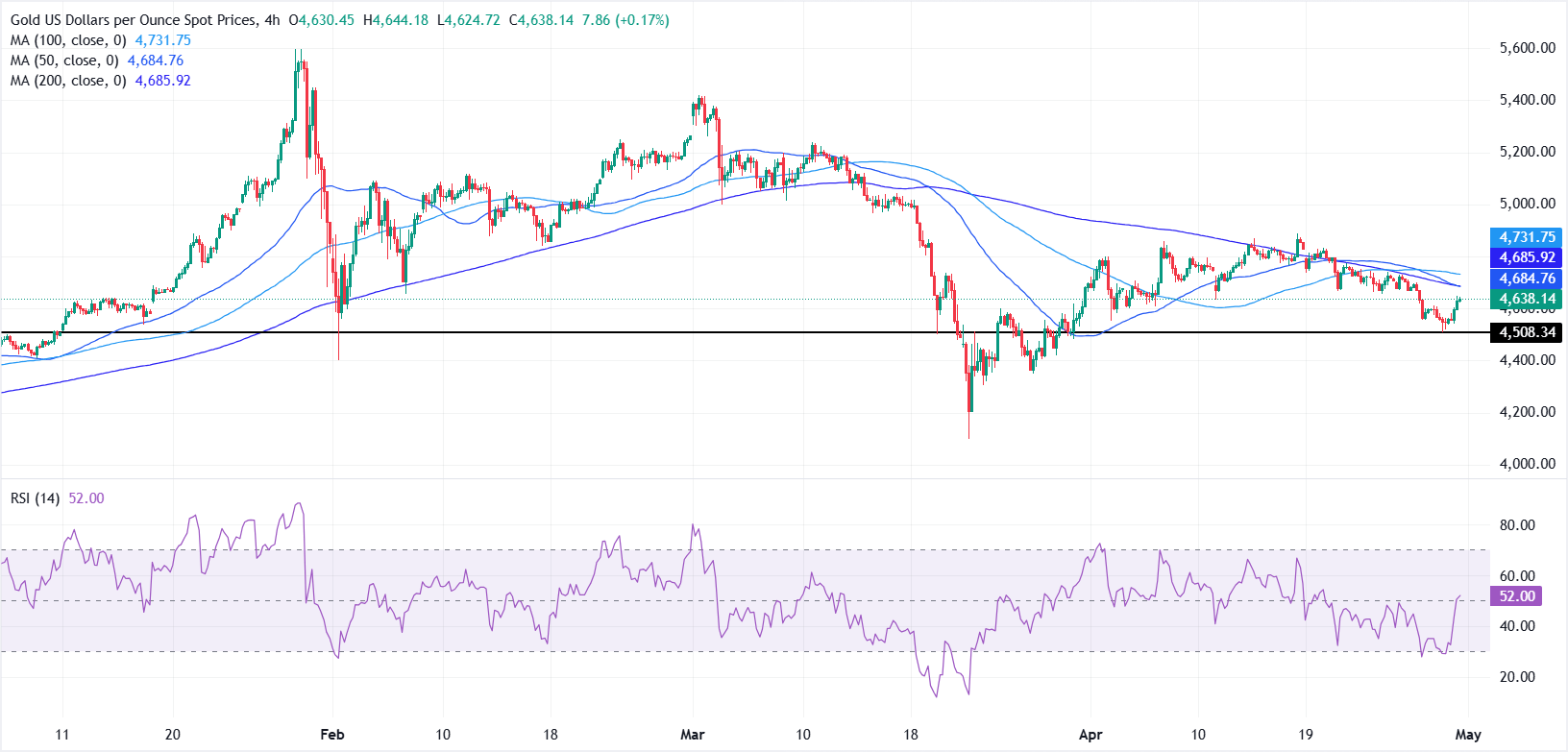
In the 4-hour chart, XAU/USD maintains a bearish near-term bias as price holds beneath a dense cluster of moving averages. The Relative Strength Index has edged above the 50 line to about 52, which hints at a modest improvement in momentum but not yet enough to dislodge the prevailing overhead supply from these key averages.
On the topside, immediate resistance is defined first by the 50-period SMA at $4,684, closely followed by the 200-period SMA at $4,685, with the 100-period SMA near $4,731 reinforcing a broader supply zone if a recovery extends. On the downside, the next notable cushion emerges at the horizontal support around $4,500, where a break would likely reopen the last leg lower, while holding above this floor would keep scope for further consolidation beneath the moving-average ceiling.
(The technical analysis of this story was written with the help of an AI tool.)
Gold FAQs
Gold has played a key role in human’s history as it has been widely used as a store of value and medium of exchange. Currently, apart from its shine and usage for jewelry, the precious metal is widely seen as a safe-haven asset, meaning that it is considered a good investment during turbulent times. Gold is also widely seen as a hedge against inflation and against depreciating currencies as it doesn’t rely on any specific issuer or government.
Central banks are the biggest Gold holders. In their aim to support their currencies in turbulent times, central banks tend to diversify their reserves and buy Gold to improve the perceived strength of the economy and the currency. High Gold reserves can be a source of trust for a country’s solvency. Central banks added 1,136 tonnes of Gold worth around $70 billion to their reserves in 2022, according to data from the World Gold Council. This is the highest yearly purchase since records began. Central banks from emerging economies such as China, India and Turkey are quickly increasing their Gold reserves.
Gold has an inverse correlation with the US Dollar and US Treasuries, which are both major reserve and safe-haven assets. When the Dollar depreciates, Gold tends to rise, enabling investors and central banks to diversify their assets in turbulent times. Gold is also inversely correlated with risk assets. A rally in the stock market tends to weaken Gold price, while sell-offs in riskier markets tend to favor the precious metal.
The price can move due to a wide range of factors. Geopolitical instability or fears of a deep recession can quickly make Gold price escalate due to its safe-haven status. As a yield-less asset, Gold tends to rise with lower interest rates, while higher cost of money usually weighs down on the yellow metal. Still, most moves depend on how the US Dollar (USD) behaves as the asset is priced in dollars (XAU/USD). A strong Dollar tends to keep the price of Gold controlled, whereas a weaker Dollar is likely to push Gold prices up.
Nothing in this material constitutes investment advice, personal recommendation, investment research, an offer, or a solicitation to buy or sell any financial instrument. The content has been prepared without consideration of your individual investment objectives, financial situation, or needs, and should not be treated as such.
Past performance is not a reliable indicator of future performance and/or results. Forward-looking scenarios or forecasts are not a guarantee of future performance. Actual results may differ materially from those anticipated.
Mitrade makes no representation or warranty as to the accuracy or completeness of the information provided and accepts no liability for any loss arising from reliance on such information.
Recommended Articles


