



Silver catches a bid, not a bottom
- XAG/USD bounced off its session low and closed higher on the day, yet stayed trapped in a steep downtrend.
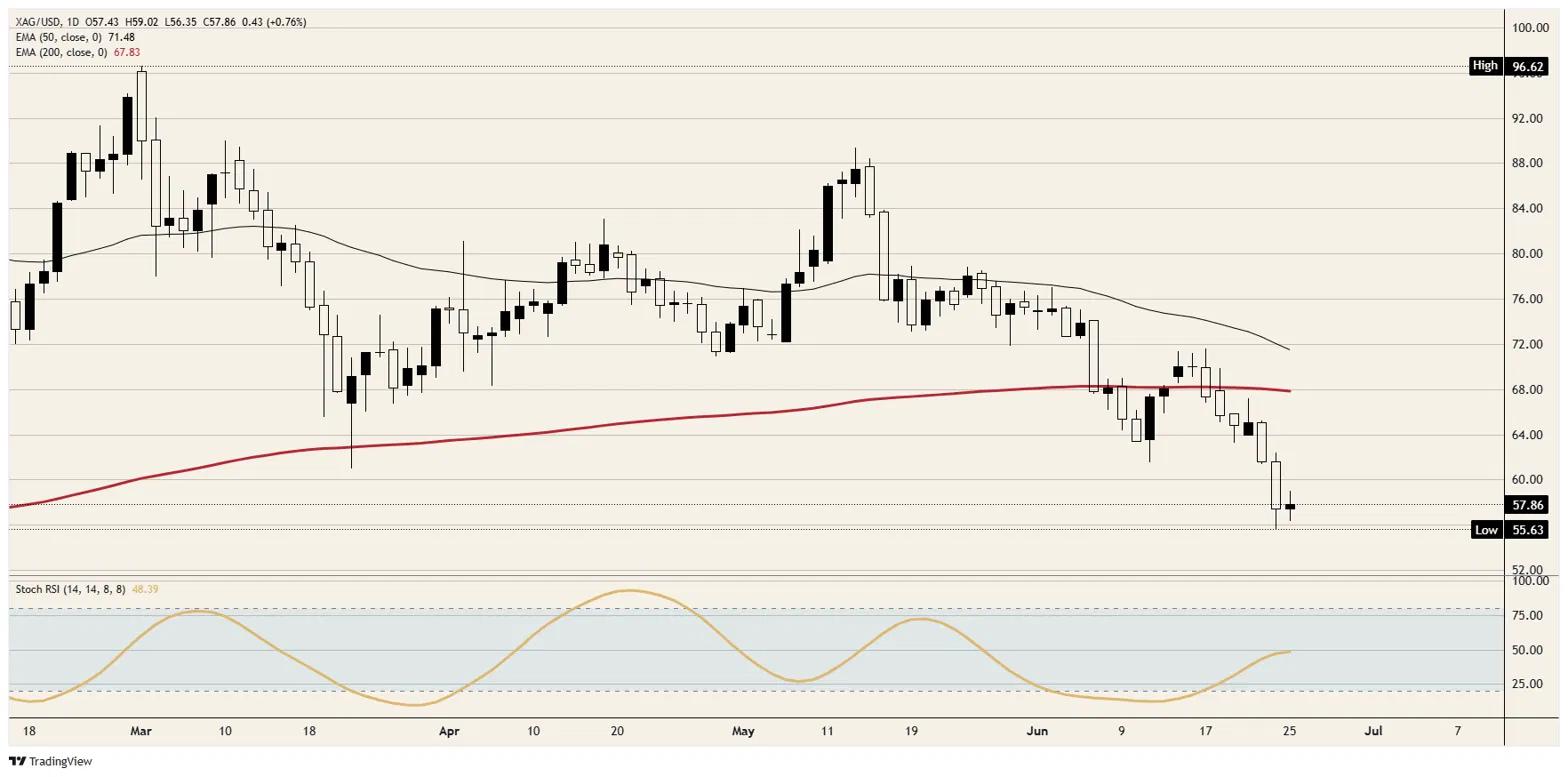
- Silver remains far below its 50 and 200 EMAs after collapsing from its early-year highs.
- A hawkish Fed, a firm Dollar and a fading geopolitical premium keep the metal under pressure.
Silver enjoyed a rare green session on Thursday, and reading much into it would be a mistake. The metal bounced off a session low near 56.50, briefly spiking close to 59.00 just after the US data hit the wires, before fading back to around 58.00, up roughly 0.8% on the day. Set against the wreckage of the past several months, a single up-day looks far more like oversold mechanics than the start of a turn.
A bounce, not a base
Several forces combined to lift Silver intraday. Thursday's firm Gross Domestic Product (GDP) and a jump in capital goods orders hinted at resilient industrial demand; the in-line inflation print cooled the most aggressive rate-hike bets; and a softer Dollar intraday gave the metal room to breathe. Silver also entered the day deeply oversold, the kind of stretched condition that invites a snapback.
The follow-through told the real story. Silver gave back most of the spike within hours; the daily Stochastic Relative Strength Index (Stoch RSI) sits mid-range near 48 rather than turning up with force; and the short-term reading is already rolling over again. Bounces like this are a feature of downtrends, not evidence they are ending.
The Fed is still the problem
The regime that has been crushing Silver has not changed at all. A hawkish Federal Reserve (Fed) held its policy rate at 3.75% last week with projections pointing to higher-for-longer, and markets are pricing at least one more hike rather than the cuts they expected at the start of the year. Real yields have climbed and stayed elevated.
That is poison for a metal that pays no income. When cash and bonds offer a real return, non-yielding Silver has to compete on price alone, and it keeps losing. Thursday's data, firm growth with sticky inflation and no cuts in sight, simply reinforced the backdrop that has driven the metal down sharply from its early-year peak above 96.00.
The trade everyone loved, unwound
Silver did not fall in a vacuum; it fell from a bubble. The metal had become the market's favourite story earlier this year, bid up as both an inflation hedge and the so-called AI metal for its use in semiconductors and data centres, with a hefty safe-haven premium layered on during the Middle East conflict. That combination took it to records.
Each of those pillars has since given way. The US-Iran peace framework has pulled Crude Oil back toward pre-conflict levels and drained the war premium; the inflation-hedge case wobbles as the Fed proves it will not blink; and a wave of forced liquidations earlier in the year exposed how crowded the trade had become. What is left is a metal still searching for a floor, with Thursday's bounce more noise than signal.
Levels to watch
Support: The recent swing low near 55.50 is the immediate line in the sand; a daily close beneath it opens the door toward the low-50s, with little obvious support until then.
Resistance: Bounces face resistance quickly. The 59.00 to 60.00 zone, near Thursday's intraday high, is the first real hurdle, and the metal would need to reclaim its moving averages up in the high-60s and low-70s before any talk of a trend change is credible.
Bias: Lower. The trend, the macro backdrop and the positioning all point the same way, and until Silver can hold a base and reclaim broken levels, rallies are for selling rather than chasing. Treat Thursday's green candle as a pause in the decline, not its end.
XAG/USD daily chart
Silver FAQs
Silver is a precious metal highly traded among investors. It has been historically used as a store of value and a medium of exchange. Although less popular than Gold, traders may turn to Silver to diversify their investment portfolio, for its intrinsic value or as a potential hedge during high-inflation periods. Investors can buy physical Silver, in coins or in bars, or trade it through vehicles such as Exchange Traded Funds, which track its price on international markets.
Silver prices can move due to a wide range of factors. Geopolitical instability or fears of a deep recession can make Silver price escalate due to its safe-haven status, although to a lesser extent than Gold's. As a yieldless asset, Silver tends to rise with lower interest rates. Its moves also depend on how the US Dollar (USD) behaves as the asset is priced in dollars (XAG/USD). A strong Dollar tends to keep the price of Silver at bay, whereas a weaker Dollar is likely to propel prices up. Other factors such as investment demand, mining supply – Silver is much more abundant than Gold – and recycling rates can also affect prices.
Silver is widely used in industry, particularly in sectors such as electronics or solar energy, as it has one of the highest electric conductivity of all metals – more than Copper and Gold. A surge in demand can increase prices, while a decline tends to lower them. Dynamics in the US, Chinese and Indian economies can also contribute to price swings: for the US and particularly China, their big industrial sectors use Silver in various processes; in India, consumers’ demand for the precious metal for jewellery also plays a key role in setting prices.
Silver prices tend to follow Gold's moves. When Gold prices rise, Silver typically follows suit, as their status as safe-haven assets is similar. The Gold/Silver ratio, which shows the number of ounces of Silver needed to equal the value of one ounce of Gold, may help to determine the relative valuation between both metals. Some investors may consider a high ratio as an indicator that Silver is undervalued, or Gold is overvalued. On the contrary, a low ratio might suggest that Gold is undervalued relative to Silver.
Nothing in this material constitutes investment advice, personal recommendation, investment research, an offer, or a solicitation to buy or sell any financial instrument. The content has been prepared without consideration of your individual investment objectives, financial situation, or needs, and should not be treated as such.
Past performance is not a reliable indicator of future performance and/or results. Forward-looking scenarios or forecasts are not a guarantee of future performance. Actual results may differ materially from those anticipated.
Mitrade makes no representation or warranty as to the accuracy or completeness of the information provided and accepts no liability for any loss arising from reliance on such information.
Recommended Articles


