



Gold price rebounds as falling US yields weigh on US Dollar
- Gold hits consolidates above $4,000 as Treasury yields extend decline.
- Sticky Core PCE keeps Fed rate-hike expectations alive.
- Warsh testimony, NFP and ISM data shape the next catalyst.
Gold (XAU/USD) price recovers some ground on Friday, hitting a two-day high of $4,096 as the Greenback edges lower alongside Treasury yields after investors trimmed hawkish bets on the Federal Reserve (Fed). The XAU/USD pair trades at $4,076, up 1.24%.
XAU/USD rises as traders trim Fed hawkish bets
The yellow metal has failed to gain meaningful traction over the last few days, even though the US 10-year Treasury yield has fallen nearly 14 basis points since Wednesday, to 4.374%.eExpectations that prices would fall after the resolution of the US-Iran conflict and the reopening of the Strait of Hormuz sent Oil prices tumbling, along with US yields.
The US Dollar Index (DXY), which measures the buck’s performance against six peers, is down 0.10% at 101.33, a tailwind for bullion prices.
Meanwhile, the latest US inflation report, the Core Personal Consumption Expenditures (PCE) Price Index, which is the Federal Reserve’s favorite inflation gauge, rose by 3.4% YoY as expected in May, up from April’s 3.3% and well above the US central bank’s goal of 2%.
The backdrop justifies Fed hawks seeking further tightening, led by Minneapolis Fed President Neel Kashkari, who penciled in one rate hike in 2026, and told Bloomberg that “widespread inflation” suggests that raising rates is needed.
On Thursday, Chicago Fed President Austan Goolsbee said core inflation remains too high and is trending in the wrong direction. New York Fed John Williams added that inflation is still too high, though he revealed that policy is “well-positioned.”
Recently, US data showed that the University of Michigan Consumer Sentiment for June improved from 48.9 to 49.5 on its final reading, exceeding forecasts and May’s print of 44.8. Further data showed that inflation expectations for one year were unchanged at 4.6% and for five years at 3.3%, down from 3.4% in the previous reading.
All in all, traders are expecting the Fed to raise interest rates. Prime Terminal data shows that for the September meeting, odds of a rate hike are 73%, with Fed funds futures implying 18.46 basis points of tightening.
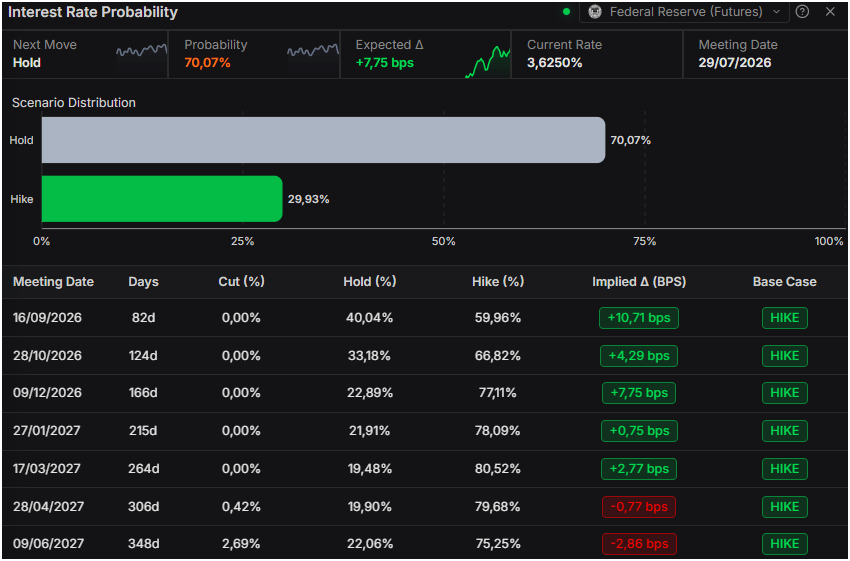
Next week, the US economic docket will feature Fed Chair Kevin Warsh's appearance before US Congress, the crucial June Nonfarm Payrolls, and the release of the ISM Manufacturing PMI for June.
XAU/USD price forecast: Gold rebounds, yet faces strong resistance at $4,100
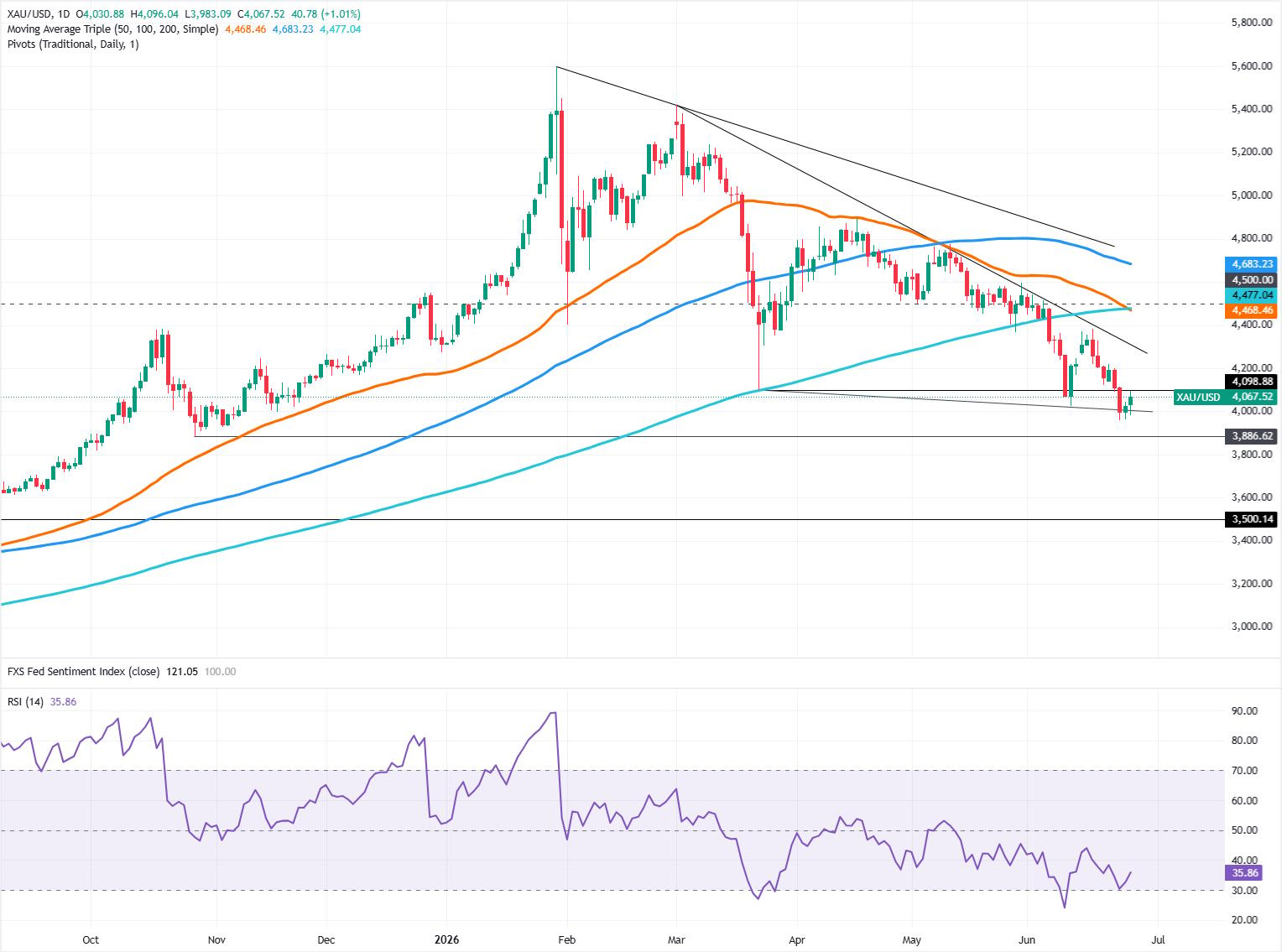
Price action shows that Gold is still downward-biased unless buyers clear key technical resistance levels, such as the March 23 daily low-turned-resistance at $4,098, ahead of the $4,100 round level.
Momentum, as measured by the Relative Strength Index (RSI), is aiming towards its neutral level; yet it remains bearish. However, traders must be aware that the RSI formed a positive divergence, indicating that momentum is tilted upwards, while XAU/USD price action signals the opposite, registering lower lows. Therefore, further upside is expected in the short term, but some resistance levels need to be broken for it to materialise.
If XAU/USD clears $4,098, the next resistance would be the psychological $4,100, followed by key psychological levels $4,150 and $4,200. Up next lies a downslope resistance level near the $4,280- $4,300 range.
Downwards and the path of least resistance, the first XAU/USD support would be $4,050, followed by $4,000. Below this level is the year-to-date (YTD) low of $3,959.
Gold FAQs
Gold has played a key role in human’s history as it has been widely used as a store of value and medium of exchange. Currently, apart from its shine and usage for jewelry, the precious metal is widely seen as a safe-haven asset, meaning that it is considered a good investment during turbulent times. Gold is also widely seen as a hedge against inflation and against depreciating currencies as it doesn’t rely on any specific issuer or government.
Central banks are the biggest Gold holders. In their aim to support their currencies in turbulent times, central banks tend to diversify their reserves and buy Gold to improve the perceived strength of the economy and the currency. High Gold reserves can be a source of trust for a country’s solvency. Central banks added 1,136 tonnes of Gold worth around $70 billion to their reserves in 2022, according to data from the World Gold Council. This is the highest yearly purchase since records began. Central banks from emerging economies such as China, India and Turkey are quickly increasing their Gold reserves.
Gold has an inverse correlation with the US Dollar and US Treasuries, which are both major reserve and safe-haven assets. When the Dollar depreciates, Gold tends to rise, enabling investors and central banks to diversify their assets in turbulent times. Gold is also inversely correlated with risk assets. A rally in the stock market tends to weaken Gold price, while sell-offs in riskier markets tend to favor the precious metal.
The price can move due to a wide range of factors. Geopolitical instability or fears of a deep recession can quickly make Gold price escalate due to its safe-haven status. As a yield-less asset, Gold tends to rise with lower interest rates, while higher cost of money usually weighs down on the yellow metal. Still, most moves depend on how the US Dollar (USD) behaves as the asset is priced in dollars (XAU/USD). A strong Dollar tends to keep the price of Gold controlled, whereas a weaker Dollar is likely to push Gold prices up.
Nothing in this material constitutes investment advice, personal recommendation, investment research, an offer, or a solicitation to buy or sell any financial instrument. The content has been prepared without consideration of your individual investment objectives, financial situation, or needs, and should not be treated as such.
Past performance is not a reliable indicator of future performance and/or results. Forward-looking scenarios or forecasts are not a guarantee of future performance. Actual results may differ materially from those anticipated.
Mitrade makes no representation or warranty as to the accuracy or completeness of the information provided and accepts no liability for any loss arising from reliance on such information.
Recommended Articles


