



Bitcoin Price Forecast: BTC braces for volatility as US-Iran deal uncertainty keeps traders on edge
- Bitcoin trades slightly down to near $70,000 on Tuesday after recovering nearly 5% the previous day.
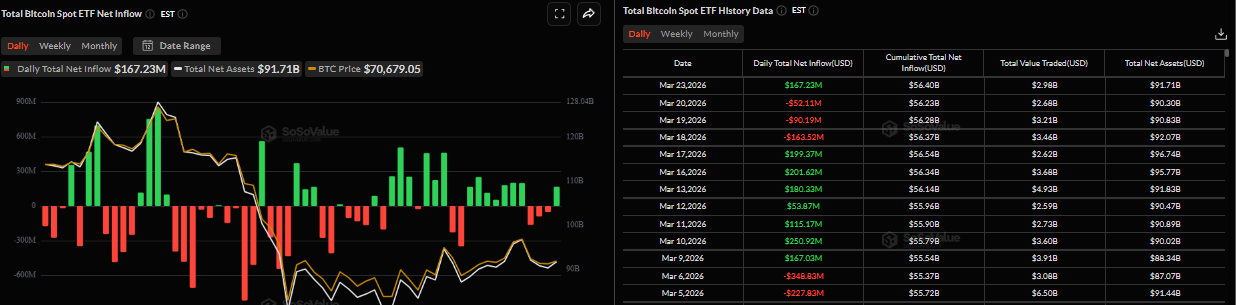
- US-listed spot ETFs recorded an inflow of over $167 million, while Strategy added 1,031 BTC on Monday.
- Traders should be cautious as uncertainty around US-Iran deal persists, with any escalation or breakthrough likely to trigger sharp volatility in BTC.
Bitcoin (BTC) is trading in the red around the $70,000 mark at the time of writing on Tuesday, following a sharp recovery the previous day. Institutional and corporate demand supports BTC recovery, as spot Exchange Traded Funds (ETFs) recorded fresh inflows while Strategy (MSTR) added more BTC to its reserves on Monday. Traders should be cautious, as volatility could spike for the Crypto King, whether in a deal or a no-deal scenario between the US and Iran.
Why a 5% recovery on Monday?
Bitcoin started the week on a positive note, recovering nearly 5% on Monday after recording losses following macroeconomic headwinds the previous week.
Monday’s recovery in the Crypto King came after the news that US President Donald Trump directed the Department of War to suspend attacks on Iran’s power plants and energy infrastructure for a five-day period, citing productive talks between the two nations.
These positive remarks come following Saturday’s threat by Trump, who issued a 48-hour ultimatum for Iran to reopen the Strait of Hormuz and threatened to target Iran’s energy infrastructure if the demand wasn't met.
These easing developments amid the ongoing Middle East war boosted risk sentiment, with US equities closing positive on Monday and risky assets such as Bitcoin gaining nearly 5%.
However, citing sources with knowledge, Iran's Fars News agency quickly reported that there were no direct communications with the US nor through intermediaries, according to Reuters. Moreover, Iran’s Foreign Minister, Abbas Araghchi, stated that there was “no dialogue” between Tehran and Washington, and Iranian Parliament Speaker Mohammad Bagher Ghalibaf said in a social media post on Monday that “no negotiations have been held with the US.”
On Tuesday, the news came in that the Israeli military had launched a fresh wave of strikes on Tehran. The Israeli Defense Forces (IDF) stated that it would continue operations in line with Israeli government directives until told otherwise.
Asian equities and US futures markets trade slightly down amid this uncertainty, with BTC trading slightly down, nearing to $70,000 on Tuesday.
Traders should closely watch developments surrounding the fragile US-Iran peace deal. Any escalation would dampen investor confidence, weighing on risky assets such as Bitcoin. On the contrary, a breakthrough is likely to boost investor confidence, supporting riskier assets.
Volatility spikes are likely to be seen across the largest cryptocurrency by market capitalization, whether in a deal or a no-deal scenario.
Institutional and corporate demand support BTC recovery
Institutional demand started the week on a positive note. SoSovalue data shows that spot Bitcoin ETFs recorded inflows of $167.23 million on Monday, breaking a three-day streak of withdrawals in the previous week. If these inflows continue and intensify, BTC could see further recovery ahead.
On the corporate side, Michael Saylor announced on X on Monday that Strategy had purchased another 1,031 BTC for $76.6 million following its purchase of 22,337 BTC the previous week. Monday’s purchase brings the firm’s total holdings to 762,099 BTC, highlighting its continued aggressive accumulation strategy despite uncertainty in global markets. Strategy’s average purchase price for all its holdings is $75,694, above current market price.
Bitcoin Price Forecast: Indecision among traders
Bitcoin price is trading slightly down at around $70,400 on Tuesday after recovering over 4% in the previous day. The near-term bias stays mildly bearish as price remains limited within a parallel channel, trading just below the upper boundary near $72,600, while the lower bound comes in around $65,900. BTC also remains well below the 50-day, 100-day and 200-day Exponential Moving Averages (EMAs), which cap the broader trend above $72,000 and reinforce downside risk on rallies.
Momentum conditions are balanced rather than weak, with the Relative Strength Index (RSI) on the daily chart around 50 and the Moving Average Convergence Divergence (MACD) line hovering just below the signal line near the zero area, suggesting a lack of strong directional conviction as the market consolidates under recent highs.
Initial resistance aligns around the 50-day EMA near $72,200, and a daily close above this level would open the way toward the channel top at $72,600 and the March 17 peak at $76,000
On the downside, first support is seen near Monday’s open around $67,860, ahead of the channel floor and the start of a reaction low clustered around $65,900, where dip-buying interest previously emerged. A break below $65,900 would expose a deeper retracement toward the $64,000 psychological area, while holding above $69,900 would keep the pair locked in a sideways-to-soft range within the broader descending structure.
-1774335413292-1774335413293.png)
(The technical analysis of this story was written with the help of an AI tool.)
Bitcoin, altcoins, stablecoins FAQs
Bitcoin is the largest cryptocurrency by market capitalization, a virtual currency designed to serve as money. This form of payment cannot be controlled by any one person, group, or entity, which eliminates the need for third-party participation during financial transactions.
Altcoins are any cryptocurrency apart from Bitcoin, but some also regard Ethereum as a non-altcoin because it is from these two cryptocurrencies that forking happens. If this is true, then Litecoin is the first altcoin, forked from the Bitcoin protocol and, therefore, an “improved” version of it.
Stablecoins are cryptocurrencies designed to have a stable price, with their value backed by a reserve of the asset it represents. To achieve this, the value of any one stablecoin is pegged to a commodity or financial instrument, such as the US Dollar (USD), with its supply regulated by an algorithm or demand. The main goal of stablecoins is to provide an on/off-ramp for investors willing to trade and invest in cryptocurrencies. Stablecoins also allow investors to store value since cryptocurrencies, in general, are subject to volatility.
Bitcoin dominance is the ratio of Bitcoin's market capitalization to the total market capitalization of all cryptocurrencies combined. It provides a clear picture of Bitcoin’s interest among investors. A high BTC dominance typically happens before and during a bull run, in which investors resort to investing in relatively stable and high market capitalization cryptocurrency like Bitcoin. A drop in BTC dominance usually means that investors are moving their capital and/or profits to altcoins in a quest for higher returns, which usually triggers an explosion of altcoin rallies.
Nothing in this material constitutes investment advice, personal recommendation, investment research, an offer, or a solicitation to buy or sell any financial instrument. The content has been prepared without consideration of your individual investment objectives, financial situation, or needs, and should not be treated as such.
Past performance is not a reliable indicator of future performance and/or results. Forward-looking scenarios or forecasts are not a guarantee of future performance. Actual results may differ materially from those anticipated.
Mitrade makes no representation or warranty as to the accuracy or completeness of the information provided and accepts no liability for any loss arising from reliance on such information.
Recommended Articles


