



Tether’s Landmark KPMG Audit: Can Circle Survive the Loss of its ‘Golden Child’ Compliance Status?
TradingKey - Tether’s appointment of KPMG as its auditor is favorable for legal expansion, financing, and even a potential IPO, but it poses a major threat to USDC.
According to the Financial Times on March 26, the issuer of the world’s largest stablecoin USDT Tether, has selected KPMG as its auditor while also hiring PwC to refine its internal systems. Since 2014, a lack of transparency has been a persistent market criticism of USDT; why make this move suddenly after failing to resolve the issue for so many years?
It is reported that Tether’s comprehensive audit of its financial statements is likely paving the way for recent financing. In September 2025, Tether sought to raise $15 billion to $20 billion at a $500 billion valuation, a round planned for completion by the end of last year. However, this financing has not yet closed. According to previous Financial Times reports, investors are hesitant to reach a deal due to concerns over valuation and regulatory risks.
Previously, Tether only engaged firms like BDO Italia to provide a 'proof of reserves,' which was akin to a snapshot of deposits at a specific moment rather than a comprehensive audit, leaving it essentially a black box. More notably, top accounting firms had refused to audit Tether, primarily over concerns regarding reputational risk.
Now, Tether’s successful appointment of KPMG suggests that its underlying assets (particularly U.S. Treasuries) have likely passed the most stringent preliminary compliance screenings. Otherwise, KPMG would not have lightly accepted an audit for what has long been considered a 'ticking time bomb.'
For Tether, passing the audit would completely end the 'collapse theory.' For a long time, the notions that 'Tether is a Ponzi scheme' or 'insufficiently reserved' have been a Sword of Damocles hanging over the crypto market. If KPMG issues a clean audit report, these decade-long market concerns will vanish; it is also a necessary prerequisite for Tether’s legal expansion in the U.S. and a potential future IPO.
For investors, they may no longer worry about USDT de-pegging and might even choose USDT as a safe haven during extreme market conditions. Furthermore, hedge funds or corporations that previously avoided holding USDT due to the lack of an audit may buy in once the audit is complete, potentially triggering a new wave of institutional-level liquidity injection.
Clearly, the KPMG audit is a positive for both Tether and investors, but the same may not be true for its peers, especially Circle ( CRCL) as USDT enters the 'Big Four audit' era. Other stablecoin issuers will face massive transparency competition, and the entire industry must align with the high standards of traditional finance.
Circle’s core competitiveness has long been 'transparency and compliance,' but as Tether bridges its audit gap, Circle will lose its greatest advantage, and its market share may be further squeezed—a reality the stock price has already reflected. Yesterday, Circle’s stock price fell another 5%, dropping below the $100 mark to close at $98.85.
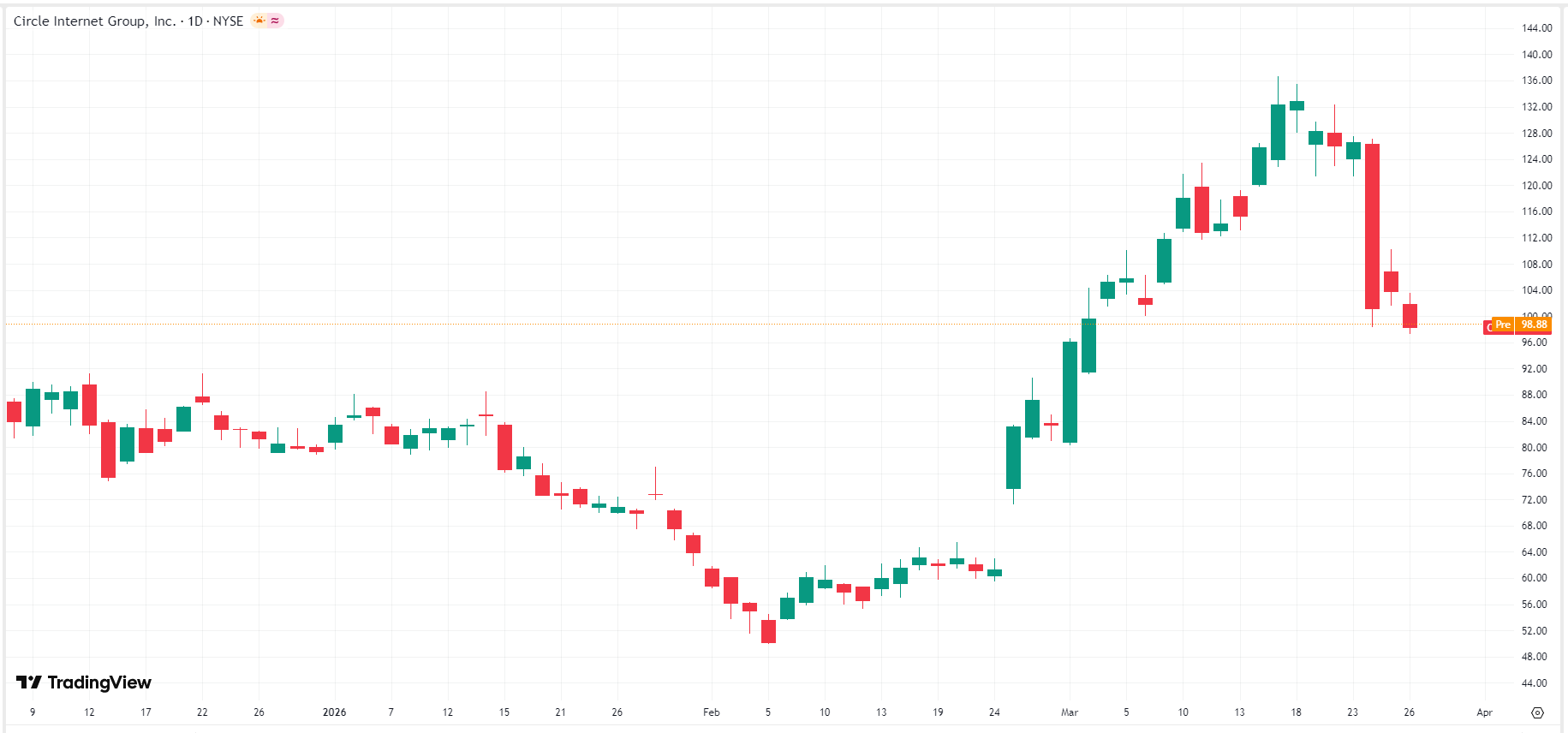 Circle stock price chart, source: TradingView
Nothing in this material constitutes investment advice, personal recommendation, investment research, an offer, or a solicitation to buy or sell any financial instrument. The content has been prepared without consideration of your individual investment objectives, financial situation, or needs, and should not be treated as such.
Past performance is not a reliable indicator of future performance and/or results. Forward-looking scenarios or forecasts are not a guarantee of future performance. Actual results may differ materially from those anticipated.
Mitrade makes no representation or warranty as to the accuracy or completeness of the information provided and accepts no liability for any loss arising from reliance on such information.
Recommended Articles


