



Will CPUs Become the Next Memory Chip to See Prices Skyrocket in 2026?
TradingKey - Price hike pressures on PC hardware are spreading from storage chips (Memory) and RAM to the processor sector. The CPU market is currently initiating a round of price increases averaging 10% to 15%, affecting both server and consumer products.
According to reports, previously Intel (INTC) and AMD have respectively notified customers that they will raise prices for their entire processor lineups starting in April. In addition, order lead times for relevant products will also be extended, stretching from several weeks to several months or even longer.
Signs of CPU price hikes first emerged as early as 2025.
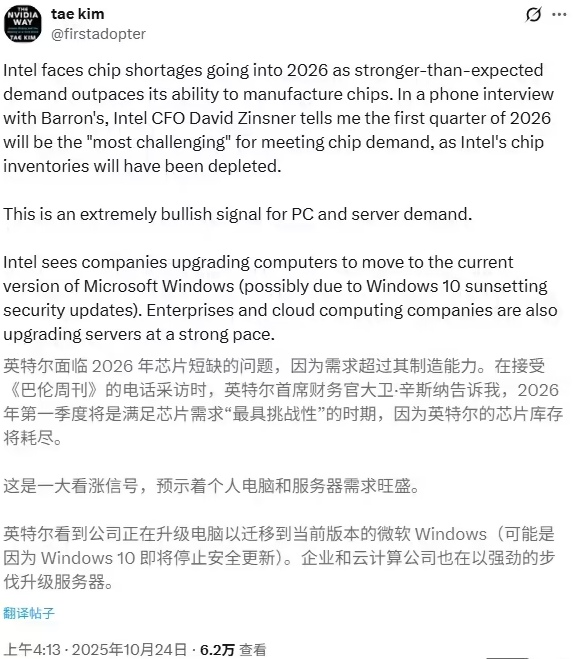
In 2025, Intel Chief Financial Officer David Zinsner noted in an interview with Barron's that Intel's chip inventory was being rapidly depleted as demand for server and PC processors far exceeded expectations. He stated that demand for data center and client CPUs is climbing quickly, and the first quarter of 2026 will be the "most challenging" period to meet chip demand, as its chip inventory will be exhausted by then.
What is a CPU?
The CPU, also known as the Central Processing Unit, is the core control unit of a computer system, responsible for executing instructions, processing data, and coordinating various hardware resources. From personal computers to cloud data centers, the CPU consistently handles general-purpose computing tasks and serves as the foundation for information processing.
In traditional architectures, the CPU emphasizes versatility and stability, making it suitable for running operating systems, logic calculations, and multi-task scheduling. In the AI era, while large-scale training tasks are increasingly handled by GPUs, the CPU remains an essential foundation for data scheduling, system control, and inference tasks. What are the differences between CPUs and memory chips?
Within the semiconductor industry chain, CPUs and memory chips represent two distinctly different underlying logics.
Functionally, the CPU is a "computing resource," whereas memory is a "capacity resource." The CPU handles instruction execution and data processing, serving as the direct manifestation of computing power, while memory is used to host data, essentially acting as a storage medium for information.
In terms of operational mechanisms, the CPU possesses high active control capabilities, with its value reflected in its continuous calculation and scheduling abilities, similar to a "production engine." In contrast, memory generates value only when invoked, behaving more like an "inventory asset." In other words, the CPU creates computing power output while memory provides data supply, together forming the fundamental "computing power-data" closed-loop.
Regarding product attributes, CPUs are highly differentiated products. Their performance depends on architectural design, manufacturing processes, and ecosystems (such as instruction sets and software compatibility). Due to extremely high technical barriers, the market has long been dominated by a few manufacturers, exhibiting clear oligopolistic characteristics. Therefore, CPU pricing tends to reflect the "interplay between technology and supply-demand," demonstrating strong resilience to cycles.
In contrast, memory displays stronger standardization and homogenization. Whether it is DRAM or NAND, product differentiation is minimal, with competition centered on cost and capacity expansion. This makes memory prices highly sensitive to supply-demand dynamics; any capacity contraction or demand explosion can lead to sharp cyclical price swings, or even trigger a "super-cycle".
Will CPU prices continue to rise?
Based on current data, CPUs have indeed entered an upward cycle, but their trajectory differs fundamentally from that of memory chips.
In the short term, CPU prices are expected to continue their upward trend. The supply-demand imbalance may intensify further in the second quarter of 2026, leaving room for further expansion in price increases. However, from a medium-to-long-term perspective, CPUs are unlikely to experience extreme market conditions similar to the "fourfold surge" seen in the memory market.
Surging prices have suppressed a portion of private-sector demand.
CPU prices are constrained by demand for complete systems. The PC and server markets exhibit significant price elasticity, where excessively high prices directly suppress shipment volumes—a trend already reflected in the sales decline reported by Amazon in early 2026.
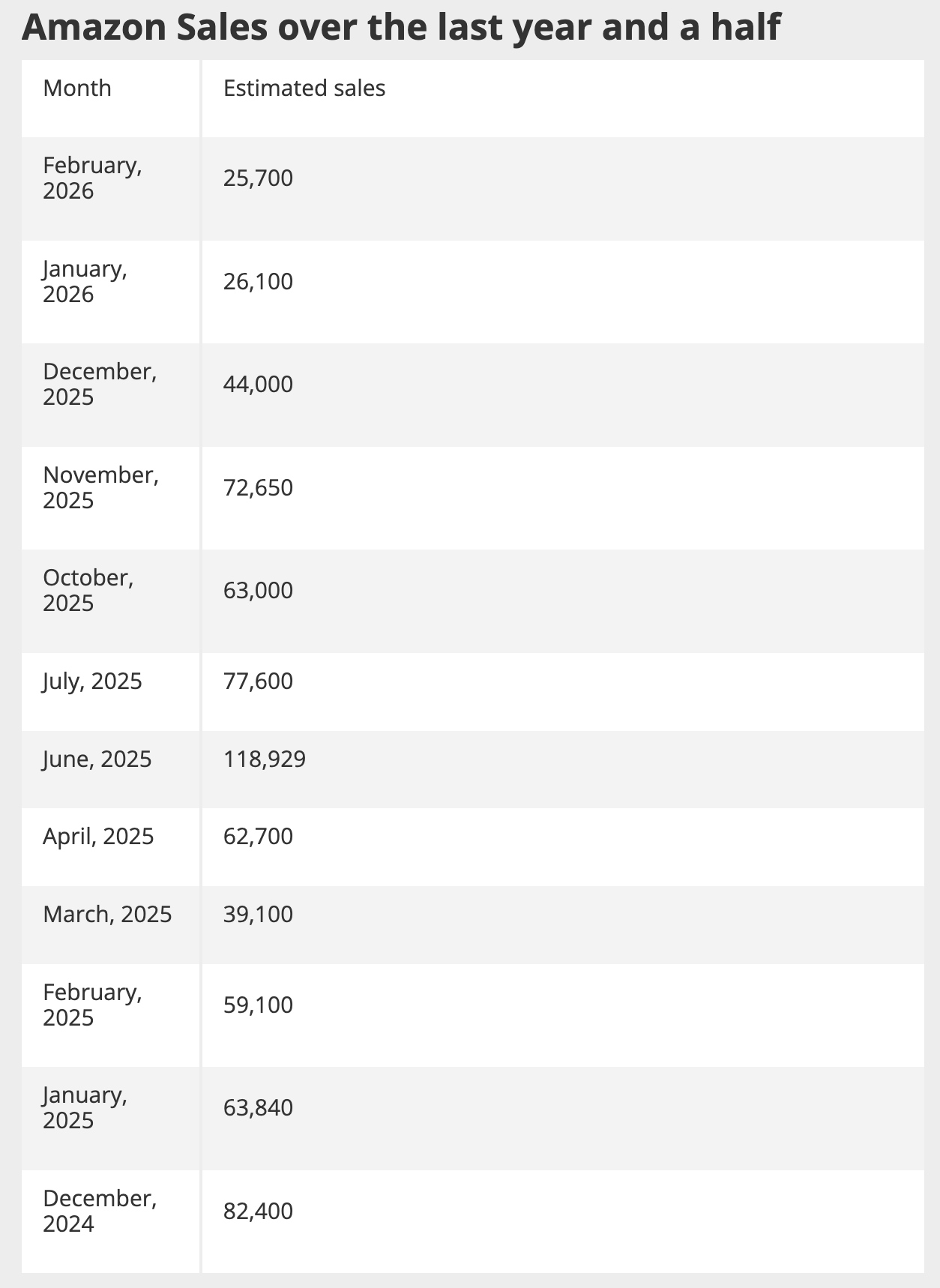
[Monthly Aggregate Sales Data, Source: 3DCenter]
It is estimated that Amazon sold approximately 26,100 CPU units in January 2026, a decrease of nearly 40,000 units compared to the same period last year. Sales in December 2025 were approximately 44,000 units, nearly 40,000 fewer than in December 2024. Statistics show that Amazon's inventory-to-sales ratio fell by 47% between December last year and February this year compared to the same period a year ago.
Alternative technologies related to CPUs are on the rise.
A previous article from Tom's Hardware pointed out that the ARM architecture and custom silicon (such as CPUs developed in-house by cloud providers) are eroding the x86 market, which will limit the upside for price increases. Since Microsoft aggressively promoted Copilot+ PCs powered by Snapdragon processors in 2024, Arm-based devices have been steadily entering the market. Furthermore, Qualcomm is even taking steps to enhance the Windows gaming experience on Arm, while Nvidia's N1X processor is expected to be featured in laptops later this year.
This poses a major threat to x86 systems, prompting Intel and AMD to join forces to defend the architecture's market position. However, if these two companies cannot meet the market demand for their processors, consumers may have no choice but to turn to alternative CPU products.
Meanwhile, Elon Musk recently disclosed plans to build a "Terafab" chip factory. Although the project is still in the planning stages and is unlikely to meet market demand in the short term, analyst Andrew Percoco estimates that the actual cost of Terafab could reach $35 billion to $40 billion; even in an optimistic scenario, chips would not roll off the line until 2028 at the earliest. Nevertheless, in the long run, future chip supply shortages are expected to be significantly alleviated.
The fab expansion cycle is now underway. Despite short-term supply tightness, the supply-demand relationship for CPUs is expected to ease in the second half of 2026 as advanced nodes gradually release capacity. Intel previously stated that supply pressure is expected to peak at the end of March; as capacity shifts toward servers and mid-to-high-end products, supply conditions are expected to improve gradually over the coming quarters.
Therefore, CPUs are more likely to exhibit a "moderate uptrend" rather than an "exponential surge."
Overall, the pricing logic of the CPU market is shifting from traditional "consumer electronics components" toward "infrastructure assets" similar to electricity and computing resources. Prices are no longer determined solely by PC demand but are instead dominated by the AI computing investment cycle.
This means that CPUs will not simply replicate the explosive growth path of memory chips, yet their strategic importance is rising significantly. In the coming years, CPU price fluctuations will increasingly depend on AI capital expenditures, the pace of data center construction, and the supply capacity of advanced manufacturing processes.
Nothing in this material constitutes investment advice, personal recommendation, investment research, an offer, or a solicitation to buy or sell any financial instrument. The content has been prepared without consideration of your individual investment objectives, financial situation, or needs, and should not be treated as such.
Past performance is not a reliable indicator of future performance and/or results. Forward-looking scenarios or forecasts are not a guarantee of future performance. Actual results may differ materially from those anticipated.
Mitrade makes no representation or warranty as to the accuracy or completeness of the information provided and accepts no liability for any loss arising from reliance on such information.
Recommended Articles


