



Today’s Market Recap: Global Markets Tumble Amid Rising Middle East Tensions and Inflation Fears
Track the Market Trend
TradingKey - The major U.S. stock indices closed lower on Wednesday as the Federal Reserve voiced concerns over persistent inflation. The S&P 500 fell 1.36% to 6,624.70, the Nasdaq Composite declined 1.46% to 22,152.42, and the Dow Jones Industrial Average dropped 1.63% to 46,225.16. Pressure on equities mounted following higher-than-expected Producer Price Index (PPI) data and the Fed's decision to hold interest rates steady, with Chair Jerome Powell signaling only one potential rate cut this year once inflation cools further.
In the energy sector, rising oil prices — with Brent crude exceeding $110 per barrel — led to mixed results. Chevron (CVX) managed a 0.32% gain to close at $198.61, while Exon Mobil (XOM) reversed its intraday gains to finish down 0.77% at $157.59. Meanwhile, Macy’s (M) jumped 4.73% following a strong Q4 earnings beat and robust sales figures.
Technology and chip stocks saw significant volatility:
- Cloudflare (NET) surged 6.59% on news of a potential stablecoin partnership with Coinbase (COIN).
- Advanced Micro Devices (AMD) rose 1.70% after announcing a new chip partnership with Samsung.
- Micron Technology (MU) and SanDisk (SNDK) both faced pressure; despite a Q1 earnings beat for Micron and AI-driven optimism for SanDisk during the day, both stocks slipped in after-hours trading.
In the EV and fintech sectors, Plug Power (PLUG) fell 0.43% to $2.32 on lower-than-average trading volume, continuing a long-term decline that has seen the stock lose 99% of its value since its 1999 IPO. SoFi Technologies (SOFI) dropped 1.09% to $17.18 despite CEO Anthony Noto’s $500,000 insider purchase. Investors remained cautious as they weighed SoFi's rebuttal to a short report from Muddy Waters against ongoing regulatory scrutiny.
Broader market anxiety was fueled by rising fuel costs, with gasoline hitting a multi-year high of $3.84 per gallon. Analysts at Citadel Securities warned that a prolonged conflict in Iran and potential disruptions in the Strait of Hormuz could pose significant risks to global economic growth and lead to further downside for the stock market.
Market Headline
The Federal Reserve has maintained current interest rates as expected, citing uncertainties in the Middle East and raising inflation forecasts while still signaling one potential rate cut this year. Chair Jerome Powell emphasized that cuts will not occur until inflation shows clear improvement, adding that he will remain at the Fed through the investigation period and serve as interim chair if necessary.
On the military front, the U.S. is reportedly planning to mass-produce replicas of Iran's "Lucas" suicide drones for use in the ongoing conflict. President Trump stated the U.S. is not yet ready to end hostilities and dismissed concerns that the situation would mirror "another Vietnam." In a significant escalation, the U.S. deployed 5,000-pound bunker-buster bombs against Iranian missile sites along the Strait of Hormuz, prompted by the arrival of the amphibious assault ship USS Tripoli. In response, Iran's parliament speaker declared that the Strait would not return to its pre-war status as the U.S. bolsters its regional presence with over 5,000 additional troops and carrier strike groups.
Energy markets are in turmoil following large-scale Iranian missile strikes on U.S.-linked energy infrastructure. Iran has warned it will treat American oil facilities as military bases and has identified targets in Saudi Arabia, the UAE, and Qatar. Attacks have already caused major fires at a Riyadh refinery and "severe damage" to Qatar's Ras Laffan LNG hub. Brent crude surged past $110 per barrel as gas supplies from Iran to Iraq were completely severed. While Saudi Arabia has successfully restored over 50% of its crude exports by bypassing the Strait of Hormuz, total Gulf oil exports fell by more than 60% last week. President Trump, while reportedly briefed on previous strikes, is now said to oppose further attacks on energy infrastructure to stabilize global prices.
Geopolitical tensions reached a breaking point with the confirmed assassination of Iran’s Intelligence Minister. Iran's Supreme Leader vowed that those responsible for Larijani’s death would "pay the price." However, strategic rifts are emerging between allies: the U.S. favors ending major operations once core military goals are met to stabilize oil markets, while Israel remains focused on regime change. Meanwhile, the IAEA stated that now is not the time to resume nuclear talks, and the White House is considering the seizure of Iranian enriched fuel.
In the technology sector, the AI-driven memory boom has propelled Micron Technology to record heights. Micron reported that second-quarter revenue nearly tripled, with gross margins approaching 75%. The company raised its quarterly dividend by 30% and issued a third-quarter outlook that significantly outperformed analyst expectations. Micron plans to increase capital expenditure to $25 billion this fiscal year, with a further $10 billion increase projected for next year. Despite these strong fundamentals, the stock experienced volatile after-hours trading, initially rising 2% before dropping as much as 6%.
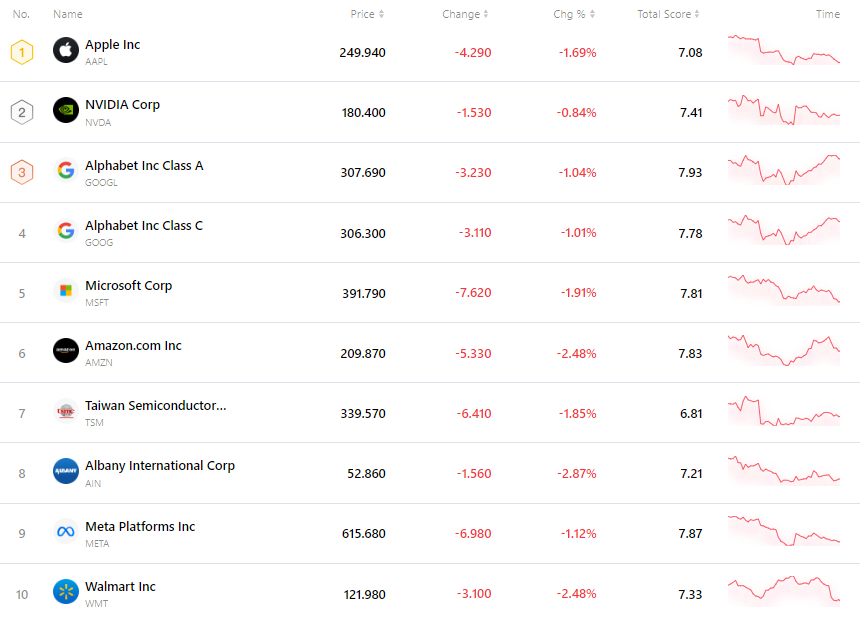
Top 10 Most Traded Stocks
The chart below lists the ten most actively traded stocks in the market. Due to their massive trading volumes and high liquidity, these stocks serve as critical benchmarks for tracking global market dynamics.
Nothing in this material constitutes investment advice, personal recommendation, investment research, an offer, or a solicitation to buy or sell any financial instrument. The content has been prepared without consideration of your individual investment objectives, financial situation, or needs, and should not be treated as such.
Past performance is not a reliable indicator of future performance and/or results. Forward-looking scenarios or forecasts are not a guarantee of future performance. Actual results may differ materially from those anticipated.
Mitrade makes no representation or warranty as to the accuracy or completeness of the information provided and accepts no liability for any loss arising from reliance on such information.
Recommended Articles


