



Japan and South Korea Open Higher Friday; SoftBank Benefits as Arm Surges Over 11%
TradingKey - The strong overnight rally in U.S. stocks, coupled with the ongoing progress of Middle East peace negotiations, has injected dual positive momentum into Asia-Pacific markets.
During Friday's morning session, Japanese and South Korean stock markets extended their previous day's recovery, continuing to fluctuate higher. The Nikkei 225 opened 0.35% higher before intraday gains quickly widened to 1%; South Korea's KOSPI opened up 0.7%, moving steadily toward the 7,900-point psychological level. In the prior session, South Korean stocks triggered a circuit breaker after gains reached the 5% threshold, eventually closing up 8.42%, a rare single-day surge in recent years. South Korean tech giants Samsung Electronics and SK Hynix traded higher in tandem.
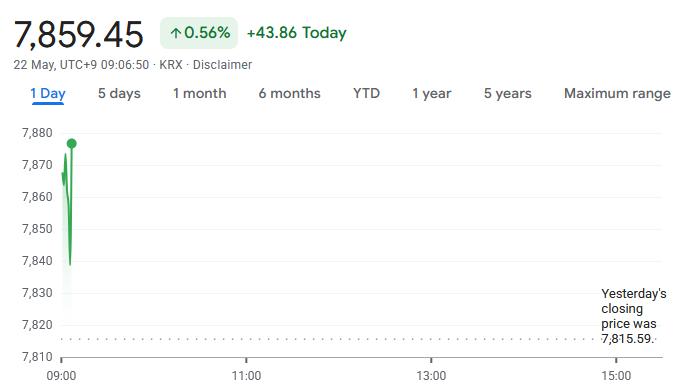
[KOSPI; Source: Google Finance]
In the Japanese market, the strong performance of SoftBank Group's shares was particularly striking, with intraday gains expanding to as much as 11% following an explosive rally in its subsidiary ARM. Bolstered by the market narrative of being the "core CPU computing power in the AI agent era," ARM's shares surged over 16% on Thursday, directly driving a valuation recovery for SoftBank.
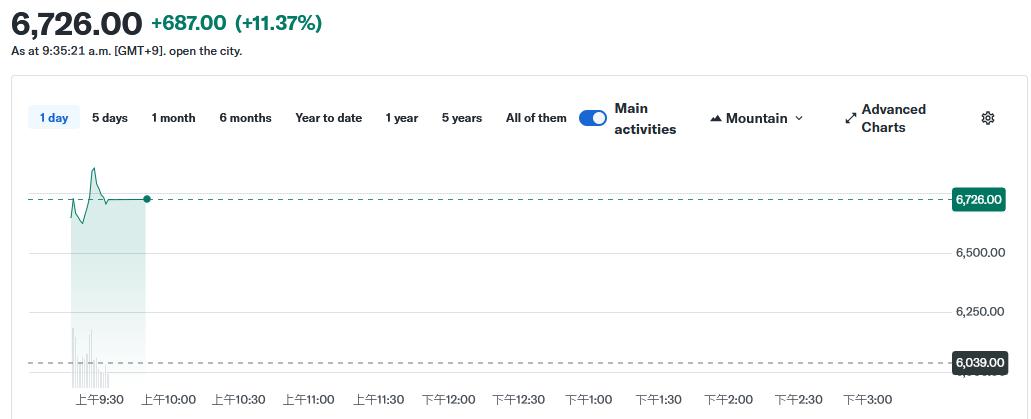
[SoftBank stock price; Source: Yahoo Finance]
Meanwhile, chip and metal sectors became significant pillars of support for the Nikkei index, with Kioxia shares rising 3.1% and Mitsui Kinzoku gaining 5.3%.
This round of vigorous rebounds in Asia-Pacific equities is closely tied to a periodic recovery in global risk appetite. Overnight, all four major U.S. benchmarks closed in positive territory: the Dow Jones Industrial Average rose 276.31 points, or 0.55%, to finish at a record high of 50,285.66; the S&P 500 rose slightly by 0.17%, the Nasdaq Composite edged up 0.09%, and the Philadelphia Semiconductor Index jumped 1.28%.
Investors are currently keeping a close watch on the progress of Middle East peace negotiations, as well as shifts in macro indicators such as oil prices and U.S. Treasury yields, as these factors will continue to influence the pricing logic of global risk assets.
Nothing in this material constitutes investment advice, personal recommendation, investment research, an offer, or a solicitation to buy or sell any financial instrument. The content has been prepared without consideration of your individual investment objectives, financial situation, or needs, and should not be treated as such.
Past performance is not a reliable indicator of future performance and/or results. Forward-looking scenarios or forecasts are not a guarantee of future performance. Actual results may differ materially from those anticipated.
Mitrade makes no representation or warranty as to the accuracy or completeness of the information provided and accepts no liability for any loss arising from reliance on such information.
Recommended Articles


