



Samsung Electronics Wins Foundry Orders From Google, AMD and BYD as TSMC Capacity Tightness Drives Client Shift
TradingKey - During the Asian trading session on June 17, Nikkei Asia reported that due to TSMC's ( TSM) advanced process capacity remaining tight, Google ( GOOGL ), AMD ( AMD ), BYD, and Tesla ( TSLA) have recently intensified their engagement with Samsung Electronics regarding foundry cooperation, leading to a significant increase in orders for Samsung's foundry business.
Capital markets reacted quickly. Samsung Electronics' share price fell over 3% in early trading, affected by the overnight decline in the US semiconductor sector, before gradually recovering to recoup its losses. As of press time, Samsung's stock price was at 346,500 KRW, up 1.02%.
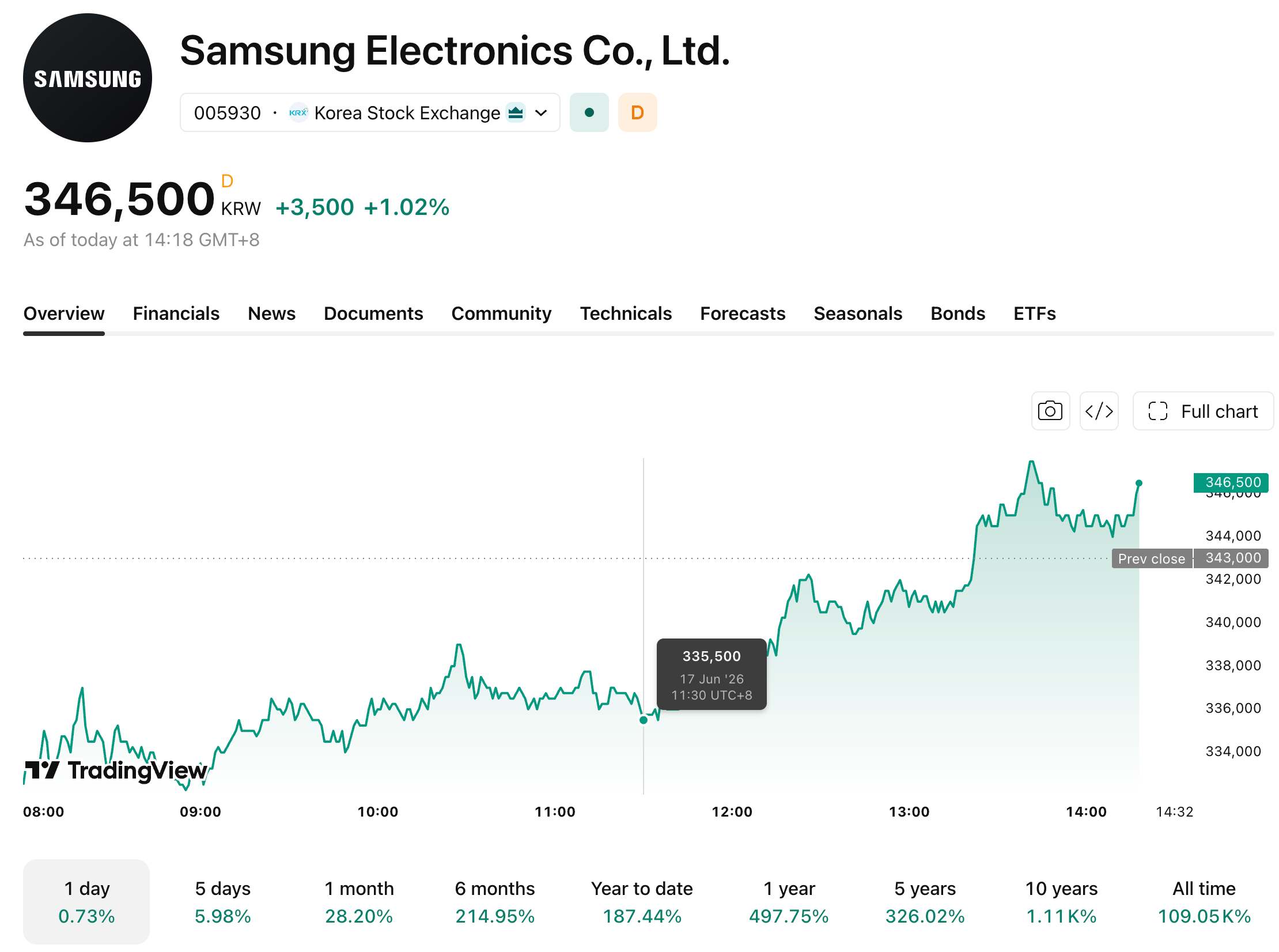
[Source: TradingView]
It is reported that BYD is currently negotiating with Samsung on future autonomous driving chip production, involving the Xuanji A3 series 4nm and next-generation 2nm GAA smart driving chips. Google is exploring having Samsung manufacture its next-generation Axion processor, scheduled for release in 2028, and some TPU chips; if the partnership is finalized, it would mark the first time Google has shifted TPU manufacturing orders away from TSMC. AMD is also in talks to have Samsung produce some of its CPUs starting in 2028. In addition, Tesla's AI6 chip has been confirmed for production at Samsung's Taylor plant in Texas.
TSMC's capacity bottlenecks and geopolitical factors are driving more companies to adopt supply chain strategies that diversify their foundry sources. Although Samsung still lags behind TSMC in yield rates, its available capacity has become an important supplementary option.
Benefiting from improved yield rates and order growth, Samsung's foundry capacity utilization rate continues to rise, with profitability expected to resume in the third quarter of 2026—ahead of its previous target of late 2026 to 2027. Analysts believe that against the backdrop of robust global demand for AI chips and TSMC's tight advanced capacity unlikely to ease this year, Samsung, as one of only three companies currently capable of mass-producing advanced semiconductors, is facing a major opportunity to enter the AI chip foundry race.
Nothing in this material constitutes investment advice, personal recommendation, investment research, an offer, or a solicitation to buy or sell any financial instrument. The content has been prepared without consideration of your individual investment objectives, financial situation, or needs, and should not be treated as such.
Past performance is not a reliable indicator of future performance and/or results. Forward-looking scenarios or forecasts are not a guarantee of future performance. Actual results may differ materially from those anticipated.
Mitrade makes no representation or warranty as to the accuracy or completeness of the information provided and accepts no liability for any loss arising from reliance on such information.
Recommended Articles


