



Today’s Market Recap:July CPI Meets Expectations,SK Hynix Surges Over 9% to Lead Memory Chips, Nebius Soars 34%
Tracking the Market Trend
TradingKey - U.S. July CPI data came in line with expectations, reducing the urgency for the Federal Reserve to tighten policy further. Performance within the tech and AI sectors was mixed, but the sectors as a whole remained supported by earnings fundamentals.
At the close, the Dow Jones Industrial Average fell 0.04% to 53,770.27; the Nasdaq Composite rose 0.54% to 26,588.49; and the S&P 500 gained 0.26% to 7,748.50.
AI-related stocks were active. In the memory chip sector, SK Hynix(SKHY)rose more than 9%, and Seagate Technology(STX)gained over 7%. Among AI cloud service providers, Nebius (NBIS) rose more than 34%, and CoreWeave (CRWV) gained over 19%. The optical communications sector also strengthened, with Lumentum (LITE) rising more than 13% and Coherent (COHR) gaining over 8%, though the latter briefly fell more than 5% in after-hours trading following its earnings release. Additionally, AI chip company Cerebras (CBRS) rose more than 11% during the trading session but fell more than 16% in after-hours trading following its earnings release.
In commodities, spot gold rose 0.86% to $4,408.84 per ounce. Spot silver rose early in the session but retreated later, closing up 1.02% at $65.322 per ounce. WTI crude oil futures closed at $83.20, up 1.30%; Brent crude oil futures rose 1.36% to $88.91.
Market Headline
U.S. July inflation data came in line with expectations, and market bets on the probability of a September rate hike remained unchanged. The U.S. July CPI was fully in line with expectations, with the year-over-year increase narrowing to 3.4% and the core CPI slowing to 2.5% year-over-year. Traders maintained their bets on a 45% probability of a Fed rate hike in September.
Coherent’s earnings and guidance both exceeded expectations, but its stock price unexpectedly plummeted in after-hours trading. Optical communications giant Coherent reported earnings and guidance that exceeded expectations across the board, citing exceptionally strong demand for the new fiscal year, yet its stock price still plummeted in after-hours trading. In the fourth fiscal quarter, Coherent’s revenue rose 34% year-over-year and EPS increased 74%, while the gross margin improved by more than 200 basis points year-over-year to just over 40%. The median guidance for first-quarter revenue and EPS was approximately 7% and 10% higher than market expectations, respectively, with the median gross margin remaining roughly flat compared to the previous quarter. The company emphasized “prioritizing investments to expand manufacturing capacity.” Following the earnings release, Coherent’s stock—which had closed up more than 8%—did not continue to rise in after-hours trading but instead fell, dropping as much as 8% at one point.
Cerebras’ hardware revenue unexpectedly declined, causing its stock to plummet in after-hours trading. Cerebras Plummets! Hardware Revenue Unexpectedly Declines, and Its Path to “Challenging NVIDIA” Faces Demand Volatility. Cerebras reported Q2 revenue of $180 million, up 74% year-over-year; hardware revenue was $54.1 million, down 23% year-over-year, while cloud computing service revenue reached $126 million, up 281% year-over-year. Core revenue for Q3 is expected to be approximately $214 million to $216 million, with a midpoint of $215 million, higher than the market’s expectation of $212 million. Cerebras’ stock price plummeted as much as 17% in after-hours trading.
Cisco(CSCO) posted record revenue last quarter with a surge in AI orders, but its stock price turned negative in after-hours trading. Cisco posted record revenue last quarter, with AI orders surging to $4 billion, and its guidance for the current fiscal year exceeded expectations. In the fourth fiscal quarter, Cisco’s revenue and earnings both exceeded expectations, with revenue up 18% year-over-year and EPS up 23%. Cisco attributed the results to “broad and record-breaking demand” for its technology; AI infrastructure orders for the quarter accounted for 43% of the total for fiscal year 2026. The midpoint of the full-year revenue and EPS guidance is approximately 6% higher than analysts’ expectations. The stock price initially rose nearly 8% in after-hours trading but later turned lower, at one point falling more than 6%.
Nebius’ Q2 revenue surged 454%, with its AI cloud business emerging as the absolute main driver. Driven by surging demand for computing power, Nebius’ Q2 revenue soared 454% year-over-year to $582.3 million, with the AI cloud business contributing 98% of revenue and adjusted EBITDA reaching $236 million. The company signed four major contracts worth over $1 billion each, enhanced its pricing power for computing power, and raised its target for contracted capacity by the end of 2026 to 5 gigawatts. Management reaffirmed its full-year revenue guidance, plans to add over 1 gigawatt of capacity annually starting in 2027, and remains highly confident in the demand for AI computing power.
SpaceXAI officially launched Grok 4.6, focusing on long-running agents and complex programming scenarios. SpaceXAI officially launched Grok 4.6, further enhancing capabilities for long-running agents, complex programming, and knowledge work scenarios. This model is an upgrade from Grok 4.5, with a focus on improving the ability to continuously execute multi-step tasks. It can be used for topic research, information analysis, cross-codebase collaboration, and transforming product ideas into working applications or deliverables. SpaceXAI stated that Grok 4.6 underwent a longer period of supplementary training, with training data covering reasoning, advanced technical concepts, and high-quality engineering content; subsequent training will also cover a wide range of agent-based reinforcement learning tasks, including knowledge work, general-purpose programming, kernel optimization, web development, and computer-aided design.
South Korean media reports that Samsung and SK Hynix are set to announce massive dividend and share buyback plans. South Korean media: Samsung and SK Hynix are planning “epic” dividend and share buybacks, with a combined total potentially exceeding $140 billion. With Samsung Electronics and SK Hynix reporting significant growth in earnings and cash flow, new shareholder return plans could be announced as early as the end of August, with a combined scale potentially exceeding 200 trillion won—a figure expected to set a new record. Samsung recently mentioned in an NDR that it will formulate a shareholder return plan based on free cash flow (FCF) growth; industry estimates suggest the scale could exceed 100 trillion won, with some institutions projecting as much as 120 trillion won. SK Hynix’s cash position has improved, and in an extreme scenario, the scale of its returns could approach 100 trillion won.
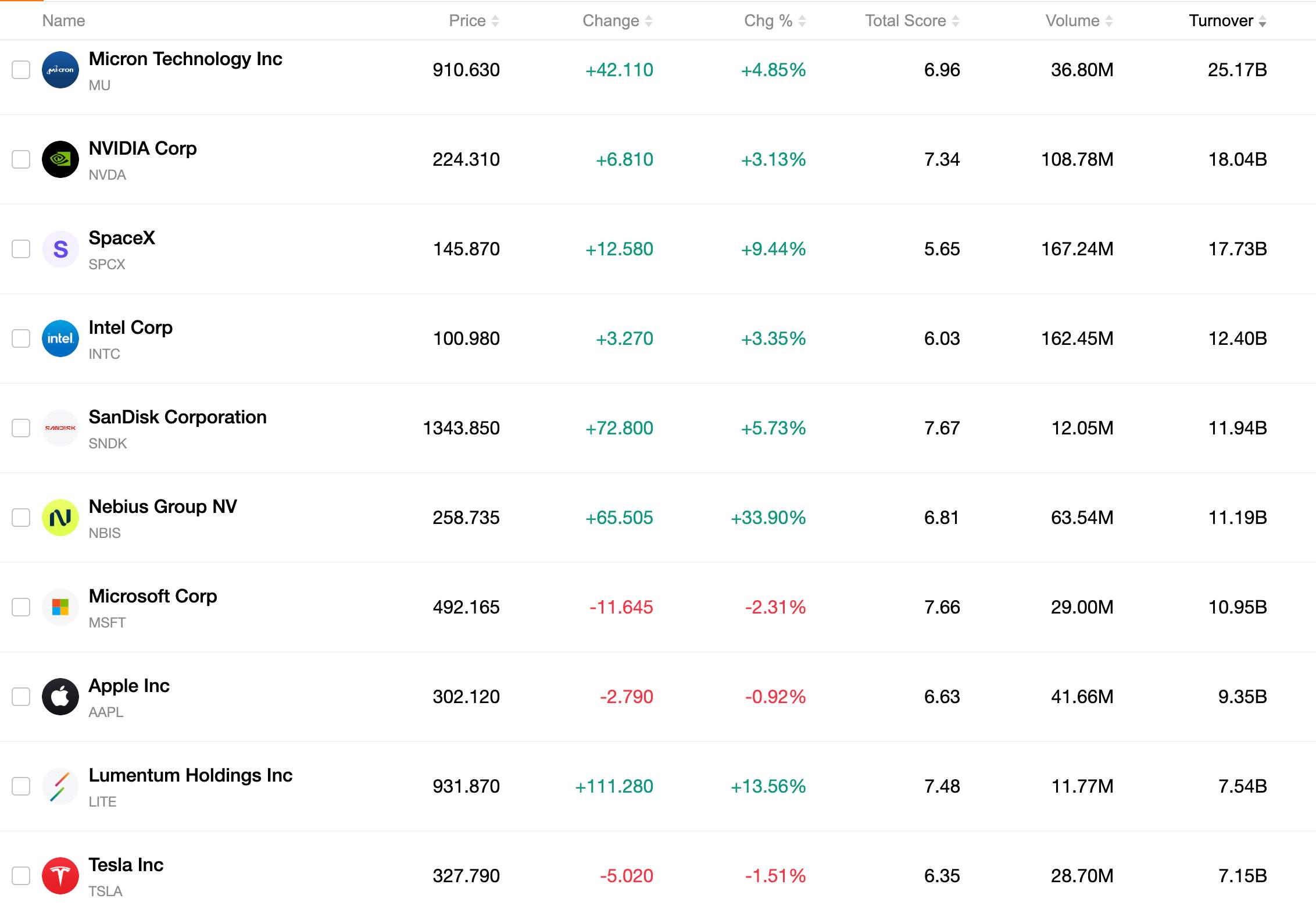
Top 10 Most Traded Stocks
The table below lists the ten most actively traded stocks in the market recently. Backed by massive trading volumes and excellent liquidity, these assets have become key benchmarks for tracking global market dynamics.
Nothing in this material constitutes investment advice, personal recommendation, investment research, an offer, or a solicitation to buy or sell any financial instrument. The content has been prepared without consideration of your individual investment objectives, financial situation, or needs, and should not be treated as such.
Past performance is not a reliable indicator of future performance and/or results. Forward-looking scenarios or forecasts are not a guarantee of future performance. Actual results may differ materially from those anticipated.
Mitrade makes no representation or warranty as to the accuracy or completeness of the information provided and accepts no liability for any loss arising from reliance on such information.
Recommended Articles


