



Kospi Index Surges 30% After Crash: Is the Bull Market Really Back?
KOSPI Index Stages Sharp 30% Rebound
TradingKey - In 2026, the South Korean stock market experienced the world's most dramatic volatility. In the first half of the year, driven by the AI semiconductor boom, the KOSPI Index broke through an all-time high of 9,300 points. Subsequently, affected by market doubts over AI capital expenditures, leverage liquidations, and an overseas memory sell-off, the KOSPI Index continued to pull back, frequently triggering circuit breakers and falling to a low near 5,200 points on July 29.
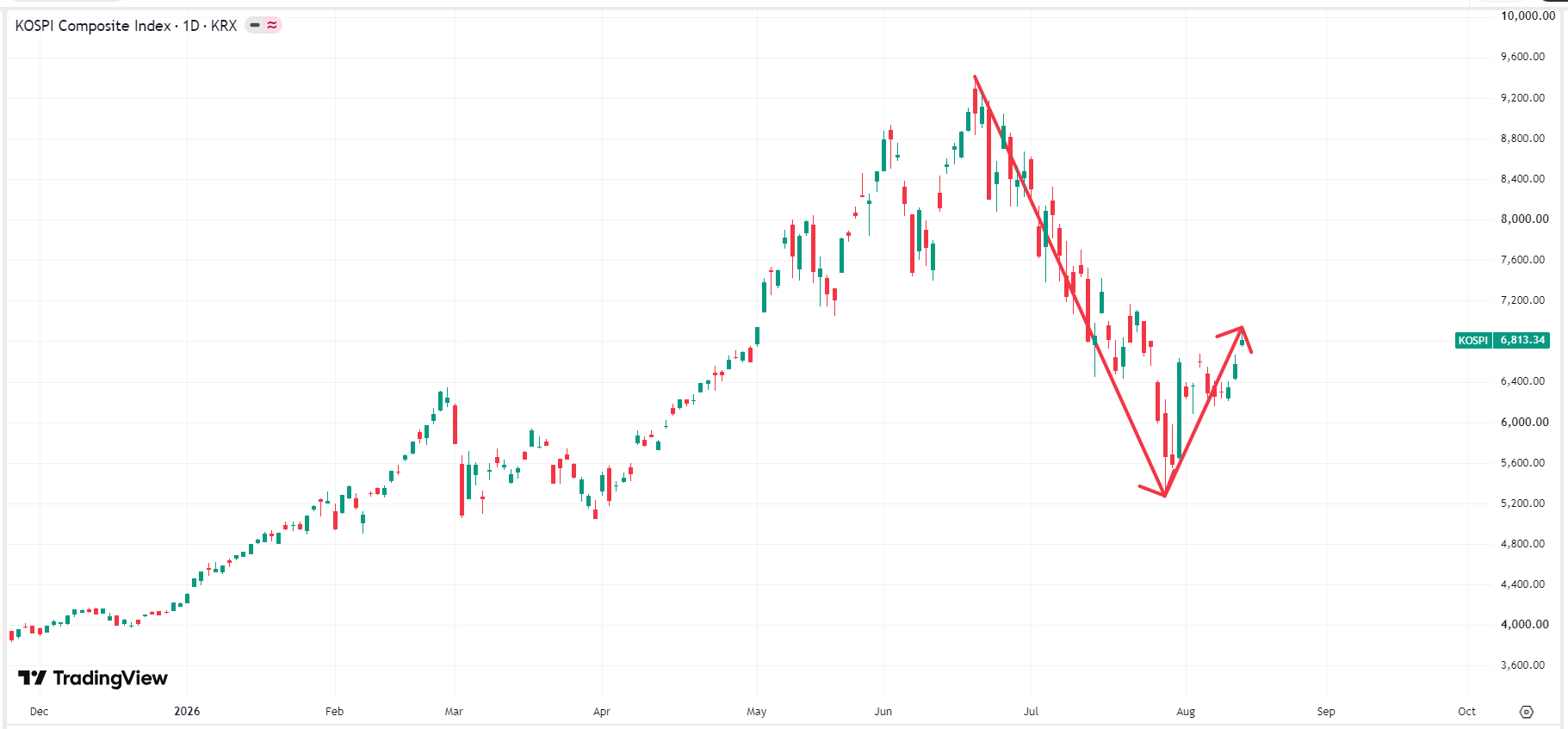 KOSPI Index chart, source: TradingView
As extreme panic sentiment dissipated and high retail leverage was flushed out, the KOSPI quickly staged a strong rebound, surging above 6,800 points in just half a month and gaining over 30%. This violent V-shaped rally in the KOSPI Index has drawn intense global investor focus on whether the bull market has regained its footing.
Three Core Drivers of the KOSPI Rebound
The KOSPI rebound was mainly driven by three factors: the end of leverage liquidations and short covering, fundamental recovery for the semiconductor duo, and expectations of a U.S. monetary policy pivot.
The earlier market plunge was largely due to a chain-reaction liquidation stampede triggered by single-stock 2x leveraged ETFs and retail margin trading. Once the highly leveraged bullish speculative position was flushed out, a supply vacuum emerged in the market, where even a slight inflow of funds sparked massive short covering, sending the index soaring. Most notably, on the third day after the KOSPI hit bottom (July 31), it surged 1,000 points—soaring nearly 18% that day to set its largest single-day gain in history.
The KOSPI is a classic heavily concentrated index, where Samsung Electronics and SK Hynix (SKHY) alone account for over half of the index's market cap weight. As major institutions such as Temasek were reported to intend to invest directly in South Korean semiconductor giants, coupled with capacity for HBM3e/HBM4 remaining in short supply, the valuation recovery of these weighted stocks directly drove the overall market.
In August, slowing U.S. labor market data and cooling inflation data further solidified market expectations of a Federal Reserve (Fed) rate cut in September. The pullback in the U.S. Dollar Index and U.S. Treasury yields provided liquidity breathing room for emerging markets, particularly high-beta markets like South Korea, sending the KOSPI rebounding past 6,800 points to hit its highest level since July 24.
Is the KOSPI Bull Market Back?
Looking strictly at technical indicators, the KOSPI has met the definition of a technical bull market, rebounding more than 20% from its late-July low and breaking upward out of its descending channel to reverse the downtrend. From the perspective of overall capital structure and macroeconomic fundamentals, cooling U.S. inflation data and a slowing labor market have made a September Fed rate cut a strong market consensus, with improving liquidity expectations directly injecting a shot in the arm into emerging markets.
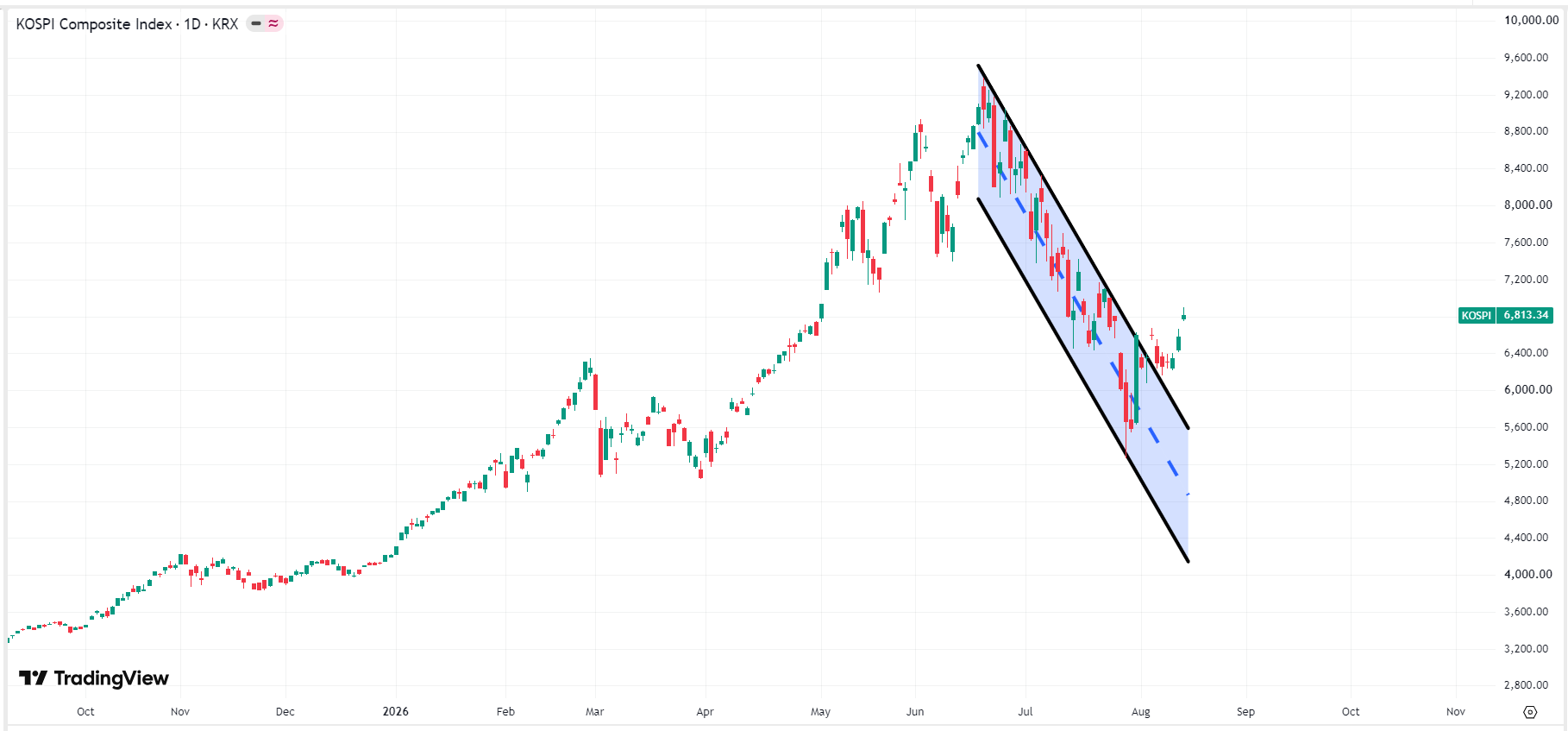 KOSPI Index Chart, Source: TradingView
Although the KOSPI has bullish arguments supporting a return to a bull market, this does not mean the future trend will be smooth sailing with steady gains. This is not only because high volatility is the norm for the KOSPI, but also because a substantial amount of trapped overhead supply remains relative to the record high set in June 2026, meaning every rise will face selling pressure from trapped investors seeking to break even. Therefore, in extreme scenarios, one should remain cautious about the 5,000 mark, as losing this level would mean that this is merely a "bull trap."
Conclusion
The KOSPI Index rebounded by over 30% to break above 6,800 points, driven primarily by short covering, recoveries in Samsung Electronics and SK Hynix, and expectations of Federal Reserve rate cuts. Although technically returning to a bull market, it still faces high volatility and overhead pressure from trapped positions. If it loses the 5,000-point mark, investors should beware of a bull trap.
Nothing in this material constitutes investment advice, personal recommendation, investment research, an offer, or a solicitation to buy or sell any financial instrument. The content has been prepared without consideration of your individual investment objectives, financial situation, or needs, and should not be treated as such.
Past performance is not a reliable indicator of future performance and/or results. Forward-looking scenarios or forecasts are not a guarantee of future performance. Actual results may differ materially from those anticipated.
Mitrade makes no representation or warranty as to the accuracy or completeness of the information provided and accepts no liability for any loss arising from reliance on such information.
Recommended Articles


