



Mastercard Q2 2026 Revenue $9.3B (+14%), BVNK Acquisition Aug 3, Stablecoin Settlement, Agentic AI Commerce
TradingKey - Mastercard (MA) had a strong start to August with its strategic initiatives in stablecoins and agentic AI. Q2 revenue was at $9.3B (+14% YoY) and adjusted EPS was at $5.04 (beating the consensus at $4.77). Gross dollar volume was at $2.9 trillion (+8%). Cross-border volumes showed a surge of 12%. Value-Added Services grew by 20%. The acquisition of BVNK on August 3rd will help Mastercard expand its capabilities in stablecoins and blockchain.
Mastercard looks to ramp up its Agent Pay (agentic AI commerce), virtual-card offering in 43 countries and 174 currencies, along with its real-time payment capabilities and BitLicense settlement. Bill Ackman's Pershing Square Capital Management disclosed new stakes in Mastercard, Visa, and Netflix around August 13th. Consumer spending remained strong, while higher-income households drove discretionary spending, and lower-income households remained conservative.
Q2 Revenue $9.3B (+14% YoY), GDV $2.9T (+8%), EPS Beat
Q2 revenue hit $9.3B (+14% YoY). Adjusted EPS came in at $5.04 (beat $4.77, +6%). Gross dollar volume was at $2.9 trillion (+8% YoY). Despite geopolitical concerns, Mastercard's revenue was strong thanks to its focus on transaction volumes versus credit risk, and therefore is shielded from issues caused by loan defaults. An earnings beat shows that consumer spending and especially higher-income households driving discretionary purchases remained strong with a focus on experiences and travel.
Cross-Border Volume +12% YoY; Travel Spending Robust
Mastercard’s cross-border transactions volume hit 12% growth YoY in Q2. Mastercard benefits from charging higher fees when cross-border transactions occur. Travel spending remained buoyant. Management expects geopolitical disruptions to have less of a residual effect, despite the competitive challenges, and less of a disruptive effect than what was anticipated. Cross-border transactions expose Mastercard to international travel and cross-border e-commerce.
Value-Added Services Revenue +20%; Recurring Revenue Growth
Revenue from Value-Added Services grew 20% year-over-year, driven by rapid payments fraud, the need for enhanced fraud detection and analytics, and other value-added services. Value-Added Services are high margin and yield recurring revenue. We expect the payments market to require AI-based tools for more sophisticated fraud prevention, making the ongoing monetization of bank/merchant datasets crucial for authorization rate improvements and detection of abnormal payment behavior. We expect Value-Added Services to continue to outpace the growth of payment volumes.
BVNK Acquisition August 3: Stablecoin Infrastructure Expansion
August 3: Mastercard completed acquisition of BVNK. BVNK has infrastructure to help businesses to store, move, convert, and settle value in and out of fiat currency as well as digital assets, and crypto. BVNK adds to Mastercard's capability of connecting stablecoins, networked deposits, and traditional networks. From a payments perspective, this helps mostly with cross-border business-to-business (B2B) payments and remittances, and settlement. It provides Mastercard a stronger role with stablecoins, rather than viewing them as competition.
Stablecoin Settlement, BitLicense, Real-Time Payments
Mastercard also announced the inclusion of stablecoin settlement, intraday settlement, and weekend settlement. It also received New York State's BitLicense. Mastercard also teamed with SoFi to integrate stablecoin settlement into their network. Their goal is to make stablecoins an integral part of corporate and cross border transactions.t separate infrastructure. Long-term growth opportunity if stablecoins adopted for corporate/international payments.
Mastercard Agent Pay: Agentic AI Commerce
With Mastercard Agent Pay, autonomous AI agents are also able to transact, as long as the right security is in place. The company noted live transactions of agentic-commerce globally are already being scaled. It's an early stage project, but it is strategically very important for AI agents to pay suppliers, book travel, and buy goods.
Bill Ackman/Pershing Square Position (August 13)
August 13: Bill Ackman said Pershing Square now owns a stake in Mastercard along with Visa and Netflix. This stake seems to show confidence for a promising private equity opportunity consisting of a strong and capital light business, great margins, network effects that are difficult to compete with, and long exposure to cash to digital currency conversion.
Virtual Cards in 43 Countries; B2B Growth Engine
Mastercard virtual-card platform supports 43 countries and 174 currencies. Provides exposure to B2B payments market where transaction values exceed consumer purchases. Commercial payments category less mature than consumer, offering significant adoption runway globally.
Consumer Spending Bifurcated: Higher Income Strong, Lower Cautious
Diverging Q2 consumer spending. Upper income households are continuing to make discretionary purchases on travel and services. Lower income consumers are being much more careful. MA earns income from transaction volumes, not credit risk, which exposes them less to loan defaults compared to card issuers. A recession will reduce volumes and cross border travel.
Technical: Support $583.24, Resistance $607.51, Breakout Confirmed
MA at $599.83. Confirmed breakout above resistance of $583.24. Price is above moving averages at $573.92 and $563.56. RSI of 75 (overbought).
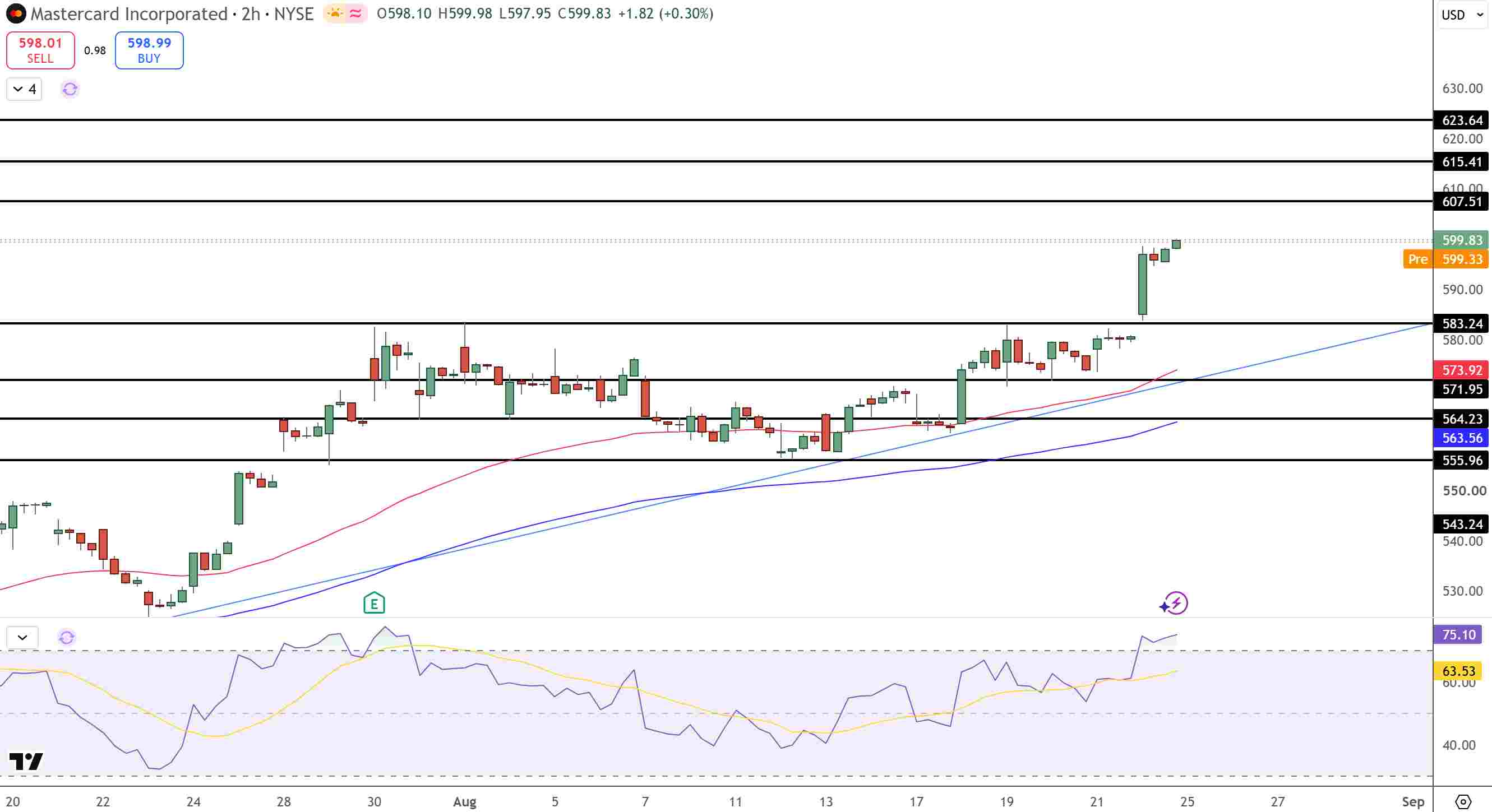
Mastercard Price Chart - Source: Tradingview
Target resistance is now at $607.51. Above that, resistance may be up to $615.41, $623.64. Overbought conditions may lead to consolidation/pullback. Support is now at $583.24 (breakout), $573.92-$571.95 (moving averages).
Key Levels
- Support: $583.24 (breakout), $573.92-$571.95 (moving averages)
- Resistance: $607.51 (target), $615.41, $623.64 (extended)
- Momentum: RSI 75 (overbought), consolidation risk
Bottom Line: Digital Payments Platform, Stablecoin Expansion, Agentic Commerce
MA Q2: Revenue $9.3B (+14%), EPS $5.04 (beat), GDV $2.9T (+8%), cross-border +12%, VAS +20%. BVNK Aug 3. Stablecoin settlement, Agent Pay, BitLicense. Virtual cards 43 countries.
For investors: Mastercard is shifting to a digital payments infrastructure provider from a card network operator. With the focus on blockchain settlement, BVNK and stablecoin expansion foresee growth for MA. Addition of Agentic AI and virtual card B2B develop growth avenues from consumer cards. Cross border spending is growing along with increasing travel. Regulatory pressure and interchange fees, and prevalent economic slowdown, create pressure on revenue. A clear breakout above $583 was confirmed. The RSI at 75 also signals that after a test of the range at $607-$615, consolidation will occur. This is analysis, not investment advice.
Nothing in this material constitutes investment advice, personal recommendation, investment research, an offer, or a solicitation to buy or sell any financial instrument. The content has been prepared without consideration of your individual investment objectives, financial situation, or needs, and should not be treated as such.
Past performance is not a reliable indicator of future performance and/or results. Forward-looking scenarios or forecasts are not a guarantee of future performance. Actual results may differ materially from those anticipated.
Mitrade makes no representation or warranty as to the accuracy or completeness of the information provided and accepts no liability for any loss arising from reliance on such information.
Recommended Articles


