



Japanese Yen tumbles as Fed signals higher rate path
- USD/JPY climbs above 160 as Yen pressure deepens.
- Warsh stresses inflation fight, offering little forward policy guidance.
- Fed SEP lifts rate median, boosting Dollar appeal.
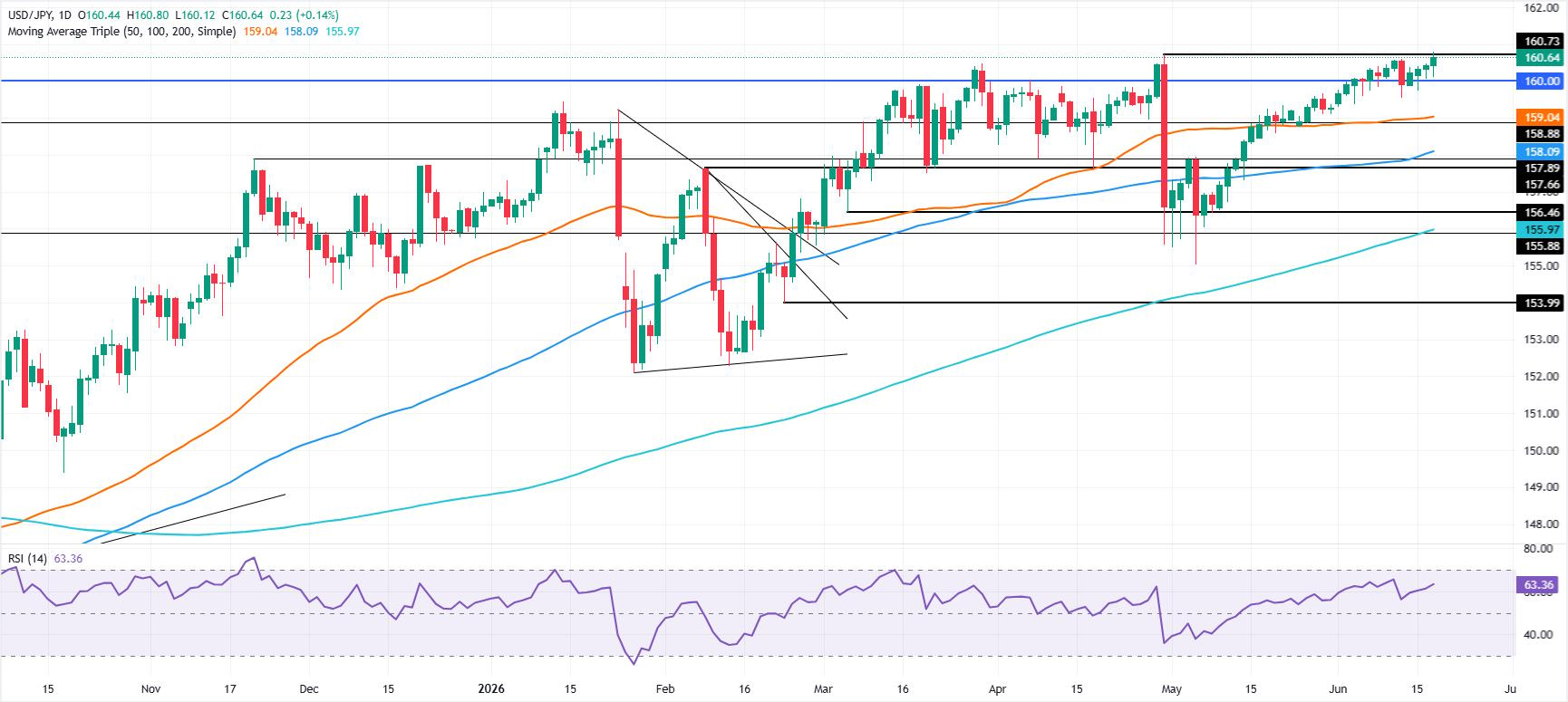
The Japanese Yen depreciated against the US Dollar on Wednesday after the US Federal Reserve delivered a hawkish hold, with most officials expecting one rate hike towards the end of the year, while the new Fed Chair, Warsh, reiterated the Fed’s commitment to achieving the 2% inflation goal. At the time of writing, the USD/JPY trades at 160.66 after bouncing off the daily low of 160.11.
Yen weakens as Fed dots revive US yield advantage
Fed Chair Kevin Warsh provided little insight into the future policy path during his press conference, noting that he had not submitted economic projections. Nonetheless, he stressed that inflation remains well above the Fed’s 2% target and said policymakers are unanimous in their commitment to restoring price stability.
About the policy statement, Warsh said it was designed to present the facts rather than signalling forward guidance. He also revealed plans to form task forces focused on communications, the balance sheet, data sources, productivity, employment, and inflation, among other areas, as part of a review of the Federal Reserve’s current framework.
On the US central bank dual mandate, Warsh said policymakers are not facing a “cruel choice” between achieving price stability and maximum employment. However, he acknowledged that the central bank still has more work to do to bring inflation back under control.
Fed’s monetary policy statement shortened
In its statement, the Fed eliminated forward guidance. The Fed recognized that the economy continues to grow strongly despite uncertainties surrounding the Middle East conflict and noted that the jobs market remains stable, with the unemployment rate remaining nearly unchanged.
Furthermore, “Inflation remains elevated relative to the Committee’s 2 per cent goal, in part reflecting supply shocks that have driven price increases in certain sectors, including energy. The Committee will deliver price stability.”
The Fed’s Summary of Economic Projections (SEP) indicated that the median forecast is for the Fed Funds Rate to finish at 3.8%, up from 3.4% in March. US GDP is expected to expand by 2.2% by the end of 2026, while Core PCE, the Fed’s preferred inflation measure, is projected at 3.3%, which is 1.3% above the Fed’s 2% target.
USD/JPY Price Forecast: Technical outlook
The USD/JPY rallied by 0.14%, with the advance capped by investor fears of a possible Bank of Japan (BoJ) FX market intervention. The rise of US Treasury yields drove the pair higher, a headwind for the Yen, which is usually undermined by currencies with a wider interest rate differential, favouring the latter.
On the upside, the first resistance is 161.00. A breach of the latter will expose the 161.50, ahead of 162.00. On the downside, the first support would be the June 15 low of 159.73, ahead of the 50-day Simple Moving Average (SMA) at 159.04.
Japanese Yen FAQs
The Japanese Yen (JPY) is one of the world’s most traded currencies. Its value is broadly determined by the performance of the Japanese economy, but more specifically by the Bank of Japan’s policy, the differential between Japanese and US bond yields, or risk sentiment among traders, among other factors.
One of the Bank of Japan’s mandates is currency control, so its moves are key for the Yen. The BoJ has directly intervened in currency markets sometimes, generally to lower the value of the Yen, although it refrains from doing it often due to political concerns of its main trading partners. The BoJ ultra-loose monetary policy between 2013 and 2024 caused the Yen to depreciate against its main currency peers due to an increasing policy divergence between the Bank of Japan and other main central banks. More recently, the gradually unwinding of this ultra-loose policy has given some support to the Yen.
Over the last decade, the BoJ’s stance of sticking to ultra-loose monetary policy has led to a widening policy divergence with other central banks, particularly with the US Federal Reserve. This supported a widening of the differential between the 10-year US and Japanese bonds, which favored the US Dollar against the Japanese Yen. The BoJ decision in 2024 to gradually abandon the ultra-loose policy, coupled with interest-rate cuts in other major central banks, is narrowing this differential.
The Japanese Yen is often seen as a safe-haven investment. This means that in times of market stress, investors are more likely to put their money in the Japanese currency due to its supposed reliability and stability. Turbulent times are likely to strengthen the Yen’s value against other currencies seen as more risky to invest in.
Nothing in this material constitutes investment advice, personal recommendation, investment research, an offer, or a solicitation to buy or sell any financial instrument. The content has been prepared without consideration of your individual investment objectives, financial situation, or needs, and should not be treated as such.
Past performance is not a reliable indicator of future performance and/or results. Forward-looking scenarios or forecasts are not a guarantee of future performance. Actual results may differ materially from those anticipated.
Mitrade makes no representation or warranty as to the accuracy or completeness of the information provided and accepts no liability for any loss arising from reliance on such information.
Recommended Articles


