



GBP/USD Price Forecast: Soft US CPI data backs upside towards 1.3500
- GBP/USD rises to near 1.3403 amid weakness in the US Dollar.
- Traders trim hawkish Fed bets due to lower-than-expected US CPI growth in June.
- Andy Burnham is set to become the new UK Prime Minister.
The British Pound (GBP) is up 0.1% at around 1.3403 against the US Dollar (USD) during the European trading session on Wednesday. The GBP/USD pair gains as the US Dollar comes under selling pressure, with market participants dialing down expectations for Federal Reserve (Fed) interest rate hikes.
In the European trade, the US Dollar Index (DXY), which tracks the Greenback’s value against six major currencies, has recovered its early losses and is marginally down to near 100.87. However, the DXY is still holding Tuesday’s losses.
According to the CME FedWatch tool, the odds of the Fed raising interest rates in the policy meeting this month have eased to 16.6% from 41.7% recorded on Monday.
Traders pare hawkish Fed bets as the United States (US) Consumer Price Index (CPI) report for June showed on Tuesday that both headline and core inflation grew at a slower-than-expected pace.
In the United Kingdom (UK), Andy Burnham is set to replace Prime Minister (PM) Keir Starmer on July 20 and will likely appoint a new Finance Minister (FM). The smooth UK leadership transition is supporting the British Pound.
GBP/USD technical analysis
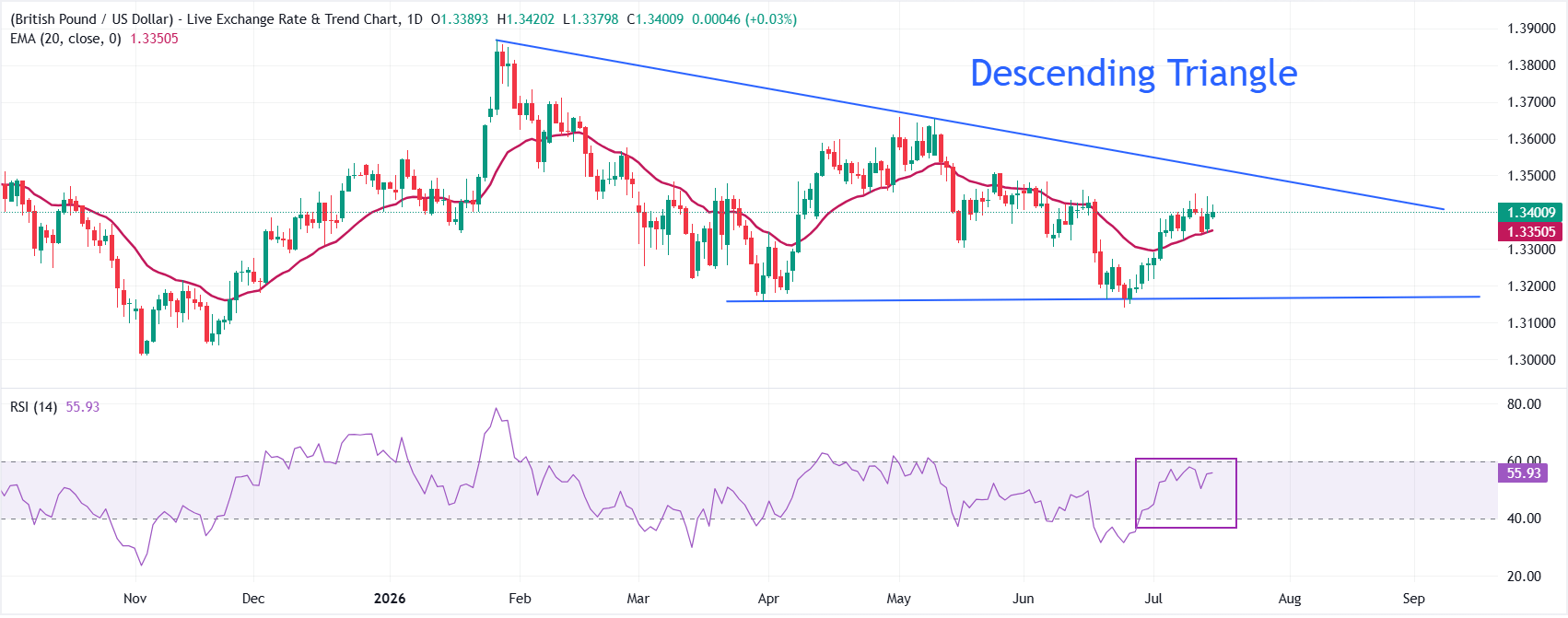
GBP/USD trades slightly higher at around 1.3400, holding a mildly bullish near‑term bias as it remains above the 20‑period exponential moving average (EMA) at 1.3350. However, the overall trend appears sideways amid the Descending Triangle formation.
The Relative Strength Index (RSI) at 55.93 suggests steady, but not overextended, upside momentum.
On the downside, initial support is seen at the current price area around 1.3401, with the 20‑period EMA at 1.3350 reinforcing a nearby demand zone before the structural floor defined by the rising trend‑line break near 1.3166. On the topside, a sustained move above 1.3520, where the descending resistance trend line break level resides, would be needed to open the door for a more decisive bullish extension beyond the recent range. Above 1.3520, the pair could extend its advance towards 1.3600.
(The technical analysis of this story was written with the help of an AI tool. Know more.)
Inflation FAQs
Inflation measures the rise in the price of a representative basket of goods and services. Headline inflation is usually expressed as a percentage change on a month-on-month (MoM) and year-on-year (YoY) basis. Core inflation excludes more volatile elements such as food and fuel which can fluctuate because of geopolitical and seasonal factors. Core inflation is the figure economists focus on and is the level targeted by central banks, which are mandated to keep inflation at a manageable level, usually around 2%.
The Consumer Price Index (CPI) measures the change in prices of a basket of goods and services over a period of time. It is usually expressed as a percentage change on a month-on-month (MoM) and year-on-year (YoY) basis. Core CPI is the figure targeted by central banks as it excludes volatile food and fuel inputs. When Core CPI rises above 2% it usually results in higher interest rates and vice versa when it falls below 2%. Since higher interest rates are positive for a currency, higher inflation usually results in a stronger currency. The opposite is true when inflation falls.
Although it may seem counter-intuitive, high inflation in a country pushes up the value of its currency and vice versa for lower inflation. This is because the central bank will normally raise interest rates to combat the higher inflation, which attract more global capital inflows from investors looking for a lucrative place to park their money.
Formerly, Gold was the asset investors turned to in times of high inflation because it preserved its value, and whilst investors will often still buy Gold for its safe-haven properties in times of extreme market turmoil, this is not the case most of the time. This is because when inflation is high, central banks will put up interest rates to combat it. Higher interest rates are negative for Gold because they increase the opportunity-cost of holding Gold vis-a-vis an interest-bearing asset or placing the money in a cash deposit account. On the flipside, lower inflation tends to be positive for Gold as it brings interest rates down, making the bright metal a more viable investment alternative.
Nothing in this material constitutes investment advice, personal recommendation, investment research, an offer, or a solicitation to buy or sell any financial instrument. The content has been prepared without consideration of your individual investment objectives, financial situation, or needs, and should not be treated as such.
Past performance is not a reliable indicator of future performance and/or results. Forward-looking scenarios or forecasts are not a guarantee of future performance. Actual results may differ materially from those anticipated.
Mitrade makes no representation or warranty as to the accuracy or completeness of the information provided and accepts no liability for any loss arising from reliance on such information.
Recommended Articles


