



Crude Oil watches the Houthis aim at the last export route that still works
- WTI trades near 79.10 after tagging 80.29 on Houthi threats against Saudi oil infrastructure, fading at the 50-day EMA to sit modestly red on the day.
- Yemen's rebels threaten all Saudi oil sites and key facilities if Riyadh escalates, putting the Red Sea export workaround in the crosshairs while Hormuz stays dysfunctional.
- A reinstated American naval blockade and fresh strike waves on Iran barely moved the tape this week, a numbness Thursday's headline interrupted only briefly.
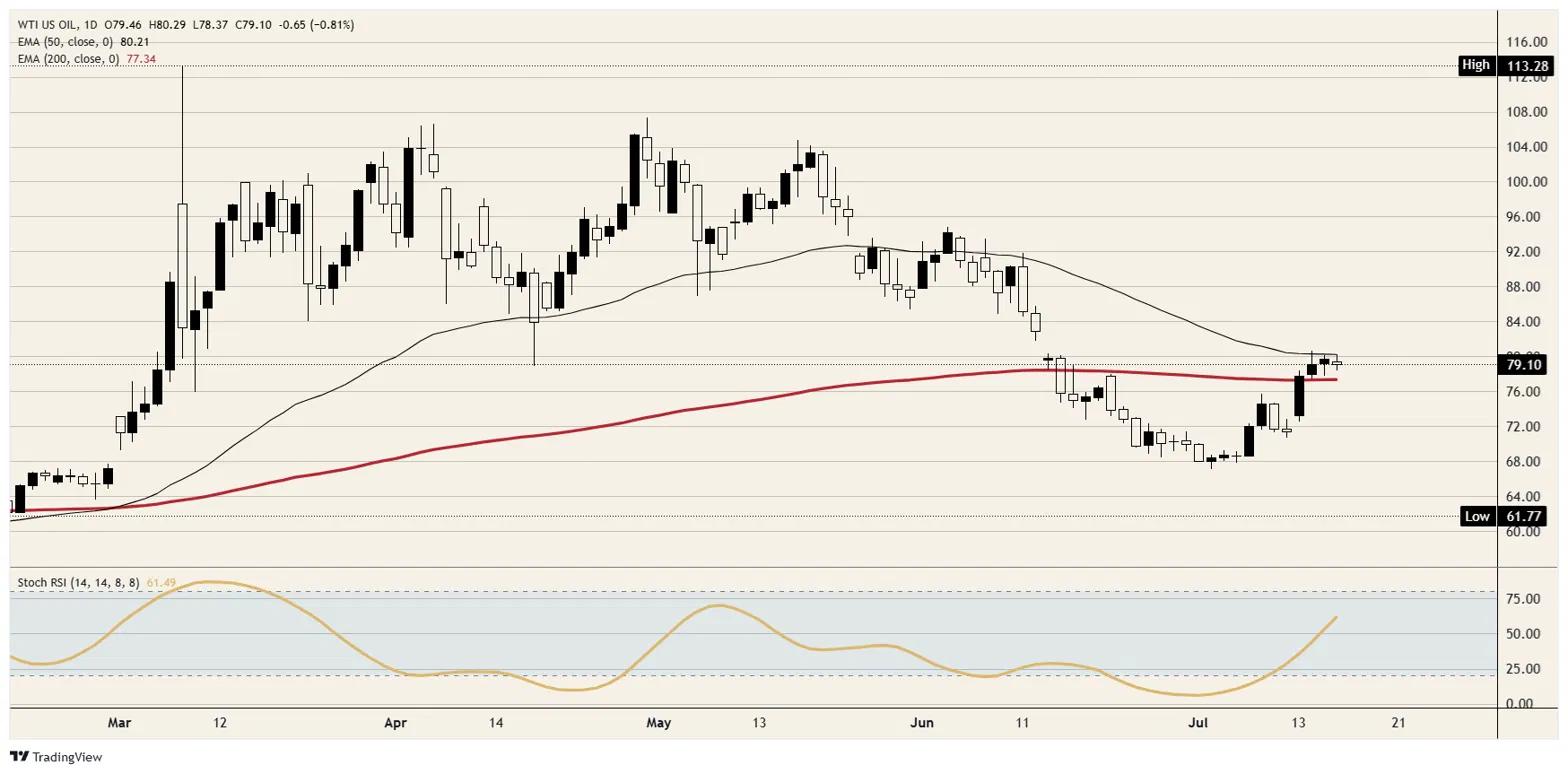
West Texas Intermediate (WTI) spent Thursday's European morning grinding down to 78.37 before ripping nearly two dollars to 80.29 when the Houthis threatened to target all Saudi oil sites and key facilities should Saudi Arabia escalate its actions against Yemen. The bid did not survive the 50-day Exponential Moving Average (EMA) at 80.21; the American benchmark now changes hands near 79.10, down 0.81% on a session that priced a supply catastrophe and then thought better of it.
The threat lands on the bypass, not the sideshow
Thursday's warning caps a four-day escalation ladder that began on a runway rather than an oilfield. Yemen's Saudi-backed government bombed Sanaa airport on Monday to stop an Iranian aircraft carrying a Houthi delegation home from Tehran; the Houthis answered with ballistic missiles and drones at Abha International Airport, their heaviest strike on the Kingdom since the 2022 truce froze the war, then warned airlines out of Saudi airspace and floated a siege of the country outright.
Markets have filed the Yemeni front as a sideshow to Hormuz, and the filing is exactly backwards. Riyadh has spent this conflict rerouting a growing share of exports through the East-West Pipeline to Yanbu on the Red Sea, the quiet assumption that keeps Saudi barrels priced as reliable whatever Iran does at the Strait. A Houthi campaign against Saudi facilities, alongside the group's open musings about the Bab al-Mandeb chokepoint, aims squarely at that workaround; the 2019 Abqaiq strike briefly took Saudi output from 9.8 to roughly 4.1 million barrels per day, and the group is now advertising a sequel with a longer target list.
Hormuz fatigue is doing the heavy lifting
The backdrop this premium faded against is what makes the fade notable. Washington reinstated its naval blockade of Iranian ports on Tuesday after Tehran attacked seven commercial vessels in a week, leaving roughly a dozen crew dead, missing or injured, and American forces followed with back-to-back strike waves, the latest a seven-hour operation against dozens of military targets along Iran's coastline. Trump, having declared last month's peace framework over at the NATO summit, is now floating American transit fees for the Strait.
Crude Oil barely moved on Wednesday in response to any of it, and the numbness has an explanation. Traders have been whipsawed since February through a ceasefire, its collapse, its resurrection in June, and its collapse again; energy analysts read the reimposed blockade as resetting the conflict on an escalatory trajectory, while Washington's waiver for Indian purchases of Russian barrels caps every rally from the supply side. The tape now pays up only for headlines it has not seen before, and a direct threat to Saudi production qualified, briefly.
The fade is a position, not an opinion
Consensus positioning still banks on cooling tempers, on the theory that both Washington and Tehran keep signalling they want a deal more than a war. That is a defensible read of intent and a poor read of control, because the actors multiplying fastest, the Houthis among them, are precisely the ones no negotiating table binds. Every barrel of premium sold at the 50-day EMA is a bet that nobody on the periphery gets a vote.
What flips the trade is contact rather than rhetoric, and the distinction is narrowing. A confirmed strike on Saudi metal, or Houthi action at Bab al-Mandeb that forces tankers into longer routings, converts Thursday's ninety-minute premium into a standing one; until then, sellers lean on the belief that Gulf producers can route or replace whatever the headlines threaten. That belief has held all year. It has also never been tested on two chokepoints at once.
Friday hands the Dollar the microphone
Thursday's American data leaned supportive for demand, with initial jobless claims at 208K against a 217K consensus and the Philadelphia Federal Reserve's manufacturing index exploding to 41.4 versus 13 expected, its strongest print since November 2021. Three Federal Reserve speakers follow from 16:30 GMT. Friday brings housing starts and building permits at 12:30 GMT, industrial production at 13:15 GMT, then the University of Michigan's preliminary July sentiment survey at 14:00 GMT, seen at 51 from 49.5 with one-year inflation expectations last at 4.6%. A hot expectations print feeds the central bank's hawkish tilt, firms the Dollar, and taxes every Dollar-denominated barrel.
Technical levels
Resistance: The 50-day EMA at 80.21 and the session high at 80.29 form a single ceiling, and the daily chart offers little structure beyond that cluster before the mid-80s zone where June's collapse began.
Support: The session low at 78.37 guards the tape, with the rising 200-day EMA at 77.34 beneath it as the structural floor of the two-week recovery off the July base.
Bias: Higher. The daily Stochastic Relative Strength Index is climbing through the 60s with room overhead, dips keep finding buyers, and the threat surface is widening faster than the premium; a daily close above 80.21 confirms the breakout, while only a loss of 77.34 spoils the recovery.
WTI Crude Oil daily chart
WTI Oil FAQs
WTI Oil is a type of Crude Oil sold on international markets. The WTI stands for West Texas Intermediate, one of three major types including Brent and Dubai Crude. WTI is also referred to as “light” and “sweet” because of its relatively low gravity and sulfur content respectively. It is considered a high quality Oil that is easily refined. It is sourced in the United States and distributed via the Cushing hub, which is considered “The Pipeline Crossroads of the World”. It is a benchmark for the Oil market and WTI price is frequently quoted in the media.
Like all assets, supply and demand are the key drivers of WTI Oil price. As such, global growth can be a driver of increased demand and vice versa for weak global growth. Political instability, wars, and sanctions can disrupt supply and impact prices. The decisions of OPEC, a group of major Oil-producing countries, is another key driver of price. The value of the US Dollar influences the price of WTI Crude Oil, since Oil is predominantly traded in US Dollars, thus a weaker US Dollar can make Oil more affordable and vice versa.
The weekly Oil inventory reports published by the American Petroleum Institute (API) and the Energy Information Agency (EIA) impact the price of WTI Oil. Changes in inventories reflect fluctuating supply and demand. If the data shows a drop in inventories it can indicate increased demand, pushing up Oil price. Higher inventories can reflect increased supply, pushing down prices. API’s report is published every Tuesday and EIA’s the day after. Their results are usually similar, falling within 1% of each other 75% of the time. The EIA data is considered more reliable, since it is a government agency.
OPEC (Organization of the Petroleum Exporting Countries) is a group of 12 Oil-producing nations who collectively decide production quotas for member countries at twice-yearly meetings. Their decisions often impact WTI Oil prices. When OPEC decides to lower quotas, it can tighten supply, pushing up Oil prices. When OPEC increases production, it has the opposite effect. OPEC+ refers to an expanded group that includes ten extra non-OPEC members, the most notable of which is Russia.
Nothing in this material constitutes investment advice, personal recommendation, investment research, an offer, or a solicitation to buy or sell any financial instrument. The content has been prepared without consideration of your individual investment objectives, financial situation, or needs, and should not be treated as such.
Past performance is not a reliable indicator of future performance and/or results. Forward-looking scenarios or forecasts are not a guarantee of future performance. Actual results may differ materially from those anticipated.
Mitrade makes no representation or warranty as to the accuracy or completeness of the information provided and accepts no liability for any loss arising from reliance on such information.
Recommended Articles


