



Citigroup (C) Stock Forecast: Strong Earnings Beat Meets Higher Spending Concerns as Recovery Tests $140
TradingKey - In one of its best quarters in recent years, Citigroup Inc (NYSE: C) posted 14% year-on-year second-quarter revenue of $24.8 billion and a 45% surge in net income to $5.8 billion, or $3.15 in diluted EPS, a number well above analyst estimates of $2.74. However, Citigroup shares dropped more than 5% from where they were before the bank released earnings and then rallied back to around $135 on July 16 after the company said it plans to spend more money on investments in the second half of 2024 while keeping its profitability outlook unchanged for the rest of the year.
The quarter suggests Citigroup CEO Jane Fraser’s turnaround playbook is working, but now the bank’s management needs to prove that its decision to ramp up spending can be translated to earnings growth rather than pushing back margin improvements.
Citigroup Revenue Increases in Broad-Based Growth
Citigroup posted its best quarter in nearly a decade in revenue with growth across its Markets, Banking, Wealth and Services. The New York-based bank said second-quarter net income jumped to $5.8 billion from $4.0 billion, or $3.15 versus $1.96 per share, surpassing estimates. Return on tangible common equity, a key metric for banks, was about 13% in the second quarter, while for the first half, it was approximately 13.1%, comfortably in line with Citigroup’s annual target range of 10% to 11%.
Higher Cost Weighs on Stock Price
A decline in stock price reflected investor fears about higher cost rather than performance in the second quarter. Citigroup intends to accelerate spending for roughly $5 billion worth of investments in the U.S. credit-card business, wealth management, IT and institutional banking as part of its plan to drive growth. The company also said in its earnings release that employee severance costs could exceed the $800 million it previously estimated. While top executives insist revenue growth should be used to invest while retaining financial responsibility, investors will need proof that the company’s spending will translate to revenue growth and improved returns rather than more costs.
Markets, Corporate and Investment Banking Continue Improvement
Institutional businesses were the primary drivers of Citigroup’s second-quarter growth.
The company’s equities business earned 45% more, and its fixed-income business increased 7% with clients increasing hedging against geopolitical events and monetary policy expectations. Investment banking revenue was up 44% to $1.55 billion, driven by better debt, equity and M&A markets.
Citigroup’s Services business is its best franchise. The unit’s Treasury and Trade Solutions, and Securities Services provide banking services to multinational clients, such as payments, cash management and custodial services, providing a steady source of fees and deposits. Unlike equities or investment banking, its revenue generation doesn’t rely as much on market performance and helps drive more predictable earnings for the company.
Strong Capital Base Allows Bank to Share Capital
Citigroup keeps paying shareholders with its profits while maintaining a strong capital base.
In the second quarter, the bank returned around $5 billion worth of dividends and share buybacks. Its common equity Tier 1 capital ratio was 12.8%, and tangible book value was $100.89 per share, and book value was $114.74.
Fraser added that 90% of Citigroup’s regulatory transformation efforts have been completed or are nearly done, and once that program is fully realized, the bank may be able to shed consent orders, which is an important step in Fraser’s turnaround.
Citigroup (C) Technical Analysis: Recovery Faces Fibonacci Resistance
Citigroup is hovering near $135.29 on the 4-hour timeframe after a bounce from the $131.81 support level in the wake of the post-earnings sell-off. Although the stock has regained its footing above the 200-period EMA ($134.73), it is still holding beneath the upwardly sloping 50-period EMA, which signals that the uptrend is not yet solid. The price is currently oscillating between the 23.6% Fibonacci level ($134.77) and the 38.2% level ($136.59), which represents the nearest resistance.
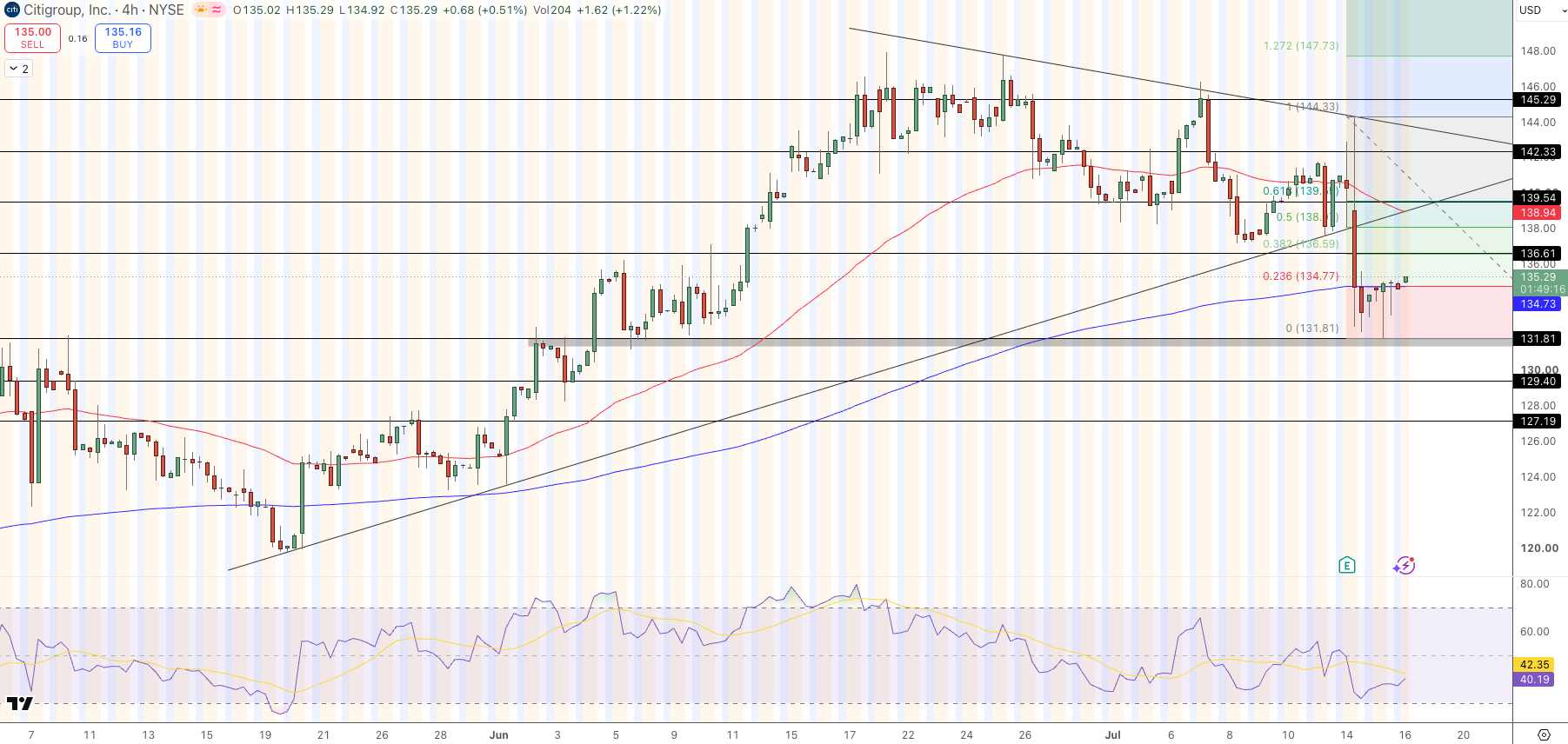
Citigroup (C) Stock Price Chart - Source: Tradingview
A few bullish candles show that buyers are protecting the long-term support, while the previous ascent is now serving as resistance. For a continuation, Citigroup stock needs to push past $136.59 and test $138.16, the subsequent resistance at the 61.8% Fibonacci retracement ($139.79).
Momentum has shifted away from oversold territory, yet the RSI is still hovering around the 40 level, underscoring that buyers must build up greater momentum before we can confidently call this a reversal. If C continues to hold above $134.73 and $131.81, we remain in favor of recovery toward $136.59 with the upside targets being $138.16 and $139.79.
Frequently Asked Questions
Why did Citigroup stock fall after earnings?
Even though Citigroup exceeded earnings estimates, the stock slid because the company kept its FY'26 profit growth forecast even as it ramped up ~$5B investment spending, which investors worried would lead to higher expenses during the second half of 2026.
Did Citigroup beat Wall Street estimates?
Indeed, the bank's second-quarter EPS was $3.15 per share, surpassing the $2.74 estimate, while sales came in at $24.8 billion, exceeding expectations.
What is the outlook for Citigroup stock?
The firm's fundamentals continue to improve, buoyed by better-than-expected sales for trading, investment banking and Services. However, investors will keep a close eye on the company's expenses, regulatory improvements, and if management can continue to earn above its 10% to 11% target.
Bottom Line
It has been a strong second quarter for Citigroup. Revenue climbed 14% and net income advanced 45%, with a per share earnings figure of $3.15 that comfortably topped analysts' expectations. The post-earnings dip was more about concerns of increased investment spending rather than a deterioration in the business itself. The next leg of Fraser's turnaround plan will be determined by execution. If it can turn today's spending into sustained revenue growth, while keeping a leash on expenses, it could boost both its earnings and valuation over the long run.
Nothing in this material constitutes investment advice, personal recommendation, investment research, an offer, or a solicitation to buy or sell any financial instrument. The content has been prepared without consideration of your individual investment objectives, financial situation, or needs, and should not be treated as such.
Past performance is not a reliable indicator of future performance and/or results. Forward-looking scenarios or forecasts are not a guarantee of future performance. Actual results may differ materially from those anticipated.
Mitrade makes no representation or warranty as to the accuracy or completeness of the information provided and accepts no liability for any loss arising from reliance on such information.
Recommended Articles


