



Are U.S.-Iran Negotiations Real or Fake? What’s Next for Crude Oil, Gold and Stock Markets?
TradingKey - The current US-Iran situation boils down to one core point: the US claims highly productive contacts have occurred and has submitted a 15-point proposal via intermediaries, while Iran has repeatedly denied direct negotiations, stating only that it is reviewing the US proposal.
Recently, the US and Iran have shown clear divergence in their narratives regarding a ceasefire and peace talks. On the same matter, both sides are telling different stories. Trump stated that the US is in contact with the "most appropriate people" in Iran, progress has been made, and a 15-point proposal has even been submitted to Iran.
On the other hand, Iranian Foreign Minister Araghchi explicitly stated that Tehran is merely reviewing the US proposal via intermediaries, which does not equate to negotiations with the US. According to Reuters, communication is currently being facilitated primarily by Pakistan, Egypt, Turkey, and Gulf nations; it remains uncertain whether direct negotiations can be realized in Islamabad.
This means the focus should not be on who is louder, but on whether both sides have entered a substantive stage for negotiation. Judging by the conditions released by Iran, the threshold is quite high: Tehran wants guarantees against future attacks, compensation for war losses, the lifting of sanctions, and demands that the issue of control over the Strait of Hormuz be included in the discussion. Meanwhile, Iran rejects any arrangements that would limit its ballistic missile program.
For the US, these are hardly easy concessions, especially given that Trump has publicly put the nuclear program, missile program, regional proxies, and the Strait of Hormuz all on the table.
What happens next if negotiations do not commence?
If the US and Iran remain at the stage of "verbal signaling" and "intermediary messaging," the market is highly likely to continue in a state of high volatility.
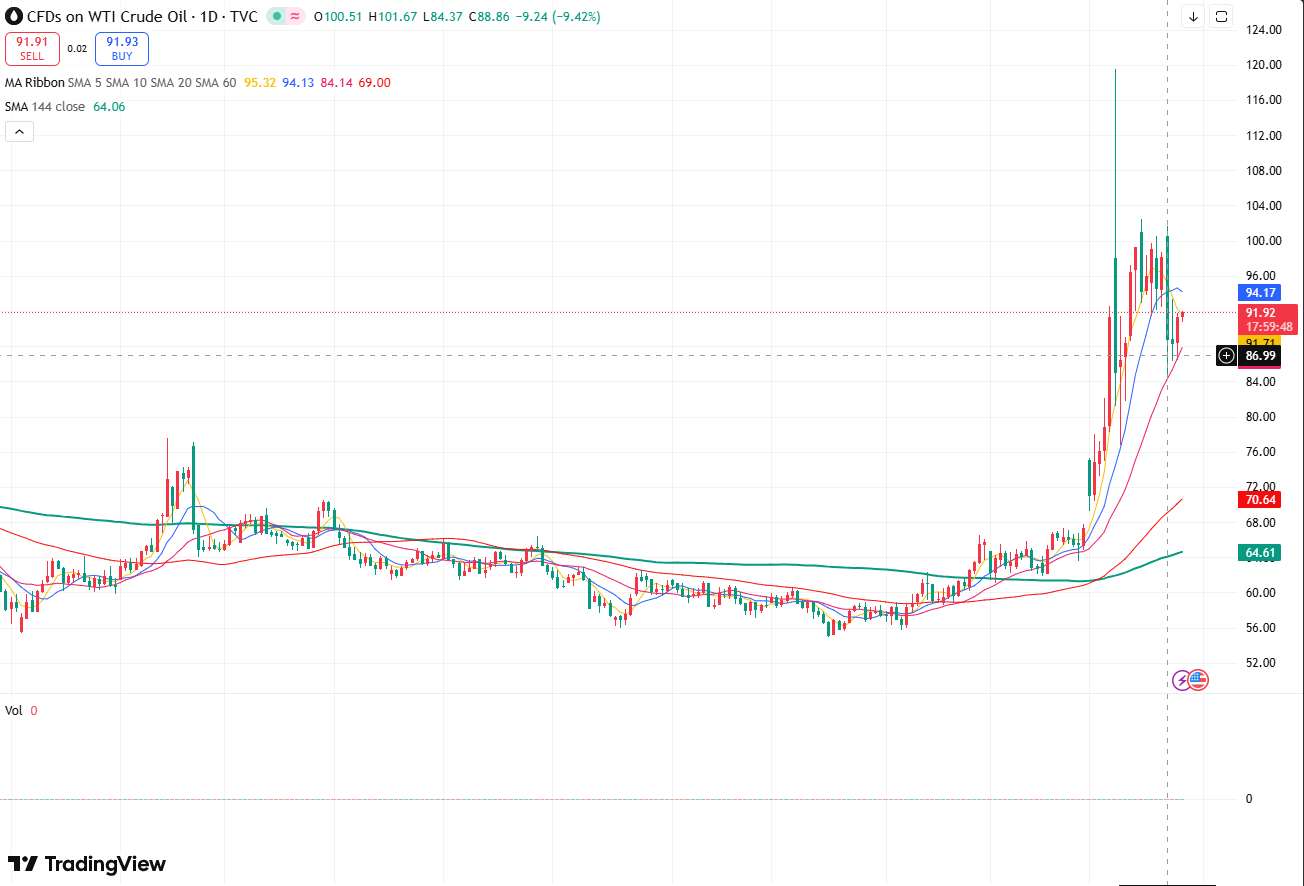
Oil prices will continue to be supported by geopolitical risks and supply uncertainties in the Strait of Hormuz. In the previous round of trading, Brent crude once plunged 14% in a single day to $92.78, WTI and dropped even further by 16% to $84.37, but Brent crude subsequently fluctuated around $100 due to shifting developments.
Source: TradingView
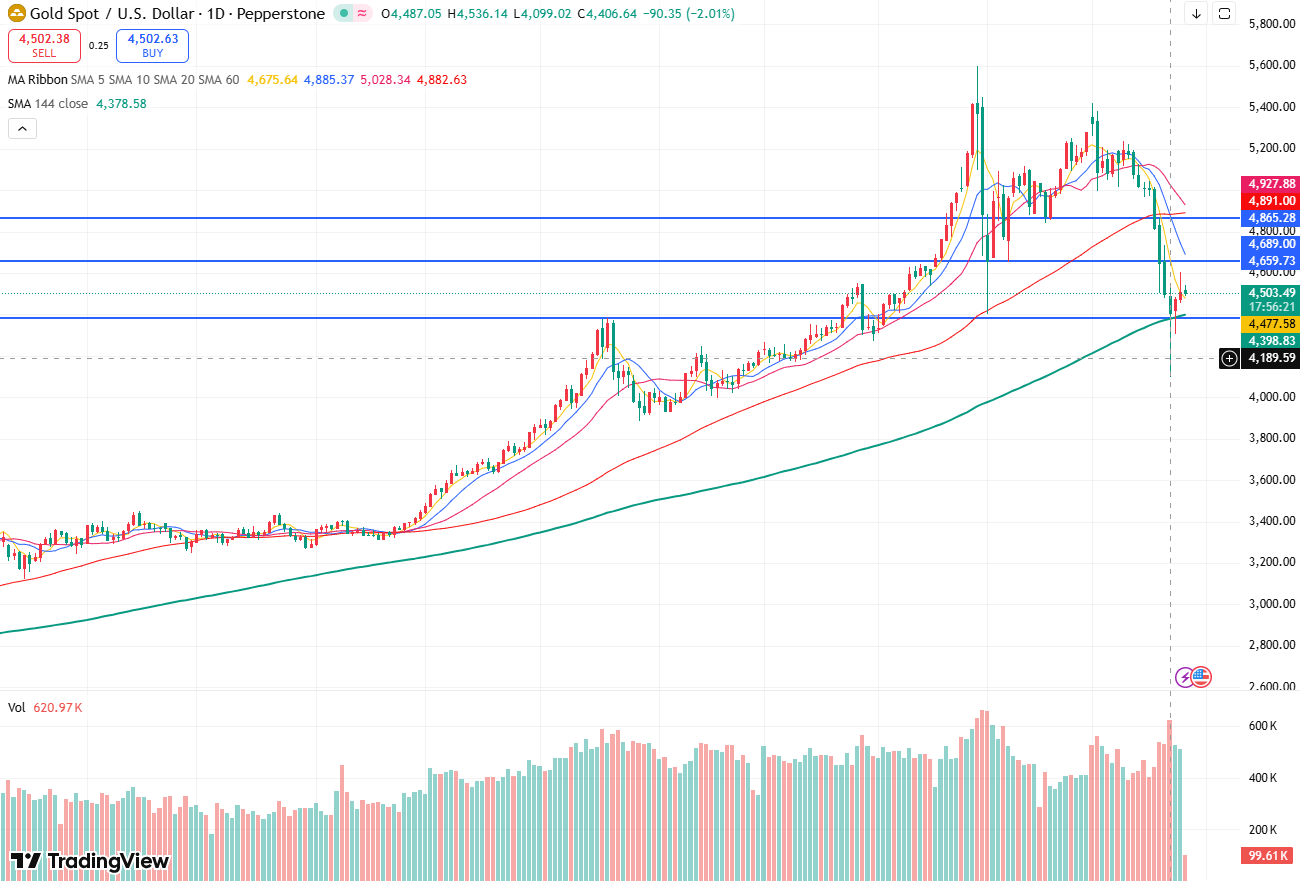
At the same time, gold has been repeatedly hedged by safe-haven demand against expectations of high interest rates. On March 23, gold prices once fell 9.6% from their intraday high, ultimately closing down 2.01% at $4,406.64. If the US-Iran situation deteriorates further without negotiations, gold could move higher again supported by safe-haven demand.
Source: TradingView
Global stock markets are more susceptible to pressure from inflation and yields; in particular, once an energy shock resurfaces, the stock market will first face a valuation correction.
What happens next if actual negotiations are conducted?
Once both sides truly enter substantive negotiations, the market will first trade on the "unwinding of the war premium." In recent days, global stock markets have already reacted to signals of easing tensions; oil prices have fallen, while US, European, and Asian stock markets have rebounded. Meanwhile, the US dollar remains strong, and 10-year Treasury yields have declined.
Reuters noted that investors are buying in because they are starting to bet on a potential cooling of the conflict, rather than simply believing a specific hawkish or dovish statement.
For gold, if negotiations progress and oil prices continue to fall, safe-haven buying will cool. However, if expectations for interest rate cuts do not re-emerge, gold prices may not necessarily rebound significantly immediately and will only slowly recover from extreme volatility.
For the stock market, the easing of energy cost pressures and weakened expectations of rising interest rates are more conducive to a recovery in risk appetite.
More importantly, even if negotiations actually begin, it does not mean there will be immediate results. According to currently disclosed information, control over negotiations within Iran remains in the hands of hardliners, with the Revolutionary Guard's influence on decision-making rising. Israel believes it is difficult for Iran to accept core US requirements, especially regarding the nuclear program, missile program, and regional influence.
There is also a realistic concern in Iran's strategic assessment: it is unwilling to be attacked again after signing an agreement. Therefore, "security guarantees" are not an additional condition in Tehran's eyes, but a prerequisite. This structure determines that even if negotiations begin, the process will likely be slow and full of reversals.
Therefore, the more accurate judgment right now is not that the US and Iran are about to reconcile or that negotiations will definitely fail, but whether both sides have entered a state of "fighting while talking" and "signaling while testing."
For the market, what needs to be watched is not a specific hawkish statement, but three signals: whether intermediary communication escalates to direct contact, whether Iran is willing to include sanctions and security guarantees in the negotiation framework, and whether the US is willing to leave room for exchange on the nuclear and missile issues. As long as these three things do not appear simultaneously, the volatility in oil, gold, and stock markets will not truly end.
Nothing in this material constitutes investment advice, personal recommendation, investment research, an offer, or a solicitation to buy or sell any financial instrument. The content has been prepared without consideration of your individual investment objectives, financial situation, or needs, and should not be treated as such.
Past performance is not a reliable indicator of future performance and/or results. Forward-looking scenarios or forecasts are not a guarantee of future performance. Actual results may differ materially from those anticipated.
Mitrade makes no representation or warranty as to the accuracy or completeness of the information provided and accepts no liability for any loss arising from reliance on such information.
Recommended Articles


