



Gold softens as firm US Dollar, higher yields and rising Fed hike bets weigh
- Gold trades on the defensive as firm US Dollar demand and higher Treasury yields weigh on bullion.
- Rising Oil prices are pushing inflation expectations higher, leading markets to price in a greater chance of a Fed rate hike later this year.
- Technically, XAU/USD remains under pressure as sellers defend the 50-day and 100-day SMAs.
Gold (XAU/USD) trades on the back foot on Tuesday as traders closely monitor developments surrounding the US-Iran negotiations and amid a broad macroeconomic background linked to the prolonged conflict that continues to weigh on the precious metal. At the time of writing, XAU/USD is trading around $4,544, hovering near the one-and-a-half-month low of $4,480 touched on Monday.
US President Donald Trump said on Monday that he had halted an immediate planned military attack on Iran after requests from Gulf leaders to allow peace negotiations to continue. In a post on Truth Social, Trump said ongoing negotiations could lead to a deal that would be “very acceptable” for the United States and the Middle East, adding that the agreement would ensure “no nuclear weapons for Iran.”
However, Trump also warned that he had instructed the US military to remain prepared for a “full, large-scale assault” on Iran at a moment’s notice if an acceptable agreement is not reached.
Investors remained cautious over whether a lasting peace deal could actually be reached as disagreements over Iran’s nuclear programme continue to complicate negotiations.
While geopolitical uncertainty would typically support bullion, Gold remains down nearly 15% since the war began, as markets increasingly focus on the inflationary impact of surging Oil prices amid the continued disruptions around the Strait of Hormuz.
Higher crude Oil prices are already pushing inflation higher across major economies, reinforcing expectations that central banks, particularly the US Federal Reserve (Fed), may need to raise interest rates. According to the CME FedWatch Tool, traders are now pricing in nearly a 50% probability that, by the end of the year, the Fed will have increased rates by at least 25 basis points. This is a significant increase compared with the 35% probability seen a week ago.
Rising inflation concerns have triggered a broad sell-off in global bond markets in recent days, pushing sovereign bond yields sharply higher. On Tuesday, the benchmark US 10-year Treasury yield hovers near 4.60%, close to its highest level in one year.
Elevated Treasury yields increase the opportunity cost of holding non-yielding assets such as Gold.
Meanwhile, the US Dollar (USD) remains supported by hawkish Fed expectations and persistent uncertainty surrounding the US-Iran talks, further limiting upside momentum in bullion by making the precious metal more expensive for foreign buyers.
Looking ahead, a relatively quiet US economic calendar on Tuesday leaves markets focused on Fed commentary and upcoming releases, including the Fed meeting minutes on Wednesday, preliminary May Purchasing Managers Index (PMI) data on Thursday and the University of Michigan Consumer Sentiment survey on Friday.
Technical Analysis: XAU/USD bearish bias intact as RSI softens and ADX signals weak trend
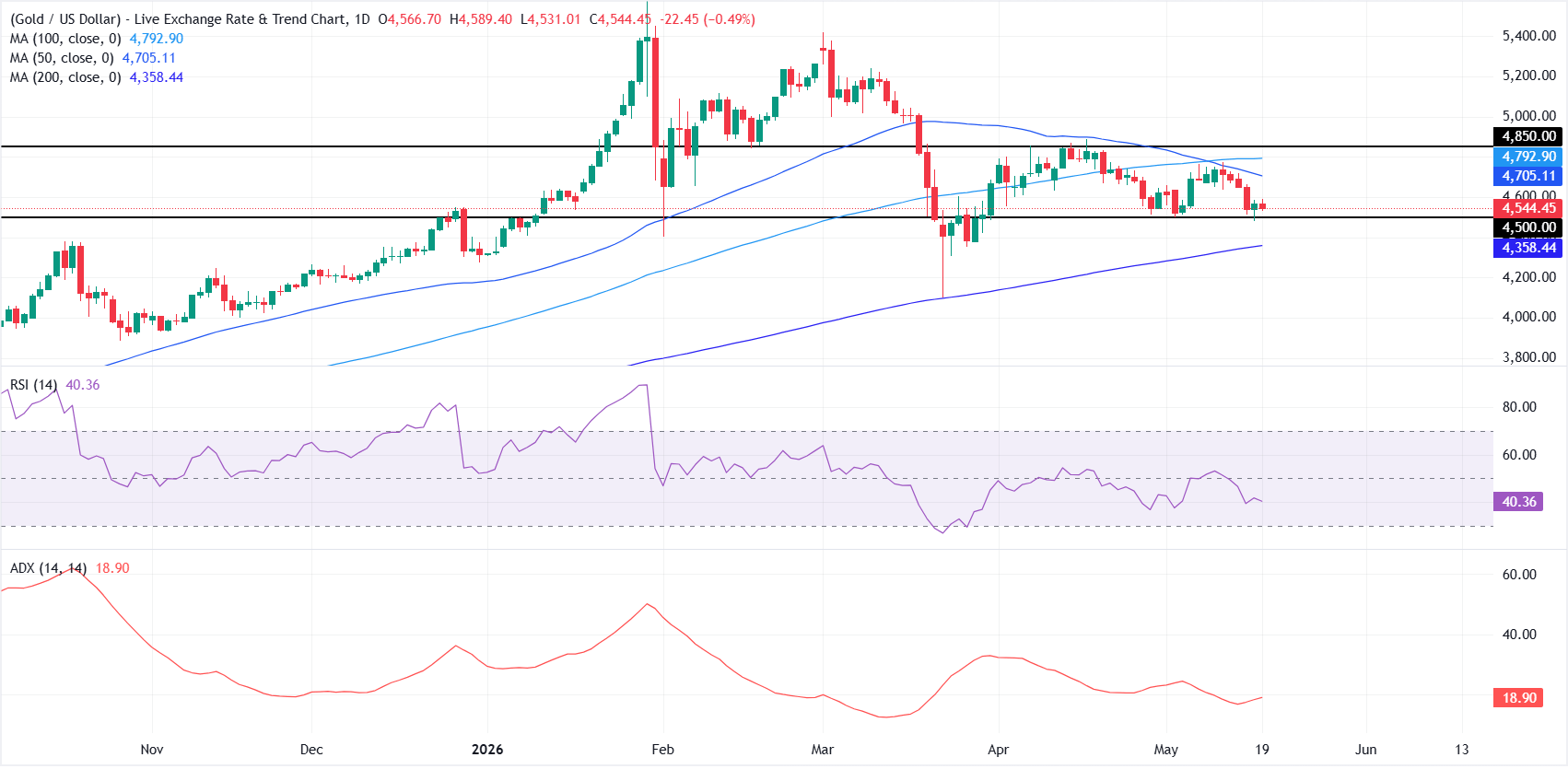
On the daily chart, XAU/USD holds a soft bearish bias, trading below the nearer-term moving averages while staying well above the longer-term trend floor. The 200-day Simple Moving Average (SMA) at $4,358 sits comfortably underneath the price and suggests the broader uptrend remains intact.
The Relative Strength Index (RSI) is around 40 points, indicating waning bullish momentum without oversold conditions, while the Average Directional Index (ADX) is near 19, hinting at a weak, consolidative trend rather than a strong directional move.
On the topside, initial resistance is aligned at the 50-day SMA near $4,705, followed by the 100-day SMA around $4,793, with a stronger barrier further up at the horizontal resistance zone near $4,850.
On the downside, immediate protection is seen around the nearby horizontal support at $4,500, ahead of the more substantial medium-term demand area at the 200-day SMA near $4,358. A clear break below this latter level would significantly deepen the bearish tone, while recovery above the clustered short- and medium-term SMAs would ease downside pressure.
(The technical analysis of this story was written with the help of an AI tool.)
Gold FAQs
Gold has played a key role in human’s history as it has been widely used as a store of value and medium of exchange. Currently, apart from its shine and usage for jewelry, the precious metal is widely seen as a safe-haven asset, meaning that it is considered a good investment during turbulent times. Gold is also widely seen as a hedge against inflation and against depreciating currencies as it doesn’t rely on any specific issuer or government.
Central banks are the biggest Gold holders. In their aim to support their currencies in turbulent times, central banks tend to diversify their reserves and buy Gold to improve the perceived strength of the economy and the currency. High Gold reserves can be a source of trust for a country’s solvency. Central banks added 1,136 tonnes of Gold worth around $70 billion to their reserves in 2022, according to data from the World Gold Council. This is the highest yearly purchase since records began. Central banks from emerging economies such as China, India and Turkey are quickly increasing their Gold reserves.
Gold has an inverse correlation with the US Dollar and US Treasuries, which are both major reserve and safe-haven assets. When the Dollar depreciates, Gold tends to rise, enabling investors and central banks to diversify their assets in turbulent times. Gold is also inversely correlated with risk assets. A rally in the stock market tends to weaken Gold price, while sell-offs in riskier markets tend to favor the precious metal.
The price can move due to a wide range of factors. Geopolitical instability or fears of a deep recession can quickly make Gold price escalate due to its safe-haven status. As a yield-less asset, Gold tends to rise with lower interest rates, while higher cost of money usually weighs down on the yellow metal. Still, most moves depend on how the US Dollar (USD) behaves as the asset is priced in dollars (XAU/USD). A strong Dollar tends to keep the price of Gold controlled, whereas a weaker Dollar is likely to push Gold prices up.
Nothing in this material constitutes investment advice, personal recommendation, investment research, an offer, or a solicitation to buy or sell any financial instrument. The content has been prepared without consideration of your individual investment objectives, financial situation, or needs, and should not be treated as such.
Past performance is not a reliable indicator of future performance and/or results. Forward-looking scenarios or forecasts are not a guarantee of future performance. Actual results may differ materially from those anticipated.
Mitrade makes no representation or warranty as to the accuracy or completeness of the information provided and accepts no liability for any loss arising from reliance on such information.
Recommended Articles


