



WTI Crude Falls Below $80, Slumping 5% Intraday. Trump Says US-Iran Deal Soon to Be Signed, Will Oil Price Uptrend End?
TradingKey - As of the European session today (June 15), the crude oil market plummeted intraday, driven by the imminent signing of a peace agreement in US-Iran negotiations. WTI ( USOIL) crude briefly fell below the $80 mark, with its decline exceeding 5%, while Brent crude's drop once surpassed 4%.
Whether a US-Iran agreement is successfully signed could mark a turning point for oil price trends.
From a fundamental perspective, Trump's latest remarks regarding U.S.-Iran negotiations served as the catalyst for the decline in the crude oil market.
According to the latest reports, Trump stated that a U.S.-Iran deal is essentially finalized and will be officially signed this Friday (June 19); the agreement will include ending military conflicts, lifting blockades on Iranian ports, and facilitating the reopening of the Strait of Hormuz. For the crude oil market, the Strait of Hormuz is one of the world's most critical energy transit corridors. Once the passage is restored, the risk premiums previously driven by transportation disruptions, rising insurance costs, tanker rerouting, and supply concerns will rapidly recede.
Subsequently, Iranian officials stated that both parties have reached an agreement on the text of a memorandum of understanding, adding that negotiations on broader issues—including sanctions, asset releases, and nuclear arrangements—will continue during the ceasefire window. However, Iran did not signal a posture of total concession, emphasizing instead that the deal must align with its own interests and that the restoration of the Strait of Hormuz may proceed according to its own schedule.
Investors should focus on whether the U.S.-Iran deal can actually be signed. If the agreement is successfully signed on June 19 with clear details—including the scope of the ceasefire, a timetable for reopening shipping lanes, steps for lifting port blockades, and a mechanism for subsequent nuclear negotiations—then oil prices may have further room to move lower.
Conversely, if there are reversals before the signing—such as Iran perceiving the text as being unilaterally interpreted by the U.S., or resistance emerging from the U.S. Congress, Israel, or Lebanon, leading to delays or vague terms—then oil prices are likely to see a rapid rebound.
WTI Crude Oil Price Analysis: $79 Mark Becomes the Critical Line for Bulls
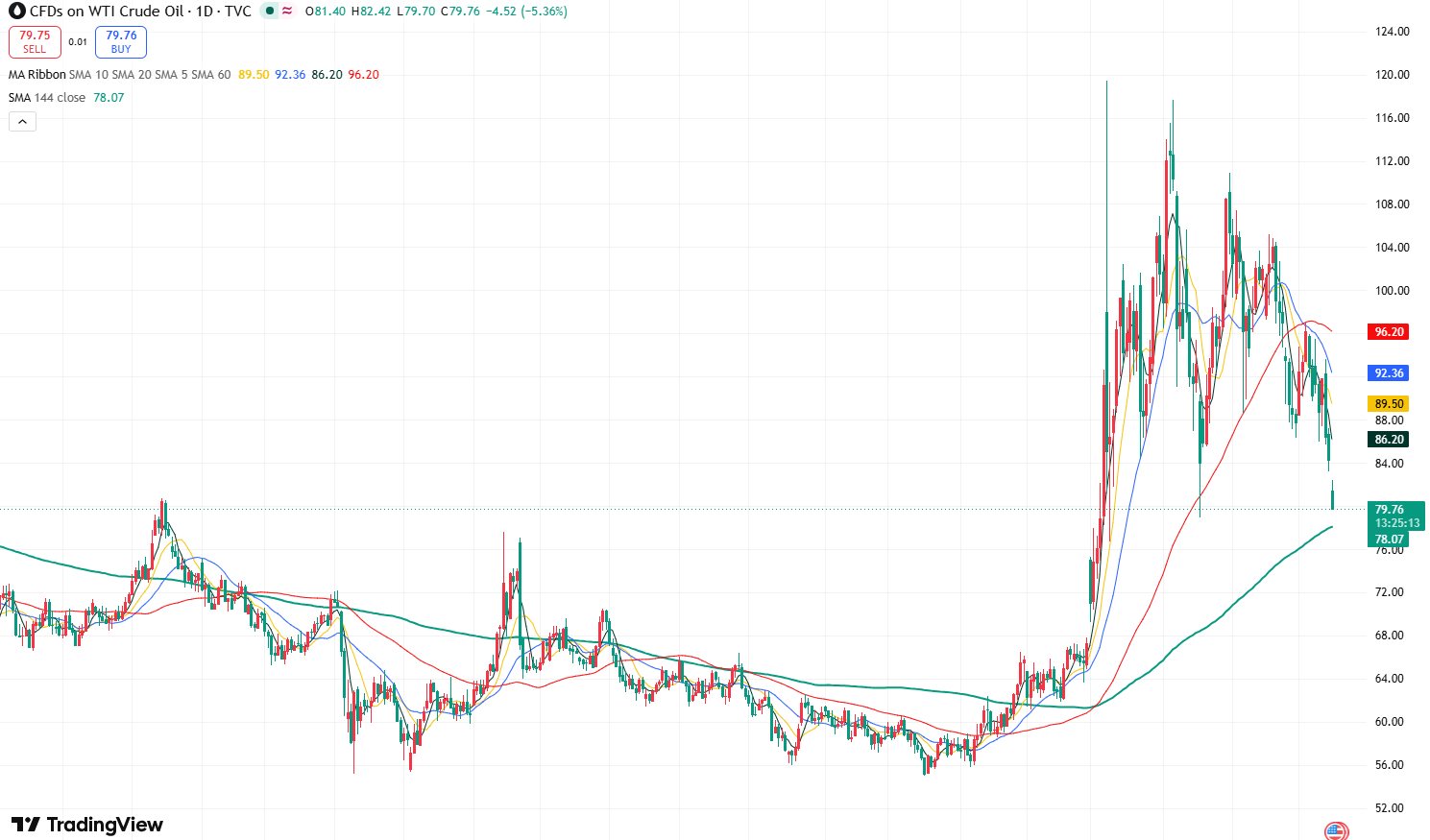
WTI Crude Oil Price Daily Chart, Source: TradingView
According to the WTI crude oil daily chart, WTI opened with a gap down today and continued to trend lower, briefly breaking below the $80 mark intraday. This indicates that the market is being driven by news, leading to panic selling by investors and an overall bearish market sentiment. However, it is worth noting that WTI prices have not fallen below the low of $78.97 set on April 17, nor have they broken below the 144-day moving average, suggesting that support remains intact below.
Currently, if WTI prices break below $79.00, the downside room for oil prices will open further, with the potential to test the $70.00 level or even move lower to fill the March gap of $67.20-$71.00.
Conversely, if WTI prices show signs of stabilizing above $79.00, short-term bearish momentum will be weakened, and oil prices may see a technical corrective rebound. The primary target would likely be to fill today's gap between $81.40 and $84.30.
Nothing in this material constitutes investment advice, personal recommendation, investment research, an offer, or a solicitation to buy or sell any financial instrument. The content has been prepared without consideration of your individual investment objectives, financial situation, or needs, and should not be treated as such.
Past performance is not a reliable indicator of future performance and/or results. Forward-looking scenarios or forecasts are not a guarantee of future performance. Actual results may differ materially from those anticipated.
Mitrade makes no representation or warranty as to the accuracy or completeness of the information provided and accepts no liability for any loss arising from reliance on such information.
Recommended Articles


