



Sui bets on gasless stablecoin transfers to transform payments
- Sui launches gasless transfers, enabling users and businesses to send stablecoins without paying protocol gas fees.
- Sui’s new feature aligns with the network’s push to build infrastructure for scalable finance and global payments.
- Sui extends its rebound above $1.00, with the 100-day EMA offering immediate support.
Sui Network (SUI), a Layer-1 protocol, launched a new feature that supports gasless stablecoin transfers. The feature enables users and businesses to send supported stablecoins without paying gas fees or maintaining a separate SUI token balance.
Sui’s gasless stablecoin transfers revolutionize payments
The launch, supported by Fireblocks, a platform that provides access to institutional-grade digital financial services including custody and stablecoin scaling, is part of Sui’s broader mission to build infrastructure for scalable finance and global payments.
Sui stated on Wednesday that the move aims to remove a significant bottleneck in blockchain-based payments, where users must hold a separate gas token to move assets on-chain. Sui has removed that complexity, allowing supported stablecoins to function as standalone payment assets for wallet-to-wallet transfers while nurturing a more intuitive payment environment for users, businesses and developers.
The gasless stablecoin transfers are powered by Address Balances, a new digital balance system set to launch on the Sui Mainnet.
Adeniyi Abiodun, co-founder of Mysten Labs, an original contributor to Sui, stated that “Stablecoins are becoming a core part of global finance, but the infrastructure around them still creates unnecessary complexity for users and businesses.”
The signing of the United States (US) GENIUS Act into law in 2025 marked a major boost for stablecoins, accelerating adoption among institutions and traditional finance players such as banks.
Stablecoins boast roughly $320 billion in total market capitalization, led by Tether’s USDT and Circle’s USDC.
The US Senate Banking Committee recently advanced the Clarity Act to a full floor vote following months of stalling after stakeholders in the traditional banking sector raised concerns with interest paid on deposits. While the GENIUS Act focused specifically on stablecoin issuance, the Clarity Act provides a comprehensive market structure to regulate digital assets, including the US Dollar-pegged coins.
“The Clarity Act is not law yet, and the political process still matters. But its progress is a signal that crypto is moving from regulatory argument to financial infrastructure. That is why the market is paying attention,” Bitpace CEO, Anil Oncu, said in a written comment to FXStreet.
Price analysis: Sui tests recovery strength
Sui trades at $1.09, holding just above a cluster of medium-term supports, which keeps the near-term tone neutral with a slight constructive bias. The price stands over both the 100-day Exponential Moving Average (EMA) at $1.08 and the 50-day EMA at $1.03, suggesting dip-buying interest while the broader trend remains capped by higher retracement and long-term EMA barriers overhead.
The Relative Strength Index (RSI) near 54 hints at modest positive momentum on the daily chart, though the Moving Average Convergence Divergence (MACD) histogram remains below zero with a negative histogram, signaling that upside traction is still tentative.
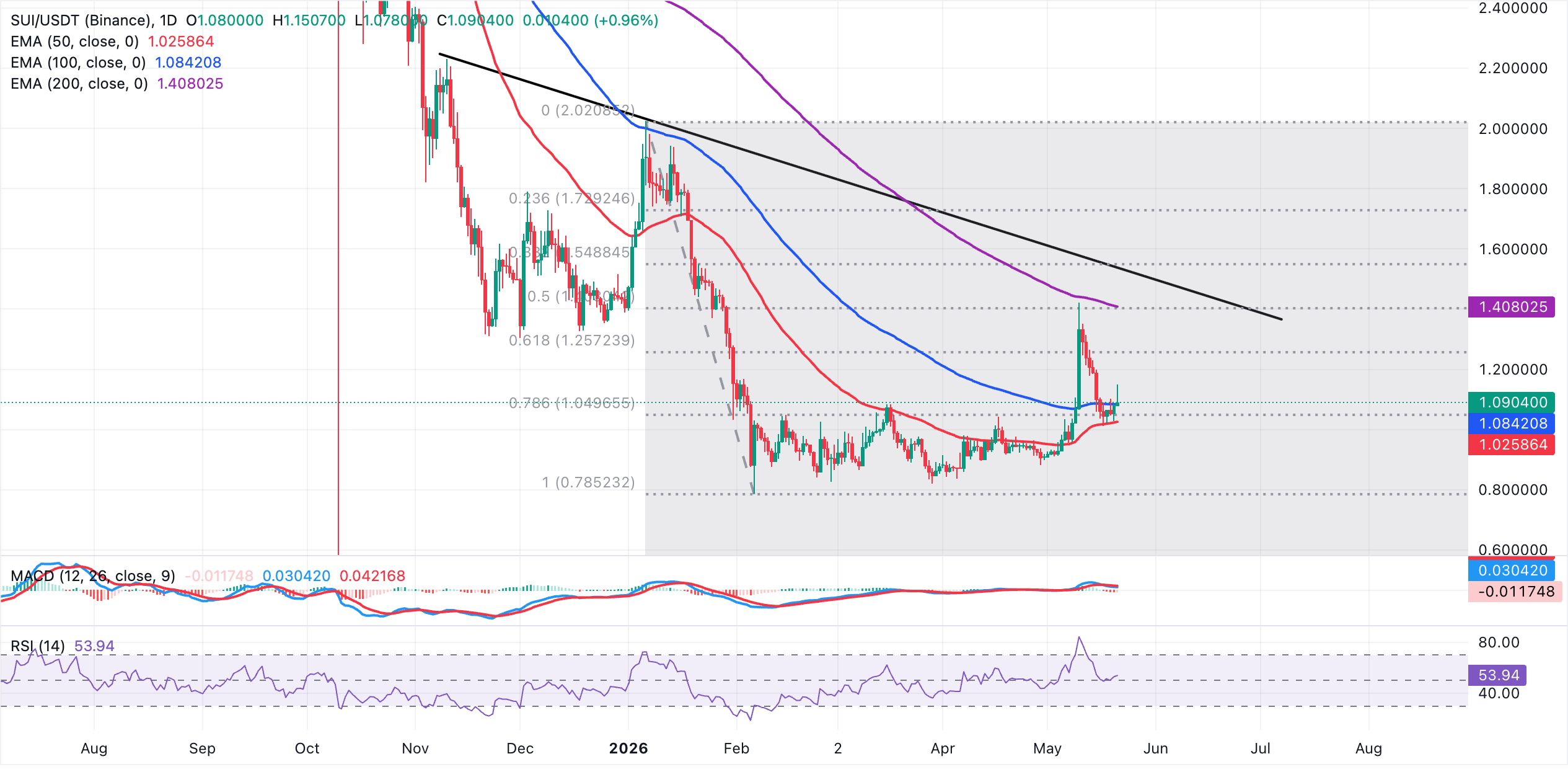
On the downside, immediate support is seen at the 100-day EMA at $1.08, followed by the 78.6% Fibonacci retracement at $1.05 and the 50-day EMA near $1.03. A daily close below this cluster would expose the prior cycle low region around the 100% Fibonacci retracement at $0.80. On the topside, the next meaningful resistance lies at the 61.8% Fibonacci retracement at $1.26, ahead of a dense barrier zone defined by the 50% Fibonacci retracement at $1.40, the 200-day EMA at $1.41, and the descending trendline around $1.54.
(The technical analysis of this story was written with the help of an AI tool.)
Bitcoin, altcoins, stablecoins FAQs
Bitcoin is the largest cryptocurrency by market capitalization, a virtual currency designed to serve as money. This form of payment cannot be controlled by any one person, group, or entity, which eliminates the need for third-party participation during financial transactions.
Altcoins are any cryptocurrency apart from Bitcoin, but some also regard Ethereum as a non-altcoin because it is from these two cryptocurrencies that forking happens. If this is true, then Litecoin is the first altcoin, forked from the Bitcoin protocol and, therefore, an “improved” version of it.
Stablecoins are cryptocurrencies designed to have a stable price, with their value backed by a reserve of the asset it represents. To achieve this, the value of any one stablecoin is pegged to a commodity or financial instrument, such as the US Dollar (USD), with its supply regulated by an algorithm or demand. The main goal of stablecoins is to provide an on/off-ramp for investors willing to trade and invest in cryptocurrencies. Stablecoins also allow investors to store value since cryptocurrencies, in general, are subject to volatility.
Bitcoin dominance is the ratio of Bitcoin's market capitalization to the total market capitalization of all cryptocurrencies combined. It provides a clear picture of Bitcoin’s interest among investors. A high BTC dominance typically happens before and during a bull run, in which investors resort to investing in relatively stable and high market capitalization cryptocurrency like Bitcoin. A drop in BTC dominance usually means that investors are moving their capital and/or profits to altcoins in a quest for higher returns, which usually triggers an explosion of altcoin rallies.
Nothing in this material constitutes investment advice, personal recommendation, investment research, an offer, or a solicitation to buy or sell any financial instrument. The content has been prepared without consideration of your individual investment objectives, financial situation, or needs, and should not be treated as such.
Past performance is not a reliable indicator of future performance and/or results. Forward-looking scenarios or forecasts are not a guarantee of future performance. Actual results may differ materially from those anticipated.
Mitrade makes no representation or warranty as to the accuracy or completeness of the information provided and accepts no liability for any loss arising from reliance on such information.
Recommended Articles


