



Dow Jones Industrial Average rides an Iran peace bid, but Nvidia holds the real verdict
- DJIA futures sagged under a punishing bond selloff before ripping back to the session highs after Trump said the US was in the final stages of talks with Iran.
- The peace signal did the heavy lifting across assets at once, knocking Oil and the US Dollar lower and, crucially, pulling Treasury yields down from multi-year highs.
- Those cooling yields matter more than the equity bounce, since a long-end blowout, with the 30-year at its highest since 2007, had been the main thing pressuring stocks.
- Nvidia reports after the close and FOMC minutes drop earlier in the session, so a bid built on one Iran headline still has to survive the night.
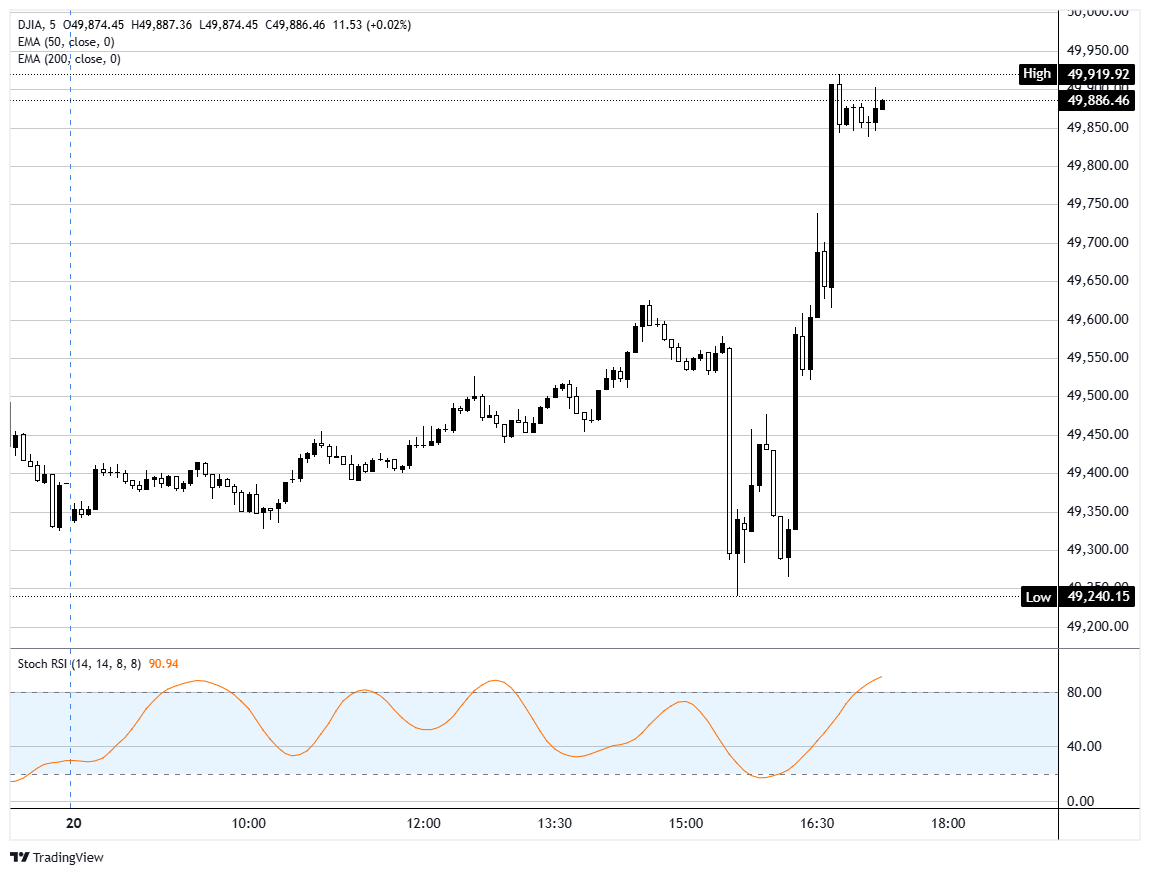
The Dow spent Wednesday hostage to two things it cannot control, the bond market and an Iran headline, and by the time of writing, the headline had won. Futures had been grinding lower under the weight of a vicious selloff in long-dated Treasuries, then turned on a dime and ripped back toward the session highs near 49,900 after President Donald Trump told reporters the US was in the final stages of negotiations with Iran. The remark, which crossed around 15:15 GMT, did in a single line what days of range-trading could not, knocking the geopolitical risk premium out of several markets simultaneously. Whether it deserves that much credit is another question entirely.
One headline, four markets
This was a textbook de-escalation trade, and the cross-asset confirmation was clean. Oil rolled over, with West Texas Intermediate (WTI) and Brent both pulling back as the supply-shock premium bled out. The US Dollar softened. Most importantly, Treasury yields cooled hard, with the 10-year shedding around 9 basis points and the 30-year about 7, a meaningful unwind given how stretched the long end had become. Earlier reports that crude was still moving through the Strait of Hormuz, roughly 6 million barrels by one account, had already nudged the peace narrative along, as had chatter that a Pakistani-brokered agreement text could be unveiled within a day. The Trump comment simply lit the fuse.
The bond market is the real story
Strip away the Iran noise and the thing actually driving equities this week has been the long end of the curve. The 30-year yield had climbed to its highest since 2007 and the 10-year was knocking on multi-year highs, both powered by a growing fear that oil-fed inflation is reigniting and that the Federal Reserve (Fed), about to pass to Kevin Warsh, is already behind the curve. That is the channel that matters. When yields scream higher they threaten an economy already squeezed by energy costs, and stocks wear it. So the afternoon relief in equities was really a relief in bonds wearing an equity costume, which is precisely why it is fragile. The inflation problem underneath does not vanish because a politician reached for the words final stages.
Why the skepticism is earned
Markets have been here before, repeatedly. This is the same conflict whose ceasefire was written off as near-worthless only days ago, whose counteroffers have been rejected more than once, and whose imminent-deal headlines have a habit of dissolving by the next session. Buying the de-escalation is rational on the day, and the cross-asset move proves traders took it seriously, but treating one pool-report soundbite as the end of a war that has run since late February is a leap the tape keeps making and the calendar keeps punishing. The honest read is that this is a tradable headline, not a resolution.
What to watch into the close
Nvidia (NVDA) reports after the closing bell, and it is the only catalyst tonight that can override the Iran story. Shares were up around 2% into the print, and strategists frame it as the single most important read on the entire artificial intelligence (AI) trade, with expectations described as relatively muted after the stock's enormous multi-year run. The things to watch are any sign of margin pressure from rising memory prices and how the company is handling sales into China. Minutes from the late-April Federal Open Market Committee (FOMC) meeting land earlier and are worth a read for how seriously officials are treating the energy-inflation problem. On the chart, the 49,250 low is the line that matters, with the 49,350 to 49,400 shelf as the first support above it. Hold those and the peace-hope bid stays alive, reclaim and hold 50K and a strong Nvidia print could extend it, lose 49,250 and the market is telling you it never believed the headline in the first place. The Dow bought the peace. Nvidia decides whether it gets to keep it.
Dow Jones 5-minute chart
Dow Jones FAQs
The Dow Jones Industrial Average, one of the oldest stock market indices in the world, is compiled of the 30 most traded stocks in the US. The index is price-weighted rather than weighted by capitalization. It is calculated by summing the prices of the constituent stocks and dividing them by a factor, currently 0.152. The index was founded by Charles Dow, who also founded the Wall Street Journal. In later years it has been criticized for not being broadly representative enough because it only tracks 30 conglomerates, unlike broader indices such as the S&P 500.
Many different factors drive the Dow Jones Industrial Average (DJIA). The aggregate performance of the component companies revealed in quarterly company earnings reports is the main one. US and global macroeconomic data also contributes as it impacts on investor sentiment. The level of interest rates, set by the Federal Reserve (Fed), also influences the DJIA as it affects the cost of credit, on which many corporations are heavily reliant. Therefore, inflation can be a major driver as well as other metrics which impact the Fed decisions.
Dow Theory is a method for identifying the primary trend of the stock market developed by Charles Dow. A key step is to compare the direction of the Dow Jones Industrial Average (DJIA) and the Dow Jones Transportation Average (DJTA) and only follow trends where both are moving in the same direction. Volume is a confirmatory criteria. The theory uses elements of peak and trough analysis. Dow’s theory posits three trend phases: accumulation, when smart money starts buying or selling; public participation, when the wider public joins in; and distribution, when the smart money exits.
There are a number of ways to trade the DJIA. One is to use ETFs which allow investors to trade the DJIA as a single security, rather than having to buy shares in all 30 constituent companies. A leading example is the SPDR Dow Jones Industrial Average ETF (DIA). DJIA futures contracts enable traders to speculate on the future value of the index and Options provide the right, but not the obligation, to buy or sell the index at a predetermined price in the future. Mutual funds enable investors to buy a share of a diversified portfolio of DJIA stocks thus providing exposure to the overall index.
Nothing in this material constitutes investment advice, personal recommendation, investment research, an offer, or a solicitation to buy or sell any financial instrument. The content has been prepared without consideration of your individual investment objectives, financial situation, or needs, and should not be treated as such.
Past performance is not a reliable indicator of future performance and/or results. Forward-looking scenarios or forecasts are not a guarantee of future performance. Actual results may differ materially from those anticipated.
Mitrade makes no representation or warranty as to the accuracy or completeness of the information provided and accepts no liability for any loss arising from reliance on such information.
Recommended Articles


