



The US Dollar Index sits still through two hawkish speeches
- DXY holds just above 99.00, unchanged on its tightest range in weeks.
- Spot sits 2.6% beneath the June peak with both moving averages overhead.
- Jackson Hole keynote at 14:00 GMT Friday, prepared text, no questions taken.
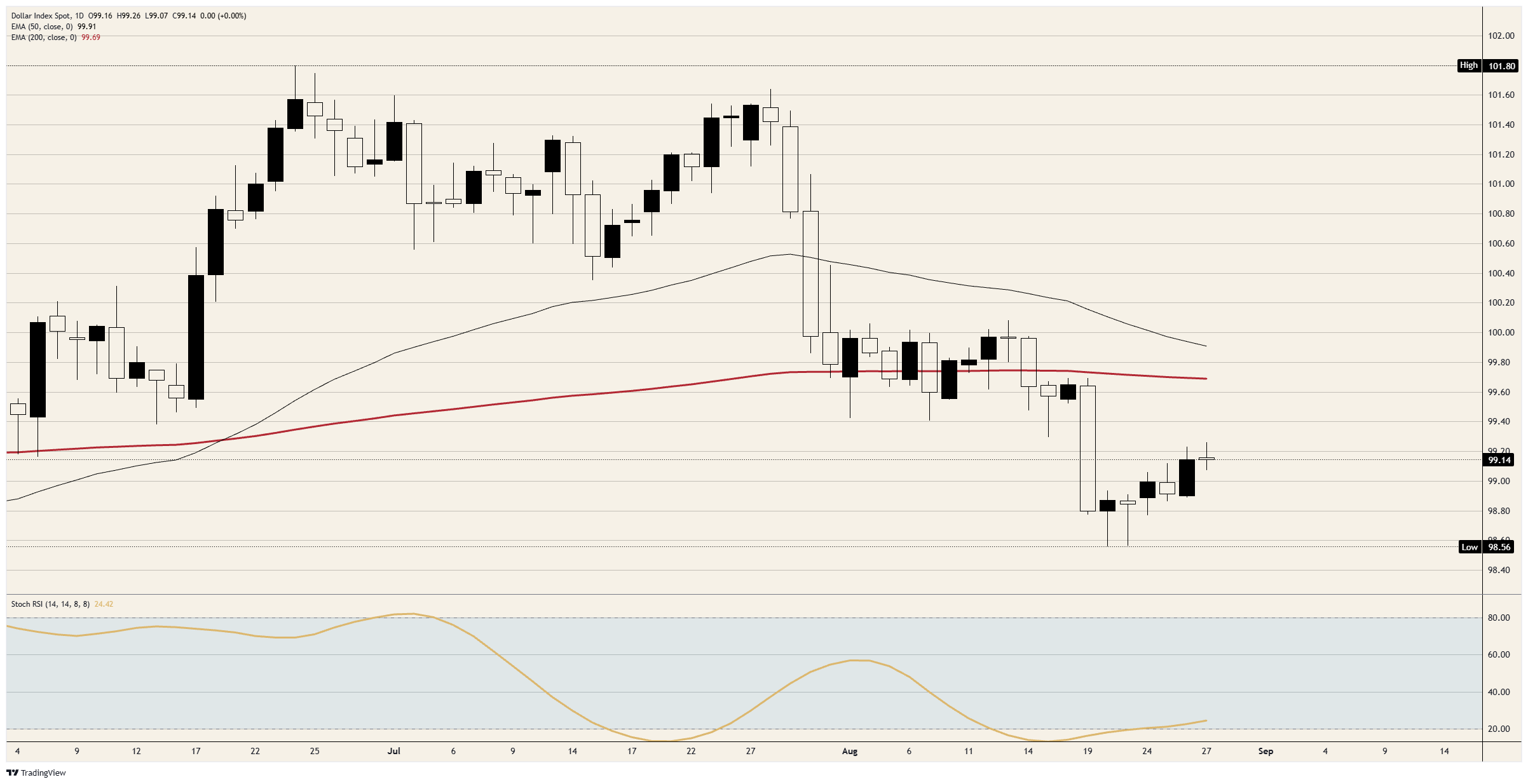
The US Dollar Index trades just above 99.00 on Thursday, unchanged on the session across a range of less than a fifth of a point. That sits roughly 2.6% beneath the June peak just under 102.00 and beneath a rolling 50-day Exponential Moving Average (EMA) near 100.00 and a flat 200-day near 99.75. Three policymakers reached the wires from Jackson Hole before the New York open, two of them scored hawkish on the calendar, and none of them moved the basket a tick.
Sold on the hawkish outcome, sold on the dovish one
The July 29 decision was the most hawkish result of this chairmanship, a fifth consecutive hold decided nine to three with the first dissents of the term, all of them from regional presidents wanting an immediate quarter point. That is the textbook currency-positive surprise. The index broke close to 1.7 points in the session that followed, from just beneath 101.50 into the 99.75 area, by a wide margin the largest daily move on the summer window, and it has not taken any of it back in the month since.
The August 19 leg went the other way and produced the same result. The Treasury doubled the ceiling on its long-end buyback operations, the thirty-year gave back more than nine basis points, and the index broke again to just above 98.50 the following day, its weakest since May. Higher yields did not bid this currency and the relief on those yields did not bid it either, which rules out the rate path as the thing being traded.
The seller of the bond is the seller of the currency
What did the running in the long end was the real yield rather than inflation compensation. Of the 67 basis points the thirty-year added between late February and mid-August, 63 are real and four are breakeven, so roughly 94% of the move is the price of capital. A rising real yield is meant to be the cleanest carry argument a currency can be handed, and this one has been handed it for six months.
The flow explains why it does not land. June foreign holdings of Treasuries fell 72.1 billion Dollars, with Japan trimming 26.4 billion while defending its own currency and China 25.9 billion, close to three quarters of the decline between two holders. A foreign holder selling the bond and taking the proceeds home lifts the yield and sells the Dollar in the same transaction. On that arithmetic the yield is a premium being charged rather than carry being offered, and the currency is on the paying side of it.
The other side of the basket is not helping
The index is a basket before it is a Dollar view, and the Euro carries close to 58% of it. The Euro area composite Purchasing Managers Index (PMI) printed 52.1 in August, the strongest reading since November, against a European Central Bank that has already moved its deposit rate to 2.25% and shows no sign of walking it back. The Yen carries close to 14% and swaps price roughly an 80% chance of a Bank of Japan increase on September 18.
Both of the index's largest weights therefore sit behind central banks still leaning toward tightening, while the Fed's own tightening is being administered by the bond market and then partly reversed by the fiscal authority. A committee that will not move and an issuer that steps in when the market does is a poor combination for the denominator of a currency pair. That is a structural drag no single speech resolves.
Friday puts two red bands in one minute
Friday at 14:00 GMT carries the Fed Chair's first Jackson Hole keynote, delivered as prepared text with no questions taken and set against a symposium theme of financial innovation in payments rather than the policy path. The same minute brings the preliminary estimate of the annual benchmark revision to the establishment survey, the exercise that has taken 818K and then 911K off the payroll level in the past two rounds. Around them the Chicago PMI lands at 13:45 GMT with a 57 consensus from 57.6 prior, and the final August Michigan readings follow at 14:00, sentiment 51 and expectations 50.6, each matching the preliminary.
Positioning going in leans toward a neutral tone, and web-sourced pricing puts a September increase near one chance in three. The risk is not that the keynote reads hawkish or dovish but that it addresses payments rails and says nothing at all about the question this currency is actually asking, which is who sets the price of US duration when the committee declines to and the issuer volunteers.
Levels
Resistance: The moving-average band between 99.75 and the 100.00 handle is the first barrier and it is also the shelf lost on August 19, so a reclaim would take back the whole buyback break. Above it the July range floor near 100.50 and the June peak just under 102.00.
Support: The 99.00 handle is the immediate line, then just above 98.50 where the August 20 low sits, with nothing structural beneath that until the spring base.
Bias: Bearish while the 99.75 to 100.00 band caps. The daily Stochastic Relative Strength Index (Stoch RSI) near 24 is turning up out of oversold, which prices a bounce rather than a base while the 50-day EMA rolls over toward the 200-day. Invalidation on a daily close above 100.00.
DXY daily chart
US Dollar FAQs
The US Dollar (USD) is the official currency of the United States of America, and the ‘de facto’ currency of a significant number of other countries where it is found in circulation alongside local notes. It is the most heavily traded currency in the world, accounting for over 88% of all global foreign exchange turnover, or an average of $6.6 trillion in transactions per day, according to data from 2022. Following the second world war, the USD took over from the British Pound as the world’s reserve currency. For most of its history, the US Dollar was backed by Gold, until the Bretton Woods Agreement in 1971 when the Gold Standard went away.
The most important single factor impacting on the value of the US Dollar is monetary policy, which is shaped by the Federal Reserve (Fed). The Fed has two mandates: to achieve price stability (control inflation) and foster full employment. Its primary tool to achieve these two goals is by adjusting interest rates. When prices are rising too quickly and inflation is above the Fed’s 2% target, the Fed will raise rates, which helps the USD value. When inflation falls below 2% or the Unemployment Rate is too high, the Fed may lower interest rates, which weighs on the Greenback.
In extreme situations, the Federal Reserve can also print more Dollars and enact quantitative easing (QE). QE is the process by which the Fed substantially increases the flow of credit in a stuck financial system. It is a non-standard policy measure used when credit has dried up because banks will not lend to each other (out of the fear of counterparty default). It is a last resort when simply lowering interest rates is unlikely to achieve the necessary result. It was the Fed’s weapon of choice to combat the credit crunch that occurred during the Great Financial Crisis in 2008. It involves the Fed printing more Dollars and using them to buy US government bonds predominantly from financial institutions. QE usually leads to a weaker US Dollar.
Quantitative tightening (QT) is the reverse process whereby the Federal Reserve stops buying bonds from financial institutions and does not reinvest the principal from the bonds it holds maturing in new purchases. It is usually positive for the US Dollar.
Nothing in this material constitutes investment advice, personal recommendation, investment research, an offer, or a solicitation to buy or sell any financial instrument. The content has been prepared without consideration of your individual investment objectives, financial situation, or needs, and should not be treated as such.
Past performance is not a reliable indicator of future performance and/or results. Forward-looking scenarios or forecasts are not a guarantee of future performance. Actual results may differ materially from those anticipated.
Mitrade makes no representation or warranty as to the accuracy or completeness of the information provided and accepts no liability for any loss arising from reliance on such information.
Recommended Articles


