



US Dollar Index Price Forecast: Struggles to extend rally beyond 61.8% Fibo retracement at 104.65
- The US Dollar regains ground after a corrective move on Tuesday.
- Investors keenly await the US PCE Inflation data for October.
- The US headline and core PCE are seen higher at 3.8% and 3.2% YoY, respectively.
The US Dollar (USD) bounces back against its major peers on Wednesday after a corrective move the previous day. As of writing, the US Dollar Index (DXY), which gauges the Greenback’s value against six major currencies, trades 0.2% higher to near 104.05.
The DXY rebounds as investors turn cautious ahead of the United States (US) Personal Consumption Expenditure (PCE) Price Index data for October, which will be published at 13:30 GMT.
Dollar focus turns to October PCE as inflation gauges seen edging higher
Analysts at Commerzbank note that attention is now firmly on the October PCE release, with the bank highlighting that “the Bloomberg consensus expects headline PCE inflation to pick up to 3.8% yoy from 3.6% in September.” They add that the underlying trend is also expected to firm slightly, as “the core PCE deflator is expected at 3.2% yoy from 3.1% previously,” underscoring market expectations for a modest re-acceleration in the Fed’s preferred inflation gauges.
The US PCE inflation is expected to have a significant influence on Federal Reserve’s (Fed) interest rate expectations. Currently, the CME FedWatch tool shows traders are confident that the Fed will hike interest rates in the December policy meeting.
US Dollar Index Technical Analysis
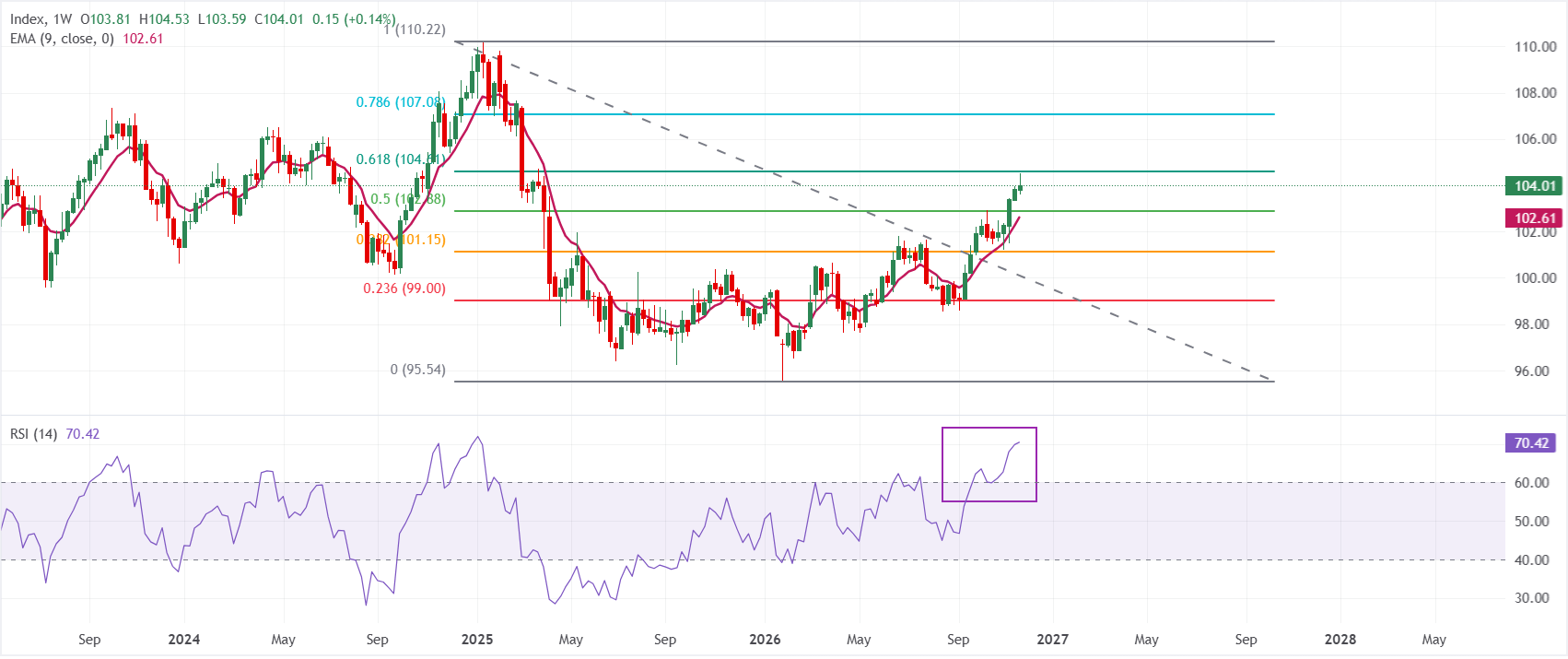
In the weekly chart, Dollar Index Spot trades at 104.01. The index holds above both the 9-week exponential moving average (EMA) at 102.61 and the 50.0% Fibonacci retracement at 102.88, keeping the near‑term bias bullish while it probes higher into the upper half of the recent range. The Relative Strength Index (14) at 70.42 has entered overbought territory, which hints that upside momentum is strong but also that the advance risks becoming stretched near the next Fibonacci barriers.
On the topside, immediate resistance is clustered at the 61.8% Fibonacci retracement at 104.61, with further hurdles at the 78.6% level near 107.08 and the cycle high area marked by the 100% retracement at 110.22. On the downside, initial support is seen at the 50.0% retracement at 102.88 and the nearby 9-week EMA at 102.61, followed by deeper structural support at the 38.2% retracement at 101.15 and the 23.6% level at 99.00, ahead of the anchor low at 95.54.
Dollar rally tests key DXY resistance ahead of Fed and US inflation data
Analysts at ING highlight that the Dollar’s latest surge has carried the DXY index to a previously flagged target, noting that “in recent weeks, we floated a DXY target of 104.60, which has just about been hit.” They argue that, with “the prospect of a hot October core PCE print on Wednesday, and now perhaps a better-supported tech environment, it is certainly hard to fight dollar strength this week.” At the same time, ING cautions that “the dollar has come a long way in a short space of time,” suggesting that “some early month-end flows in thinning holiday markets might be responsible for Monday's outsized dollar gains.”
Looking ahead, ING stresses that “we still see 104.60 as an important resistance area for the DXY and would be surprised if gains can be sustained above it this week.” In their view, “a more sustainable pullback in the dollar, however, may have to wait until the Fed meeting on 9 December or the November CPI data on 10 December, where base effects could start to see year-on-year headline CPI fall sharply.”
(The technical analysis of this story was written with the help of an AI tool. Know more.)
Inflation FAQs
Inflation measures the rise in the price of a representative basket of goods and services. Headline inflation is usually expressed as a percentage change on a month-on-month (MoM) and year-on-year (YoY) basis. Core inflation excludes more volatile elements such as food and fuel which can fluctuate because of geopolitical and seasonal factors. Core inflation is the figure economists focus on and is the level targeted by central banks, which are mandated to keep inflation at a manageable level, usually around 2%.
The Consumer Price Index (CPI) measures the change in prices of a basket of goods and services over a period of time. It is usually expressed as a percentage change on a month-on-month (MoM) and year-on-year (YoY) basis. Core CPI is the figure targeted by central banks as it excludes volatile food and fuel inputs. When Core CPI rises above 2% it usually results in higher interest rates and vice versa when it falls below 2%. Since higher interest rates are positive for a currency, higher inflation usually results in a stronger currency. The opposite is true when inflation falls.
Although it may seem counter-intuitive, high inflation in a country pushes up the value of its currency and vice versa for lower inflation. This is because the central bank will normally raise interest rates to combat the higher inflation, which attract more global capital inflows from investors looking for a lucrative place to park their money.
Formerly, Gold was the asset investors turned to in times of high inflation because it preserved its value, and whilst investors will often still buy Gold for its safe-haven properties in times of extreme market turmoil, this is not the case most of the time. This is because when inflation is high, central banks will put up interest rates to combat it. Higher interest rates are negative for Gold because they increase the opportunity-cost of holding Gold vis-a-vis an interest-bearing asset or placing the money in a cash deposit account. On the flipside, lower inflation tends to be positive for Gold as it brings interest rates down, making the bright metal a more viable investment alternative.
Nothing in this material constitutes investment advice, personal recommendation, investment research, an offer, or a solicitation to buy or sell any financial instrument. The content has been prepared without consideration of your individual investment objectives, financial situation, or needs, and should not be treated as such.
Past performance is not a reliable indicator of future performance and/or results. Forward-looking scenarios or forecasts are not a guarantee of future performance. Actual results may differ materially from those anticipated.
Mitrade makes no representation or warranty as to the accuracy or completeness of the information provided and accepts no liability for any loss arising from reliance on such information.
Recommended Articles


