



US Dollar Index stalls below 104.00 as hawkish Fed bets cushion downside
- The US Dollar heads for its first weekly loss in five weeks amid tech-driven market volatility.
- Traders have fully priced in a December Fed rate hike, with next week’s US jobs data in focus.
- The DXY holds above key moving averages, keeping the broader bullish structure intact.
The US Dollar Index (DXY) treads water on Friday and is on track to snap a four-week winning streak. The recent tech sell-off took some steam out of the Greenback’s rally after the index hit a 20-month high of 104.59. At the time of writing, DXY trades around 103.80.
The Greenback lost ground as the tech sell-off sent investors into US government bonds and drove Treasury yields lower. That move partly reverses on Friday as traders return from the Thanksgiving holiday and a calmer mood in stock markets eases demand for Treasuries. The benchmark 10-year US Treasury yield climbs to around 4.90% after touching a more than two-month low of 4.80% on Wednesday.
Meanwhile, a hawkish Federal Reserve (Fed) outlook continues to underpin the Greenback, with traders fully pricing in a rate hike in December. Attention now turns to next week’s US economic data, including the Nonfarm Payrolls (NFP) report for clues on the timing and pace of further rate hikes.
Nordea stays bullish on the Dollar as firm US data lift Fed expectations
Analysts at Nordea note that “strong US data and firm inflation are pushing Fed pricing and the USD higher,” with markets responding to the combination of resilient growth and persistent price pressures. “With growth and inflation both firm, markets have started to price more Fed rate hikes, which has supported the USD broadly,” the bank writes, adding that “absent a meaningful slowdown, we expect higher US yields and a stronger USD.”
Against this backdrop, Nordea says its “forecast therefore still includes two Fed rate hikes, with upside risks if macro data continue to confirm the strength of the cycle and equity markets stabilise.” Strategists conclude that they “remain bullish on the USD and still expect EUR/USD to test 1.08 in H1 2027.”
Technical analysis
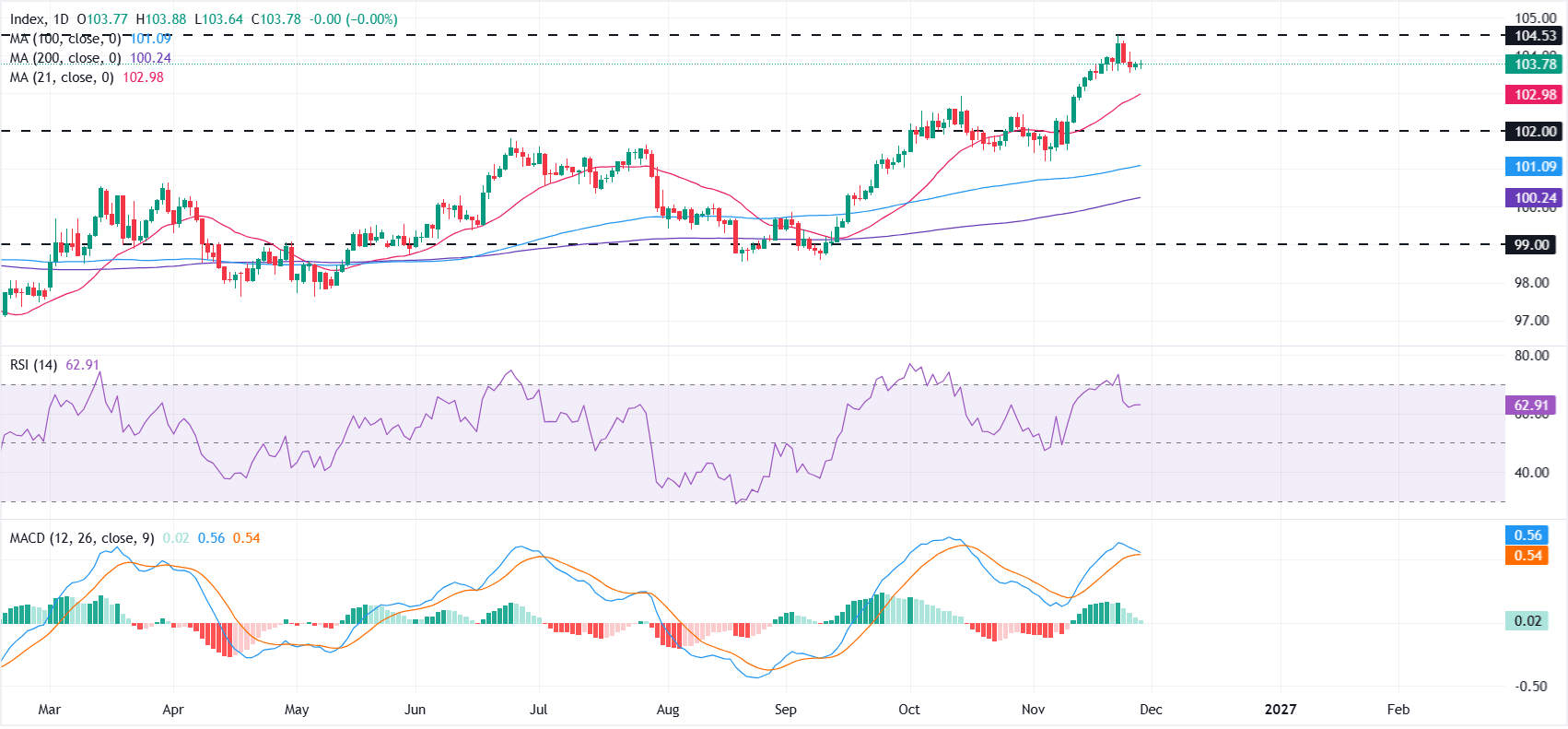
On the daily chart, the US Dollar Index retains a bullish near-term bias as it holds above the 21-, 100- and 200-day simple moving averages (SMAs).
Momentum reinforces the constructive tone, with the Relative Strength Index (RSI) hovering in bullish territory near 63 and the Moving Average Convergence Divergence (MACD) indicator marginally positive, suggesting upside pressure remains in place while the current advance consolidates below the recent highs.
On the topside, initial resistance is seen at the horizontal barrier around 104.53, where a break would open the door for a continuation of the broader recovery.
On the downside, immediate support is provided by the 21-day SMA at 102.98, followed by the horizontal floor at 102.00; a deeper pullback would expose the 100-day SMA at 101.09 and then the 200-day SMA at 100.24, with a more significant bearish reversal only expected if the longer-term base near 99.00 gives way.
(The technical analysis of this story was written with the help of an AI tool. Know more.)
Fed FAQs
Monetary policy in the US is shaped by the Federal Reserve (Fed). The Fed has two mandates: to achieve price stability and foster full employment. Its primary tool to achieve these goals is by adjusting interest rates. When prices are rising too quickly and inflation is above the Fed’s 2% target, it raises interest rates, increasing borrowing costs throughout the economy. This results in a stronger US Dollar (USD) as it makes the US a more attractive place for international investors to park their money. When inflation falls below 2% or the Unemployment Rate is too high, the Fed may lower interest rates to encourage borrowing, which weighs on the Greenback.
The Federal Reserve (Fed) holds eight policy meetings a year, where the Federal Open Market Committee (FOMC) assesses economic conditions and makes monetary policy decisions. The FOMC is attended by twelve Fed officials – the seven members of the Board of Governors, the president of the Federal Reserve Bank of New York, and four of the remaining eleven regional Reserve Bank presidents, who serve one-year terms on a rotating basis.
In extreme situations, the Federal Reserve may resort to a policy named Quantitative Easing (QE). QE is the process by which the Fed substantially increases the flow of credit in a stuck financial system. It is a non-standard policy measure used during crises or when inflation is extremely low. It was the Fed’s weapon of choice during the Great Financial Crisis in 2008. It involves the Fed printing more Dollars and using them to buy high grade bonds from financial institutions. QE usually weakens the US Dollar.
Quantitative tightening (QT) is the reverse process of QE, whereby the Federal Reserve stops buying bonds from financial institutions and does not reinvest the principal from the bonds it holds maturing, to purchase new bonds. It is usually positive for the value of the US Dollar.
Nothing in this material constitutes investment advice, personal recommendation, investment research, an offer, or a solicitation to buy or sell any financial instrument. The content has been prepared without consideration of your individual investment objectives, financial situation, or needs, and should not be treated as such.
Past performance is not a reliable indicator of future performance and/or results. Forward-looking scenarios or forecasts are not a guarantee of future performance. Actual results may differ materially from those anticipated.
Mitrade makes no representation or warranty as to the accuracy or completeness of the information provided and accepts no liability for any loss arising from reliance on such information.
Recommended Articles


