



Today’s Market Recap: Middle East Conflict Triggers Airline Slump and Inflation Fears as Trump Signals Extended Campaign
Track the Market Trend
TradingKey - On March 2, 2026, American Airlines Group (AAL) shares tumbled 4.21% to close at $12.52 as investors grappled with rising fuel costs, flight disruptions, and tightening profit margins. The decline was triggered by escalating geopolitical tensions in the Middle East, where weekend missile strikes led to airspace closures and a sharp spike in oil (USOIL) and jet fuel prices.
Trading activity was notably high, with volume reaching 86.7 million shares — approximately 52% above the three-month average. Since its 2005 IPO, the carrier's stock has declined by 35%. This downward trend mirrored broader sector struggles, as peers Delta Air Lines (DAL) and United Airlines (UAL) fell 2.21% and 2.91%, respectively, despite slight gains in the S&P 500 and Nasdaq.
The recent military exchanges between the U.S., Israel, and Iran have resulted in thousands of flight cancellations and sparked concerns over weakening international demand. These headwinds arrive at a sensitive time for American Airlines, which recently committed to a $1 billion expansion at Miami International Airport. Market participants remain wary that sustained fuel inflation and regional instability could erode profitability just as the company embarks on this significant capital investment.
Market Headline
On Monday, President Trump stated that the "great wave" of strikes against Iran has yet to begin, noting that operations could last four to five weeks, though the U.S. is prepared for a much longer duration. While the Secretary of Defense clarified that ground troops have not been deployed to Iran, he refused to rule out any future actions. Meanwhile, the Secretary of State claimed the U.S. has successfully neutralized the Iranian naval threat. However, Pentagon officials expressed concerns that the campaign could spiral out of control and deplete American air defense reserves.
In response, senior Iranian official Larijani rejected negotiations with the U.S., warning that the U.S. and Israel cannot "strike and walk away" without facing retaliation. Despite U.S. officials admitting there is no intelligence suggesting Iran planned a "preemptive" strike on American forces, Larijani emphasized that Iran will strike back. As U.S. airstrikes continue, Iran has maintained retaliatory attacks on several U.S. bases in the Middle East, leading to a steady escalation of regional conflict.
On the legal front, a $175 billion tariff refund battle has intensified after a U.S. federal appeals court rejected the Trump administration’s request to delay proceedings. The Justice Department had sought a stay of approximately four months to allow the executive and legislative branches time to consider their options following a Supreme Court ruling. The Federal Circuit Court of Appeals denied this delay, ordering the immediate resumption of legal processes and remanding cases to the Court of International Trade. Following the Supreme Court's decision, over 100 new companies filed suits, bringing the total number of tariff-related cases facing the administration to over 2,000.
Economic data from February shows the U.S. manufacturing sector expanding for a second consecutive month, though signals are mixed. The ISM Manufacturing PMI edged down slightly to 52.4, while the S&P Global U.S. Manufacturing PMI hit a seven-month low of 51.6. Notably, the ISM price index surged to a nearly four-year high, fueled by rising oil prices due to the Iran conflict. While the employment index rose to a one-year high of 48.8, analysts warn that tariffs and geopolitical strife are creating underlying inflationary pressures. Manufacturers may be forced to pass these costs to consumers, potentially restricting the Federal Reserve's ability to cut interest rates.
In the tech sector, Apple (AAPL) has announced the iPhone 17e and a new iPad Air, targeting the mid-range market with unchanged pricing. The iPhone 17e features the A19 chip, a C1X modem, and doubled storage at 256GB, though it retains a single camera and a 60Hz display. The new iPad Air is powered by the M4 chip, offering a 30% performance boost. Both products are set for release on March 11. Looking ahead to the fall, Apple plans to debut the iPhone 18 series and its first foldable iPhone, which is expected to be a centerpiece of its 2026 hardware strategy.
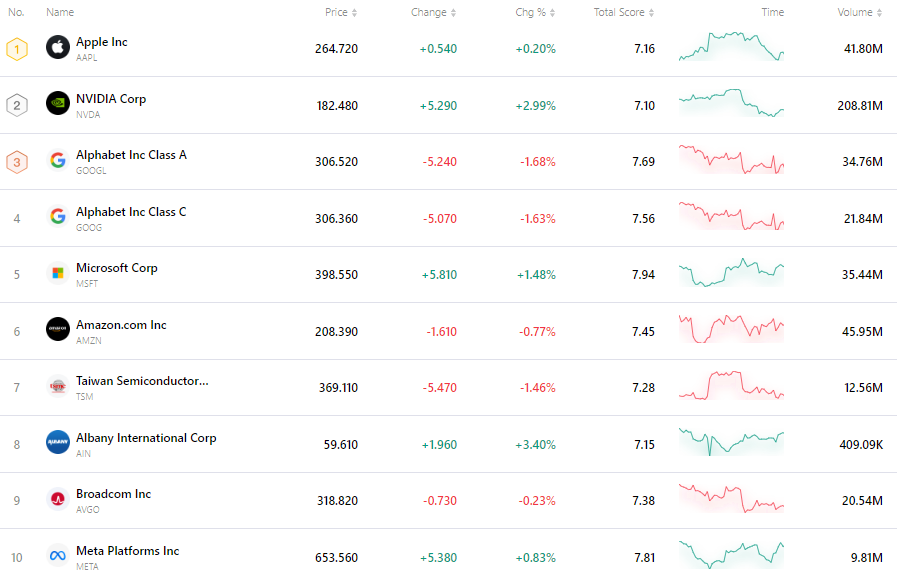
Top 10 Most Traded Stocks
The chart below lists the ten most actively traded stocks in the market. Due to their massive trading volumes and high liquidity, these stocks serve as critical benchmarks for tracking global market dynamics.
Nothing in this material constitutes investment advice, personal recommendation, investment research, an offer, or a solicitation to buy or sell any financial instrument. The content has been prepared without consideration of your individual investment objectives, financial situation, or needs, and should not be treated as such.
Past performance is not a reliable indicator of future performance and/or results. Forward-looking scenarios or forecasts are not a guarantee of future performance. Actual results may differ materially from those anticipated.
Mitrade makes no representation or warranty as to the accuracy or completeness of the information provided and accepts no liability for any loss arising from reliance on such information.
Recommended Articles


