



Helium’s 2026 Shock: Which Stocks are Most Affected
What’s going on (and why traders should care)
Most investors don’t spend much time thinking about helium. It’s the party-balloon gas… or at least that’s what most people think. But But behind the scenes, helium keeps a lot of high-end tech running - and supply has tightened fast lately.
As of March 19, 2026, the Middle East conflict has pushed Qatar - one of the world's biggest helium producers - to shut down a key export facility. The result is a supply shock that’s already hitting industries that don’t have many workarounds: computer chips, hospital MRI machines, space rockets, and quantum computers.
Here’s the thing: helium isn’t like oil, where spare capacity can show up quickly when a supplier drops out. The world depends on a handful of suppliers - and right now, one of the biggest is offline.
The numbers that matter Spot prices have roughly doubled since March 2026. Roughly a third of global supply is currently offline. Some estimates put chipmakers’ stockpiles at around six months. And this usually isn’t a quick fix - new capacity can take 2 to 5 years. |
Who gets squeezed first (and who might benefit)
Where helium actually comes from
Helium isn’t mined in the usual sense - it’s typically captured during natural gas processing. So supply is tied to a small number of big gas plants. That makes the whole market more fragile than it looks.
Country | Share of Supply | Status & Notes |
United States | 54.2% | Largest producer; Wyoming's Shute Creek plant (Exxon) is the main alternative to Qatar |
Qatar | 19.1% - OFFLINE | Ras Laffan facility shut down; force majeure declared March 4, 2026 |
Algeria | 13.3% | Limited ability to compensate for the loss of Qatari supply |
Top 3 Combined | ~86.6% | Extreme concentration - losing any one major producer triggers a global shortage |
Global helium refinery capacity by country. Qatar's Ras Laffan facility declared force majeure on March 4, 2026
Three countries account for nearly 87% of global helium supply. With Qatar offline, the remaining producers usually can’t make up the difference quickly - it’s like losing a third of the world’s coffee harvest overnight - and you can’t just “plant more” and fix it next month.
So why are prices jumping so fast?
Helium prices have already jumped sharply since this started. The chart below shows three possible scenarios depending on how long the disruption lasts - and the longer Qatar stays offline, the more severe the price spike becomes.
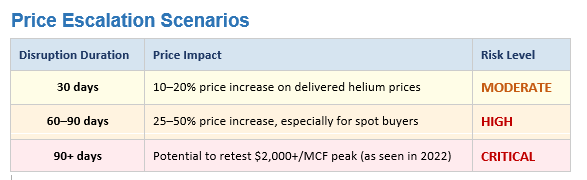
Helium price escalation scenarios across short, medium, and extended disruption timelines (2026)
For a lot of buyers, there aren’t many practical substitutes in the short run - so they either pay up, or production slows. That’s what makes helium tricky as a commodity: demand often doesn’t drop much even when prices spike. And that can be a big deal for companies sitting on supply.
Which industries feel this first?
Helium isn’t a “nice-to-have” input - in many cases it’s non-negotiable for some of the world's most important technologies. The chart below shows which sectors face the greatest exposure, and how difficult it would be for them to find any alternative.
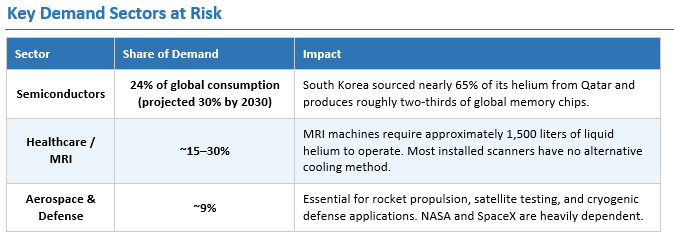
Key demand sectors at risk - helium dependency and ability to switch to alternatives (2026)
• Semiconductors (computer chips): The biggest consumer of helium today - accounting for more than 1 in 5 litres used globally. Many AI and memory chip fabs rely heavily on it. South Korea, which makes two-thirds of the world's memory chips, sourced nearly 65% of its helium from Qatar.
• Hospital MRI machines: Helium keeps MRI magnets cold enough to work. Hospitals usually can’t just switch systems or “wait it out.”
• Space rockets & defense: Helium is used to pressurize fuel systems and purge components before launch. Commercial launches are up massively over the last decade, and each launch typically needs helium.
• Quantum computing: It runs at extremely low temperatures, and helium is often part of that cooling chain.
Here’s the investor angle For high-value industries, helium can be a small line item - but downtime can cost millions a day. So buyers often pay up to keep supply steady. Suppliers tend to hold the cards. |
Public companies most exposed (if this drags on)
Semiconductor & Memory Manufacturers (Major Consumers)
Company: Samsung Electronics (KRX: 005930)
Impact: South Korea relies on Qatar for over 70% of its helium. Helium shortage concerns contributed to sharp stock declines.
Stock Performance: >$200B wiped off combined Samsung & SK Hynix value
Company Comments: Has helium recycling systems applied to some production lines.
Company: SK Hynix (KRX: 000660)
Impact: South Korea imported 64.7% of helium from Qatar in 2025. Stockpiles estimated to last ~6 months.
Stock Performance: >$200B wiped off combined value since war started
Company Comments: Diversified supplies and secured sufficient inventory. 2–3 months inventory buffer.
Company: TSMC (NYSE: TSM / TPE: 2330)
Impact: Does not currently anticipate a notable impact but is monitoring closely.
Stock Performance: Down ~7% since start of Middle East conflict
Company Comments: Does not currently anticipate a notable impact; is monitoring the situation.
Company: Micron Technology (NASDAQ: MU)
Impact: Memory chip manufacturer exposed to helium shortages.
Stock Performance: Part of broader semiconductor sell-off
Company Comments: No specific comment found.
Domestic chipmakers' helium stockpiles are expected to last about six months - meaning a prolonged crisis could still significantly affect costs and output. |
Distributors: could get squeezed, depending on contracts
Company: Linde plc (NYSE: LIN)
Notes: Mixed exposure - also listed as beneficiary
Company: Air Liquide (ENXTPA: AI)
Notes: Distributes helium from Qatar. Supply disruption risk. Relies on multiple continental sources and a European storage cavern.
Company: Iwatani Corporation (TYO: 8088)
Notes: Japan’s top helium supplier. Has maintained stable supply because it sources from the U.S. and maintains stockpiles in both the U.S. and Japan.
MRI makers: indirect pressure, not always immediate
Company: GE HealthCare (NASDAQ: GEHC)
Impact: MRI manufacturers face helium cost pressures. Helium-dependent for MRI cooling systems.
Company: Siemens Healthineers (ETR: SHL)
Impact: Higher helium costs affecting margins. Newer DryCool models use 99% less helium but slow fleet adoption.
Company: Philips (ENXTAM: PHIA)
Impact: Medical imaging division exposed. Helium shortage impacts MRI operations and new installations.
Listed Companies Positively Affected
Industrial Gas Majors (Pricing Power Winners)
Company: Linde plc (NYSE: LIN)
Impact: World’s largest industrial gas company and leading global helium supplier. Strong pricing power.
Stock Performance: Market cap: ~$143B; Revenue: $31B+
Analyst Commentary: JPMorgan upgraded to Overweight, citing tightening helium market as primary catalyst.
Company: Air Products & Chemicals (NYSE: APD)
Impact: Key global helium supplier. Wells Fargo upgraded to Overweight (PT to $325).
Stock Performance: Strong financials reported
Analyst Commentary: Major helium supplier with diversified portfolio. Taking steps to ensure supply continuity.
Company: Air Liquide (ENXTPA: AI)
Impact: Major European helium supplier with global distribution network.
Stock Performance: Global helium distributor
Analyst Commentary: Benefits from spot price doubling. Sources from multiple continents + European storage cavern.
For high-value sectors, the price of helium is a rounding error compared to the cost of a factory shutdown. Demand is fairly inelastic here, which often lets suppliers push through higher prices to companies that control supply. |
What should investors do with this?
The helium mess in 2026 is a good reminder that some of the most important market opportunities are hiding in plain sight - in the materials and commodities most people never think about.
The story here is simple: a rare, irreplaceable gas that powers the world's most important technologies has had a third of its global supply cut off overnight. There is no substitute, no stockpile to fall back on, and no new supply coming online for years. That creates winners and losers in the stock market - and understanding which is which is exactly the kind of edge that separates informed investors from the crowd.
The losers are the companies that need helium to run - chipmakers like Samsung, SK Hynix, TSMC, and Micron, whose factories depend on a steady helium supply. Stockpiles buy time. Not a lot of it, though. If Qatar remains offline, costs will rise and margins will be squeezed.
The potential winners are the companies selling helium - Linde, Air Products, and Air Liquide. When supply is tight and demand cannot move, whoever holds the gas holds the pricing power. Analyst upgrades are already flowing in, and the tailwind is likely to grow stronger the longer this disruption lasts.
If you’re new, the bigger lesson isn’t just “helium.” It is about understanding supply and demand at their most extreme - a market where one side cannot walk away, where there is no alternative, and where a small number of companies sit at a critical chokepoint. That structure tends to be very good for shareholders of the companies in control.
One thing to watch How long does Qatar's Ras Laffan facility stay offline? Every extra week offline can keep prices under pressure, puts more pressure on chipmakers' reserves, and strengthens the hand of the industrial gas suppliers. The 90-day mark is the critical threshold - beyond that, the squeeze tends to show up more visibly in contracts and production planning. |
Nothing in this material constitutes investment advice, personal recommendation, investment research, an offer, or a solicitation to buy or sell any financial instrument. The content has been prepared without consideration of your individual investment objectives, financial situation, or needs, and should not be treated as such.
Past performance is not a reliable indicator of future performance and/or results. Forward-looking scenarios or forecasts are not a guarantee of future performance. Actual results may differ materially from those anticipated.
Mitrade makes no representation or warranty as to the accuracy or completeness of the information provided and accepts no liability for any loss arising from reliance on such information.
Recommended Articles


