



Walmart Revenue Beats Expectations But Drops Over 7%, Can Transformation Highlights Support Its Stock Rebound?
TradingKey - Walmart ( WMT) reported first-quarter total revenue of $177.751 billion, up 7.3% year-over-year, beating market expectations of $174.98 billion. However, due to full-year earnings guidance falling short of analyst estimates and rising fuel costs, the stock fell 7.27% to close at $121.34, its largest single-day decline in nearly two years.
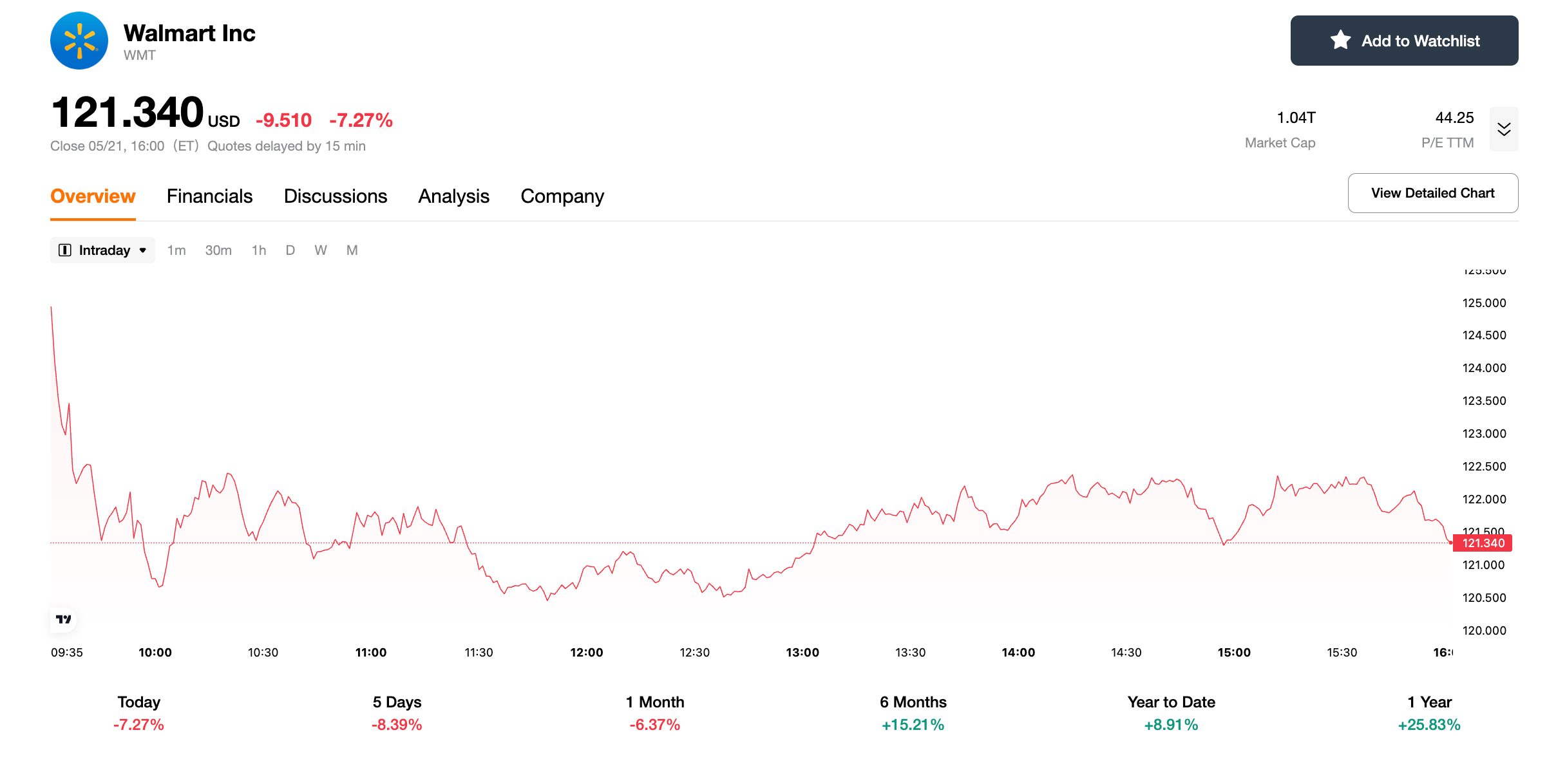
[Source: TradingKey]
Behind this slump may be an overly pessimistic interpretation of Walmart's short-term margin pressure. In reality, Walmart has already transcended its traditional retail positioning and is accelerating its transformation into an integrated 'retail + e-commerce + media + membership' model. Highlights such as sustained e-commerce profitability and high growth in advertising and membership revenue have been overshadowed by short-term headwinds.
Is this pullback, then, a good opportunity to position in the defensive consumer sector? To answer this, we should first examine the two factors in this earnings report that sparked market concern—earnings guidance falling short of expectations and fuel cost overruns—and then look at the long-term highlights that the market has overlooked.
Earnings guidance misses expectations; fuel cost overruns weigh on margins.
Walmart maintained its full-year net sales growth guidance of 3.5%-4.5%, but its median adjusted earnings per share guidance for fiscal 2027 was $2.80, falling short of market expectations of $2.91. Second-quarter EPS is projected at $0.72-$0.74, also below the market consensus of $0.75.
Walmart's move to maintain revenue growth guidance while lowering profit targets indicates a focus on market share expansion over short-term margins—a strategic choice of "volume over price"—but capital markets are clearly lacking patience.
CFO John David Rainey stated that fuel costs in delivery and fulfillment exceeded budgets by approximately $175 million in the first fiscal quarter, dragging down operating margins by about 250 basis points, as the company opted to absorb the costs rather than pass them on.
On the day the earnings report was released, WTI crude oil rose more than 4% to $102.41 per barrel. Rising oil prices directly exacerbated uncertainty regarding Walmart's subsequent costs, further weakening investor expectations for a recovery in future margins.
Overlooked Long-term Highlights: Sustained E-commerce Profitability and Rapid Growth in Advertising and Membership Revenue
On the flip side of short-term profit pressure lie several key breakthroughs in Walmart's long-term transformation.
This quarter, Walmart's global e-commerce sales grew 26% year-over-year, with the e-commerce business achieving sustained profitability. This signals that after years of heavy investment in digital infrastructure, Walmart's online retail operations have moved well beyond the break-even point.
For years, the market viewed Walmart's e-commerce as a loss-making "cost center." Sustained profitability now proves that Walmart's delivery network has achieved sufficient density to lower unit costs through scale, while leveraging advertising and third-party services to offset logistics expenses.
Notably, this profitability was achieved despite high oil prices weighing on margins. Should oil prices retreat, there is room for further margin expansion in the e-commerce business.
At the same time, high-margin segments like advertising and memberships maintained rapid growth, serving as key drivers for overall profit growth and a buffer against external risks. Global advertising grew 37% year-over-year, membership fee income rose 17.4%, and new Walmart+ member sign-ups reached a historic high for the period.
This indicates that Walmart’s profit mix is shifting from "high volume, low margin" toward higher-margin businesses. The growing contribution of advertising and membership revenue helps offset traditional retail margin volatility and provides a sturdier foundation for long-term valuation.
Benefiting from high-margin businesses such as advertising and memberships, as well as category mix optimization, the company's overall gross margin rose by 6 basis points year-over-year, with category mix contributing 29 basis points to Walmart U.S. gross margins.
The earnings call also revealed that Walmart+ members spend four times more than non-members, with e-commerce visits seven times higher. This strong user stickiness not only generates stable membership revenue but also provides a high-value audience for advertising, enabling more precise targeting; in turn, advertising revenue helps fund platform operations.
Additionally, Walmart+ members receive a 10-cent-per-gallon discount at gas stations including ExxonMobil and Walmart. According to Rainey, usage of this benefit rose amid high fuel prices, effectively locking in customer loyalty.
Peer Comparison and Analyst Views
Let's look at the performance of competitors. As another leading U.S. discount retailer, Target ( TGT) reported first-quarter revenue of $25.44 billion and adjusted earnings per share of $1.71, both exceeding market expectations, and raised its full-year guidance. On the day the earnings were released, its stock price fell by more than 6%, before rebounding by 3.12% the following day.
The triggers for their respective declines were different: Target fell after exceeding expectations (its nearly 30% year-to-date gain had already priced in the positive news), while Walmart fell after its guidance missed expectations. Nevertheless, both companies exhibited a "post-earnings decline" pattern.
Notably, Target and Walmart currently have price-to-earnings ratios of approximately 16x and 44x, respectively. This stark valuation gap illustrates that the market is assigning a higher premium to Walmart's transformation prospects.

[Source: TradingKey]
Despite the sharp correction in stock price, most institutions still maintain a positive outlook on Walmart. Following the earnings release, Freedom Broker upgraded Walmart from "Sell" to "Hold" and significantly raised its price target from $87 to $133, citing increased transaction volumes and the ongoing expansion of advertising and membership revenue.
Meanwhile, Truist Securities maintained its "Buy" rating and raised its price target to $140, noting that Walmart's digital capabilities and diversified revenue streams are structurally enhancing its profitability.
Amid consumption downgrading, is now the time to position in defensive sectors?
Walmart, as the world's largest discount retailer and consumer staples channel, has long had a core customer base dominated by low-to-middle-income households, with a product mix primarily focused on essential categories like groceries and daily necessities. This fundamental positioning ensures it inherently possesses defensive attributes during consumption downturns.
However, Walmart CFO Rainey noted that the largest market share gains this quarter came from households with annual incomes exceeding $100,000, while low-income consumers face financial pressure; higher income tax refunds partially offset the impact of high gas prices, but as refunds decline, consumer pressure will intensify further.
A specific metric corroborates this: for the first time since 2022, the average number of gallons per fill-up at Walmart gas stations fell below 10 gallons, signaling rising cost sensitivity among consumers.
The influx of high-income households into Walmart is essentially a classic signal of consumption trade-down. Even middle-class families are beginning to pinch pennies, indicating that the American consumer's wallet is shrinking.
The investment implications are clear: the consumer discretionary sector (such as high-end department stores, luxury goods, and premium dining) may face an accelerated collapse, while consumer staples and discount retail offer strong defensiveness.
The current environment may present an opportunity to gradually build positions in defensive consumer sectors, such as mass-market discount retailers, daily necessity leaders, and warehouse clubs with high member stickiness.
This is actually a double tailwind for Walmart, benefiting from both incremental gains from high-end customers and the stickiness of essential-needs customers; however, the risk remains whether Walmart can retain these high-income groups once the economy improves, though this does not change the short-term trading logic of prioritizing defense.
Risk Warning: Three Variables That Cannot Be Ignored
Before making a decision on whether to establish a position, investors must also confront the following risks:
Persistent pressure from fuel costs: If WTI crude remains above $100 per barrel, Walmart's quarterly overspending of approximately $175 million may continue, with an annual impact exceeding $700 million, potentially further weighing on earnings.
Risk of valuation contraction: A 44x P/E ratio implies the market has extremely high requirements for earnings growth. If e-commerce profit growth slows or advertising revenue decelerates in subsequent quarters, the P/E ratio could revert to the 30-35x range.
The double-edged sword of consumer downtrading: The influx of high-income households certainly brings incremental growth, but increasing pressure on low-income consumers means that average transaction values may fall. As the king of discount retail, Walmart's 'high-volume, low-margin' model has limited margin elasticity when consumer spending continues to contract.
In conclusion, Walmart's long-term transformation does have highlights, such as the continued expansion of e-commerce profitability, high growth in advertising and membership revenue, and increased foot traffic from consumer downtrading. This sharp drop in stock price reflects the market's reasonable concerns over short-term profits, but also provides an observation window for medium-to-long-term investors.
Nothing in this material constitutes investment advice, personal recommendation, investment research, an offer, or a solicitation to buy or sell any financial instrument. The content has been prepared without consideration of your individual investment objectives, financial situation, or needs, and should not be treated as such.
Past performance is not a reliable indicator of future performance and/or results. Forward-looking scenarios or forecasts are not a guarantee of future performance. Actual results may differ materially from those anticipated.
Mitrade makes no representation or warranty as to the accuracy or completeness of the information provided and accepts no liability for any loss arising from reliance on such information.
Recommended Articles


