



Samsung Wage Deal Boosts Stock to New High, Risks Remain: Can the Rally Continue?
TradingKey - On May 27, the Samsung Electronics labor union approved a wage agreement with a 73.7% approval rate, averting at the last minute a major strike that could have disrupted global chip supplies. According to the agreement, average wages will increase by 6.2%, a "special operating performance bonus" sourced from 10.5% of operating profit will be established for the semiconductor division, and a new housing loan system with a maximum of 500 million won will be introduced.
Capital markets reacted swiftly. Samsung's stock price, which had dropped by more than 4% after negotiations broke down on May 20, surged over 8% before the agreement was reached on the 21st, and rose more than 7% intraday on the 27th after the deal was finalized, hitting 323,000 won—a record high since the 2018 stock split. The market has cast a vote of confidence with real capital.
However, following this vote, how much further can the stock's record high go? The market seems to be selectively ignoring the deeper issues behind the agreement.
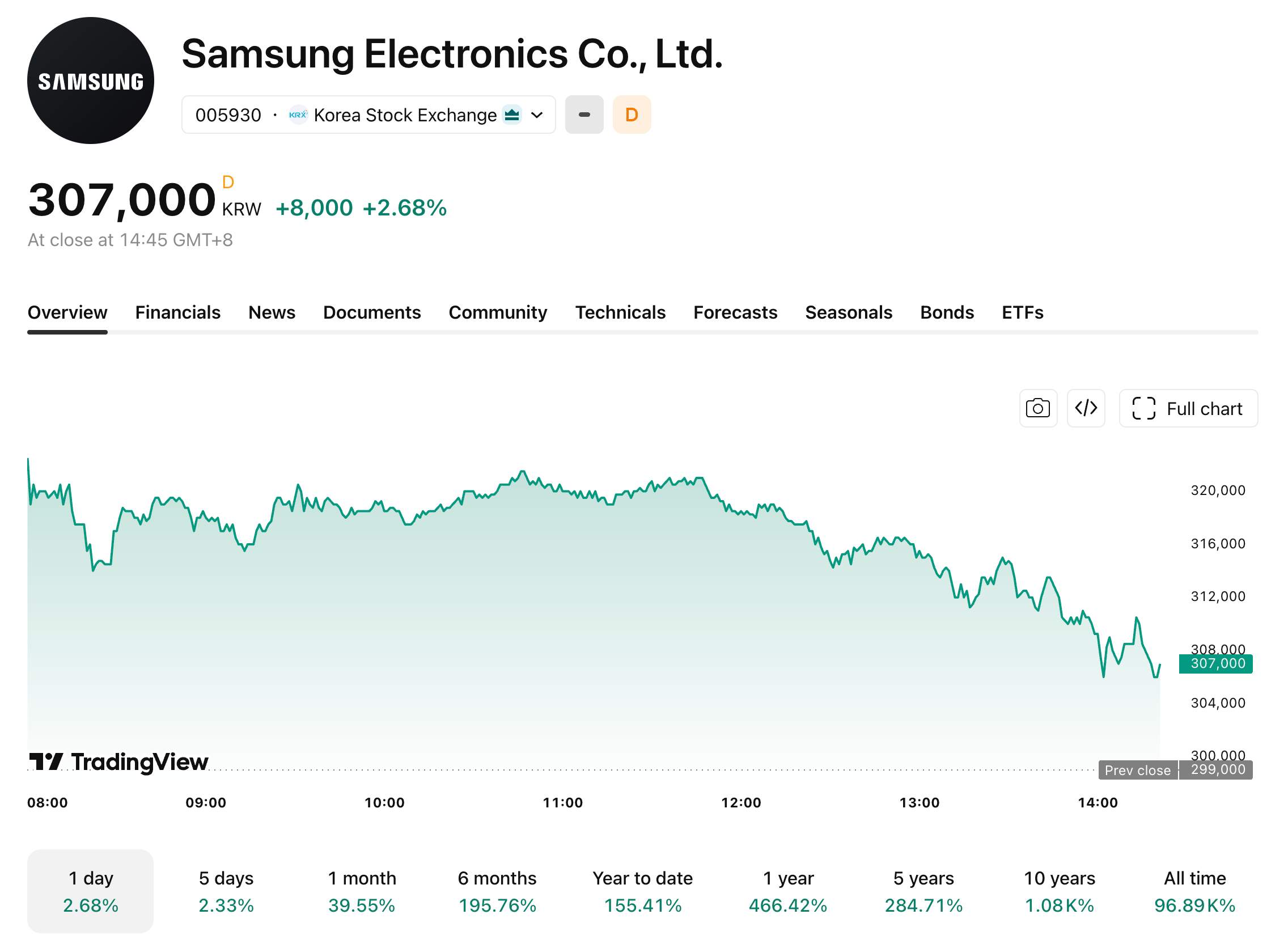
[Source: TradingView]
Divisional Rifts and Bonus Disparities Ignite Internal Strife at Samsung
The greatest risk to the agreement lies not only between labor and management, but also between departments. According to union disclosures, performance bonuses in the Memory Chip Division can reach hundreds of millions of won, while those in the Device eXperience (DX) Division are only a fraction of that, or even lower.
In the first quarter of 2026, Samsung's operating profit reached 57.2 trillion won, surging 756%. The semiconductor business contributed 53.7 trillion won in profit, accounting for over 93%, and this massive disparity in profit contribution has led to intense scrutiny regarding the procedural fairness of bonus distribution.
The consequences have already begun to manifest: union membership in the DX division surged from 3,000 to nearly 13,000, and an injunction was filed with the court to prevent the chip division's union from holding exclusive bargaining rights. However, the Suwon District Court in South Korea dismissed the application on May 26, ruling that the voting process could continue.
Furthermore, the Korea Shareholder Action HQ announced it would file a lawsuit regarding profit-linked bonuses, alleging the plan was implemented without deliberation by the general meeting of shareholders. Of these two cases, an unfavorable ruling in the shareholder lawsuit could fundamentally restructure Samsung’s compensation system, while the DX union’s lawsuit, which focuses on the duty of fair procedural representation, may have a relatively limited impact.
Tight Capacity Balance: HBM Order Share Is the Key Variable
The agreement averted a major strike, but the labor-management standoff over the past few months has already caused hidden losses. According to South Korean media reports, foundry production fell by 58.1% and memory production dropped by 18.4% on the day of the union rally in April. A more critical issue is that although Samsung's 12-layer HBM3E has passed NVIDIA's ( NVDA) quality certification, it remains uncertain how much actual order share Samsung can secure from this.
Currently, SK Hynix's 2026 DRAM capacity has been pre-booked by customers, and Micron's HBM capacity is also sold out, leaving the industry with no redundant buffer. Samsung's share of the global HBM market remains far below that of SK Hynix. If its HBM3E order volume eventually falls short of expectations, it will not only fail to further benefit from AI demand but could also prompt NVIDIA to further consolidate its exclusive supply relationship with SK Hynix. Any negative news regarding this order share will directly hit Samsung's stock price.
Brain Drain: Micron Capitalizes on the Opening
Compared to SK Hynix's abolition of its bonus cap, the relative rigidity of Samsung's incentive structure is beginning to manifest in talent mobility signals. According to the South Korean job portal JobKorea, applications from Samsung semiconductor engineers to join SK Hynix rose by approximately 35% year-over-year in the first quarter. Additional Korean media reports indicate that roughly 200 core Samsung engineers have jumped ship to SK Hynix in the last four months.
A more significant threat originates from abroad. While Samsung remains mired in labor disputes, Micron Technology ( MU) has initiated recruitment for HBM design roles in Seoul, offering annual compensation for principal-level positions of up to 300 million won plus equity. Business Korea has interpreted this move as a strategic poaching effort aimed at Samsung’s labor unrest. Samsung is not merely facing attrition from one source, but a systemic war for talent.
How much further can Samsung’s stock rally go after hitting record highs?
Samsung has avoided an immediate production collapse, and the market has rewarded it with a record high. However, the foundation of this record is fragile, built on several optimistic assumptions: ideal HBM order shares, no legal setbacks in departmental litigation, and no large-scale talent drain. If any of these assumptions fail to materialize, market expectations are likely to be recalibrated.
Over the next three months, three indicators require close monitoring: judicial progress in departmental litigation, Samsung HBM4's actual supply share in the Nvidia supply chain, and quarterly attrition data for core engineers. These metrics will ultimately determine whether this compensation agreement serves as a short-term reprieve or a long-term solution. While the AI chip industry's high-growth phase has only just begun, there is a strong link between profit distribution mechanisms and a firm's long-term sustainability. Samsung has merely avoided the worst-case scenario for now, with significant uncertainties clouding its future outlook.
Nothing in this material constitutes investment advice, personal recommendation, investment research, an offer, or a solicitation to buy or sell any financial instrument. The content has been prepared without consideration of your individual investment objectives, financial situation, or needs, and should not be treated as such.
Past performance is not a reliable indicator of future performance and/or results. Forward-looking scenarios or forecasts are not a guarantee of future performance. Actual results may differ materially from those anticipated.
Mitrade makes no representation or warranty as to the accuracy or completeness of the information provided and accepts no liability for any loss arising from reliance on such information.
Recommended Articles


