



P3 Health Partners (PIII) Pullback: Is $12.38 a Re-Entry Buy Opportunity?
TradingKey - P3 Health Partners is at $12.38 after pulling back from $18.52 post-earnings high. Ascending trendline from $5.91 intact. Q1 net income +$3M vs -$44M prior year. EBITDA $26M. Target $14.16.
P3 Health Partners (NASDAQ: PIII) rocketed to $18.52 in the wake of the May 14 earnings surprise, then gave back gains to settle at $12.38 once the hype dissipated and traders could absorb the full story over the Memorial Day break. The pivot is real: Q1 2026 moved from a $44.2 million loss to a $3.0 million profit, adjusted EBITDA came in at $26 million against negative a year earlier, and full-year 2026 forecasts were lifted to between $1.50 and $1.65 billion in revenue along with $20 million to $60 million in adjusted EBITDA.
On the 2H timeframe, PIII is respecting the rising blue trendline drawn from the $5.91 floor, with RSI resting between 35 and 59 as volume wanes on the decline. The $18.52 peak was always going to see sellers, mostly those who got in cheap earlier. So the real issue is whether $12.38 marks a buy-the-dip or if the trendline finally cracks.
What The Memorial Day Weekend Digest Tells You About PIII’s Fundamental Position
Contextualizing the memorial day post-earnings retracement from $18.52 to $12.38, we're looking at a 33% retracement from the post-earnings top, but that is not the full story. The stock traded under $4 as late as late 2025, well before the turnaround started gaining traction, so at $12.38 it's still up well over 200% from the bottom. This pullback reflects profit booking from earlier buyers, not some breakdown in fundamentals. The operating metrics that drove the earnings reaction remain intact. The fact that Q1 2026 came in with a $3.0 million profit versus a $44.2 million loss a year ago isn't a blip. The medical margin expansion, powered by a 15% hike in Medicare Advantage payment rates, contract renegotiations, and an intentional carveout of unprofitable members in riskier cohorts, is the type of fundamental shift we should expect to continue through subsequent periods.
Of all the numbers in the earnings release, the biggest factor in my decision to consider the current level a re-entry candidate is the revised 2026 outlook. Now management expects to see full-year 2026 revenue hit between $1.50 and $1.65 billion and adjusted EBITDA come in from $20 to $60 million. Even at the midpoint of $40 million and the $12.38 market cap, it's not a crazy price to be paying for a company that's delivering on the sort of margin expansion that we don't often see in this industry (and which its competitors are trading at between 8 and 12x EBITDA). Both TD Cowen and Lake Street have since increased their price targets on the stock, and Lake Street's $14 target is already above where the stock currently is.
The debt exchange deal, which swapped a big part of the balance sheet into preferred stock, has materially strengthened the balance sheet. It's removed the biggest near-term risk from the balance sheet. The big question was going to be whether P3 would be able to service all of that debt, a question that has been the biggest concern for most analysts throughout 2024 and into early 2025.
What Still Needs To Go Right For The Turnaround To Sustain Beyond Q1
So, to continue, we're in good shape here as long as a few things remain in place. The bear case post-pullback isn't that Q1's results were somehow bogus, it is that Q1's results are the last good quarter for now. Three things will determine if that's the case:
- The first is medical margin per member per month: Q1's level of $231 has to hold or improve in Q2 before the seasonal factors in medical usage in H2 can come into play.
- The second is at-risk membership: the company pruned to 103,000 to 110,000 lives to improve quality. At-risk member declines going forward with no commensurate margin increases would indicate that we're shrinking rather than improving.
- The third is the cash burn: while the adjusted EBITDA numbers are real, the company still requires disciplined cash management to fund operations through the EBITDA ramp.
The other thing to bear in mind is the macro in Medicare Advantage: the government changes to rate increases, star ratings, and risk adjustment are all external variables that can make or break the medical margin at any given time. The 15% Medicare Advantage increase that came down for 2026 was a major benefit. The next step is going to be the 2027 rate increase that CMS will announce later this year; that will be the next thing outside of P3's control to either help or hurt that medical margin for any given year. The volatility in the stock is what you'd expect from that type of capitated Medicare Advantage model, even after seeing such a fundamental improvement in the operations.
Piii Technical Analysis — Ascending Trendline Hold At $12.38 With Rsi Neutral
PIII technicals on the 2H: Holding the ascending blue trendline from the $5.91 swing low with higher lows still intact off the MA50 and MA100. The horizontal support in the $12.12 to $13.22 range is where bids show up on the downside. RSI 35 to 59 is neutral but starting to show signs of possible bullish divergence, and the volume is shrinking on the decline as we expect on this type of pattern, as there are no signs of distribution here.
If we break the $13.22 support, the pattern could extend to $14.16 to $16.75. The $11.12 stop is the structural breakdown of the trendline as well as the moving average cluster.
Trade Setup
- Entry: Long above $13.22, horizontal resistance and trendline confirmation
- Target 1: $14.16, channel extension
- Target 2: $16.75, upper channel boundary
- Stop loss: Daily close below $11.12, ascending trendline and MA cluster fail
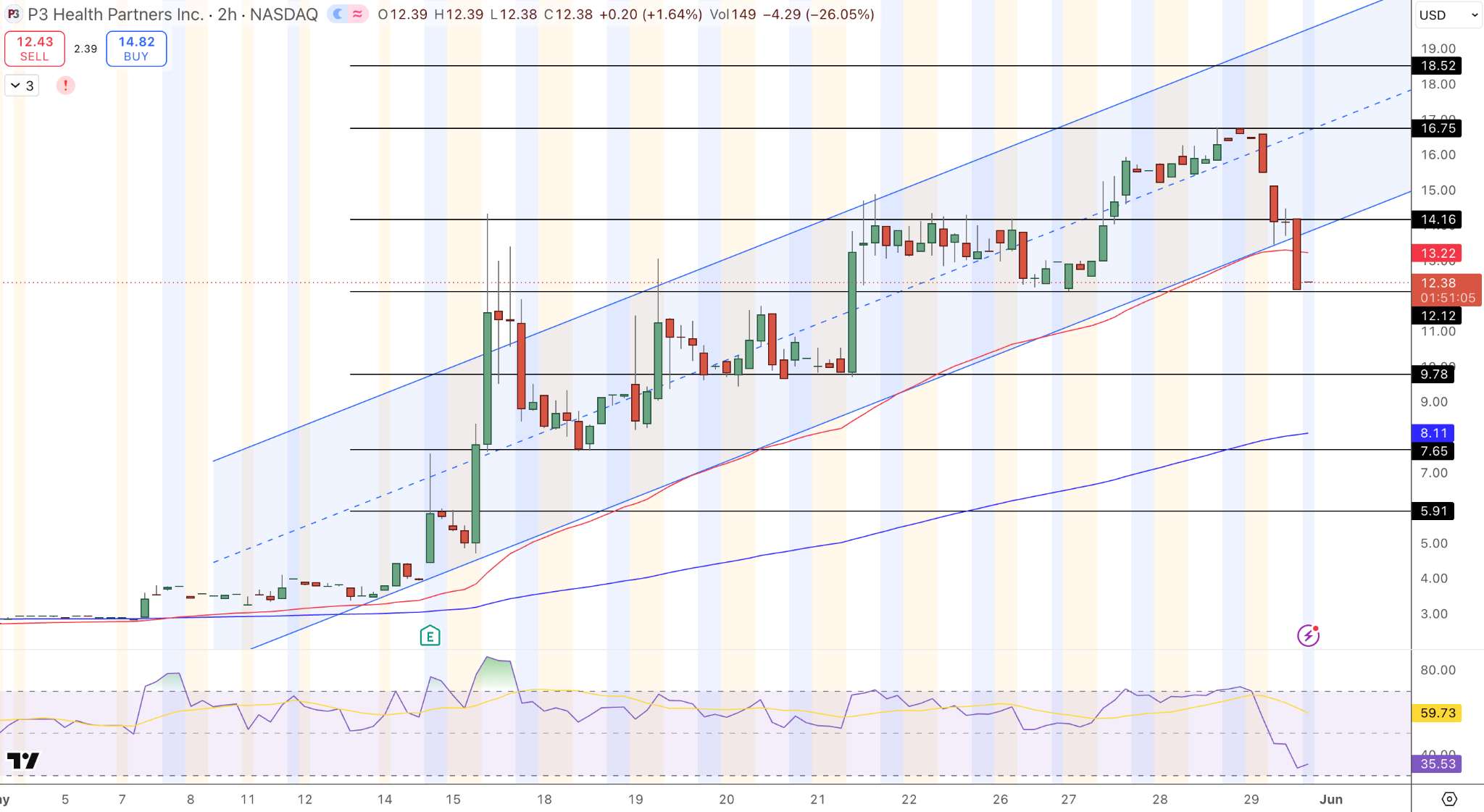 P3 Health Partners (NASDAQ: PIII) Price Chart - Source: Tradingview
How Did The P3 Health Partners Stock Retreat From $18.52 To $12.38?
PIII retraced 33% from the post-earnings high of $18.52 to $12.38, with investors who had bought in at lower levels taking their profits after the initial jump. This is a standard reaction after a 42% after-hours earnings gain on a small-cap stock that has previously shown lots of volatility.
The major inflection in the fundamentals, Q1 net income of $3.0 million against a $44.2 million loss, $26 million in adjusted EBITDA, plus elevated full-year guidance, is still in place. The uptrending support line off of $5.91 is still holding. The volume contracted during this price decline, which suggests this was a period of limited supply instead of wholesale liquidation.
How Did The P3 Health Partners Stock Retreat From $18.52 To $12.38?
P3 Health Partners has now upgraded full-year 2026 sales to $1.5 to $1.65 billion while forecasting adjusted EBITDA of $20 to $60 million (with a midpoint of $40 million). This is an important adjustment from previous expectations and is proof that management expects the turnaround in the first quarter to continue.
Additionally, the company just wrapped up a debt exchange in which significant amounts of its obligations were swapped for preferred stock to shore up the balance sheet. Expect to see Q2 2026 financial results towards the end of July, which will represent the first chance to validate whether or not the turnaround that kicked off in Q1 is continuing in the second half of the year.
How Did The P3 Health Partners Stock Retreat From $18.52 To $12.38?
The risk-to-reward ratio looks much better today at $12.38 than it did at the $18.52 post-earnings high, and the uptrending support line off of $5.91 still holding while the RSI has become neutral and volume was shrinking suggests a positive pattern. A buy above $13.22 targets $14.16 and $16.75 while a sell stop goes in at $11.12.
Based on today's price and the $40 million mid-point of management's EBITDA guidance, I believe valuation is acceptable for a company that has been able to improve its margins at this rate. There is a real possibility that Q2 medical margins slow and Medicare Advantage rate changes may become an issue for 2027, while the company may also begin to see an increase in risk-related membership losses. This is a fairly aggressive turnaround and I believe a small position is more appropriate for this type of situation.
To Summarize
P3 Health Partners’ retracement from $18.52 to $12.38 is investors pocketing their profits on a 200%+ run from 2025 bottoms, not the reversal of a fundamental shift. Switching from net income of -$44 million to +$3 million, $26 million in adjusted EBITDA, 15% better Medicare Advantage funding, and swapping debt for preferred equity represent major changes that wouldn't disappear in a single quarter.
The uptrend that started at $5.91 is still there. A trade above $13.22 will see shares heading for $14.16 and $16.75, while if medical margins slip again during the second quarter or Medicare Advantage rates are slashed in 2027, then the thesis would have collapsed. Late July earnings results should be the catalyst to watch.
Nothing in this material constitutes investment advice, personal recommendation, investment research, an offer, or a solicitation to buy or sell any financial instrument. The content has been prepared without consideration of your individual investment objectives, financial situation, or needs, and should not be treated as such.
Past performance is not a reliable indicator of future performance and/or results. Forward-looking scenarios or forecasts are not a guarantee of future performance. Actual results may differ materially from those anticipated.
Mitrade makes no representation or warranty as to the accuracy or completeness of the information provided and accepts no liability for any loss arising from reliance on such information.
Recommended Articles


