



SK Hynix Falls Below $130 to Hit Record Low as US Stock Premium Narrows to About 22%
TradingKey - On July 28 Eastern Time, impacted by the plunge in South Korean stocks today, SK Hynix's ADR ( SKHY) shares fell below the $130 psychological level, hitting a new low since listing. As of press time, SK Hynix was down 8.76% to $130.49.
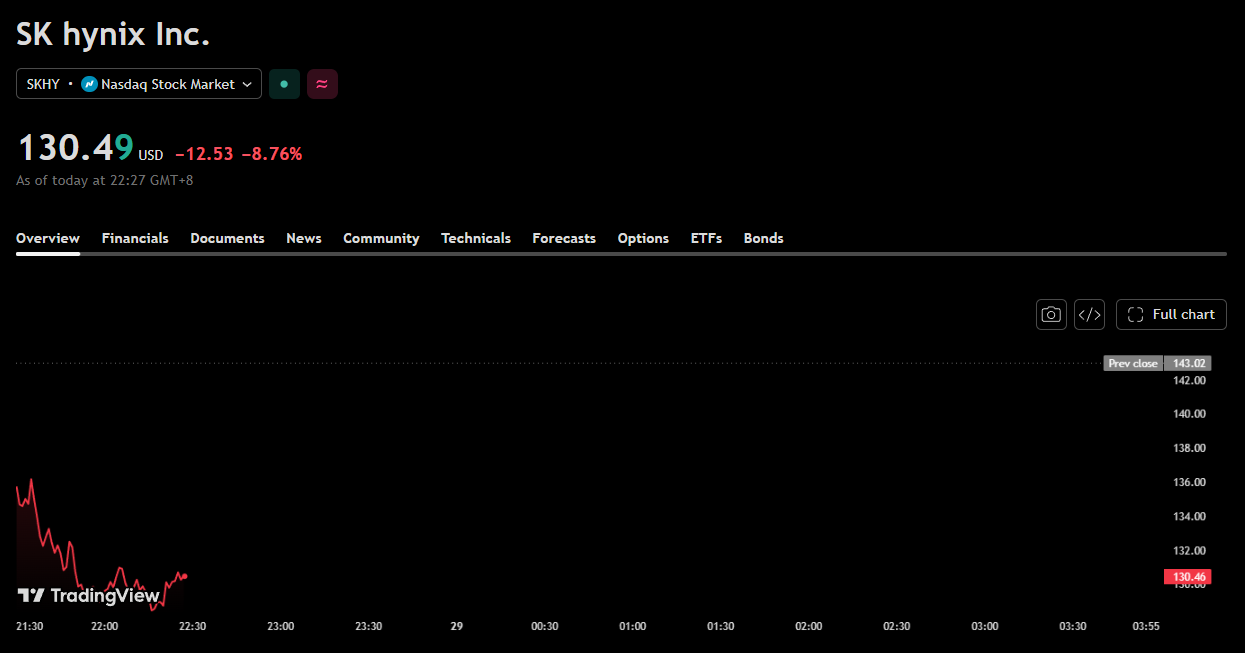
SK Hynix ADR stock price chart, Source: TradingView
SK Hynix is reportedly set to announce its second-quarter earnings after the market close today. On the same day, the two-way conversion mechanism between SK Hynix's US American Depositary Receipts (ADRs) and its locally listed common shares in South Korea is also expected to officially resume.
As of press time, SKHY's intraday share price was around $130, representing a premium of approximately 22.3% over its South Korean local shares (SK Hynix South Korean stock: 1,550,000 KRW, approximately $1,063).
Once the conversion mechanism is opened, if the channel for converting common shares to ADRs remains clear, investors will choose to "buy the relatively lower-priced South Korean shares, convert them into ADRs, and sell the premium-priced SKHY" due to the arbitrage opportunity between the two markets. This will support the South Korean shares, but SKHY will face an increase in stock supply, and the premium will narrow further.
However, the Korea Securities Depository (KSD) stated that SK Hynix has capped the total amount of local South Korean shares convertible into ADRs at 2.5% of its total outstanding shares. The ADR issuance quota has already been fully utilized by the initial listing; while there is no separate limit when canceling ADRs and converting them back to South Korean common shares, converting South Korean common shares into ADRs requires checking the remaining issuance quota.
Simply put, a portion of the price spread may persist in the long run. Converting South Korean common shares into ADRs requires the depositary bank to open its books and is also subject to constraints such as issuance caps, corporate consent, and brokers' operational capabilities.
Therefore, even if the conversion mechanism is nominally restored, currently only the one-way conversion from ADRs to South Korean shares may be operational. While converting South Korean common shares to ADRs is theoretically open, the initial remaining quota is zero.
Regarding second-quarter earnings, the market generally believes there are no signs of easing in the current data center memory shortage, and memory prices may continue to rise in the third quarter.
Morgan Stanley analyst Joseph Moore recently stated that discussions with procurement heads at several data centers revealed that HBM and high-end memory products remain in short supply, with memory prices expected to continue rising by at least 25% in the third quarter. He believes the recent correction in the memory sector's share prices reflects market sentiment rather than deteriorating fundamentals, and the industry's supply tightness could even persist until 2028.
On the other hand, Hynix is the current pricing anchor for the HBM market, with an HBM market share more than twice that of Micron. However, it should be noted that if Samsung completes customer qualification for HBM4, SK Hynix's market share and price premium will come under pressure. Meanwhile, Micron disclosed that the ramp-up speed of HBM4 12-high is twice that of HBM3E 12-high, and HBM4 revenue has already exceeded $1 billion, while mass production of HBM4E is expected to start in 2027.
Nothing in this material constitutes investment advice, personal recommendation, investment research, an offer, or a solicitation to buy or sell any financial instrument. The content has been prepared without consideration of your individual investment objectives, financial situation, or needs, and should not be treated as such.
Past performance is not a reliable indicator of future performance and/or results. Forward-looking scenarios or forecasts are not a guarantee of future performance. Actual results may differ materially from those anticipated.
Mitrade makes no representation or warranty as to the accuracy or completeness of the information provided and accepts no liability for any loss arising from reliance on such information.
Recommended Articles


