



Palantir Beat Revenue at 93% Growth — But the Stock Just Pulled Back to $171 to Test Support
TradingKey - Palantir Technology (PLTR)'s strong second quarter 2026 results fulfilled the bull thesis, yet the stock is consolidating following a breakout rally that drove the price to $179.45. The stock has since retreated to $171.10, approaching the $166.32 support level and is exhibiting a normal consolidation period after an extended rally. Positive revenue growth of 93 percent over last year and beating the consensus of $1.8 billion, and U.S. Commercial Services generating $764 million showing growth of 149 percent, forming the fastest growing segment, reflects elite level execution. A strong GAAP operating margin of 47 percent and gross margin of 80 percent adds to the execution level.
After ripping 48 points in two weeks from $130, profit takingSettlng of the stock will occur, but from a trading standpoint, the question is, will the $166.32 support level hold, continue the breakout pattern, or will a pullback set the start of a deeper correction?From an investing perspective, the fundamental performance of 93 percent growth, execution at a 155 percent Rule of 40 level, $6.24 billion of unconsummated contracts, and AI integrations are compelling fundamentals, and are not impacted by short term technicals.
The Operational Story Is Unambiguously Strong
Segments of Palantir's U.S. Commercial and U.S. Government contracts performed strongly, contributing to a 93% year-over-year growth in their $1.935 billion second quarter revenue from $1.80 billion. The commercial revenue represented a 149% growth year over year and a 39% contribution to Palantir’s total revenue, driving their forward guidance. The U.S. Government revenue represented a 90% growth and totaled $809 million. Palantir’s backlog in the second quarter was also impressive, totaling $3.37 billion and closing at a 49% year over year growth. Within the backlog, the commercial arm closed $2.13 billion, a new record high.
Palantir also posted an impressive growth in profitability. GAAP operating margin had a 47% growth over last year, and non-GAAP margin was an impressive 62%. The Rule of 40 score was an even higher 155%, with 93% growth in revenue and an impressive 62% growth on margins. GAAP net income was $1.062 billion at a 55% margin. Palantir was also able to generate free cash flow to the tune of $1.220 billion. Based on their cash flow, Palantir was able to finance their growth at $9.2 billion in cash with no capital raise.
Remaining Deal Value Is the Real Lead Indicator
The most important number is remaining deal value (RDV) of $6.24 billion, which was $5.73 billion in Q1. RDV represents the total amount of contracted revenue that is contractually bound to be spent and is the most accurate predictor of future revenue. At this company’s estimated quarterly revenue run rate of approximately $1.9 billion, $6.24 billion of RDV equals about 10 quarters of estimated future contracted revenue.
US Commercial RDV is at record-setting all-time highs. Provided Palantir continues its record-setting 149% year-over-year growth in its commercial business as its government business grows at an expected range of 15-20% each year, Palantir would very likely sustain over 50% year-over-year revenue growth for many years to come. This is what the market is indicating is possible with Palantir’s growth potential.
AI Integrations Validate the Platform Strategy
Beyond the peak numbers, Palantir has positioned itself well in the market with integrations for the OpenAI GPT-5 and the Anthropic Claude Sonnet 5, which provides clients instant access to different AI models from within the Palantir platform. This is a reference to the Palantir workflow with embedded agents. As enterprises automate decision-making through AI, Palantir can serve as the infrastructure layer within which these decisions are implemented and governed.
Technical Setup: Breakout Confirmed, Pullback Testing Support at $166.32
The 2 hour chart shows Palantir in a bullish structure after clearing a number of resistance levels in quick succession. The stock broke above $127.16, $140.07, and $152.99 and reached $179.45, before getting rejected. The pullback to $171.10 is testing $166.32 support.
The breakout remains technically important. Price rests well above the rising 50 and 100 period EMAs the $154.94 and $144.80 levels respectively. The trend therefore remains bullish. The support level at $166.32 needs to hold for the breakout structure to be maintained and encourage atry to the previous high of $179.45.
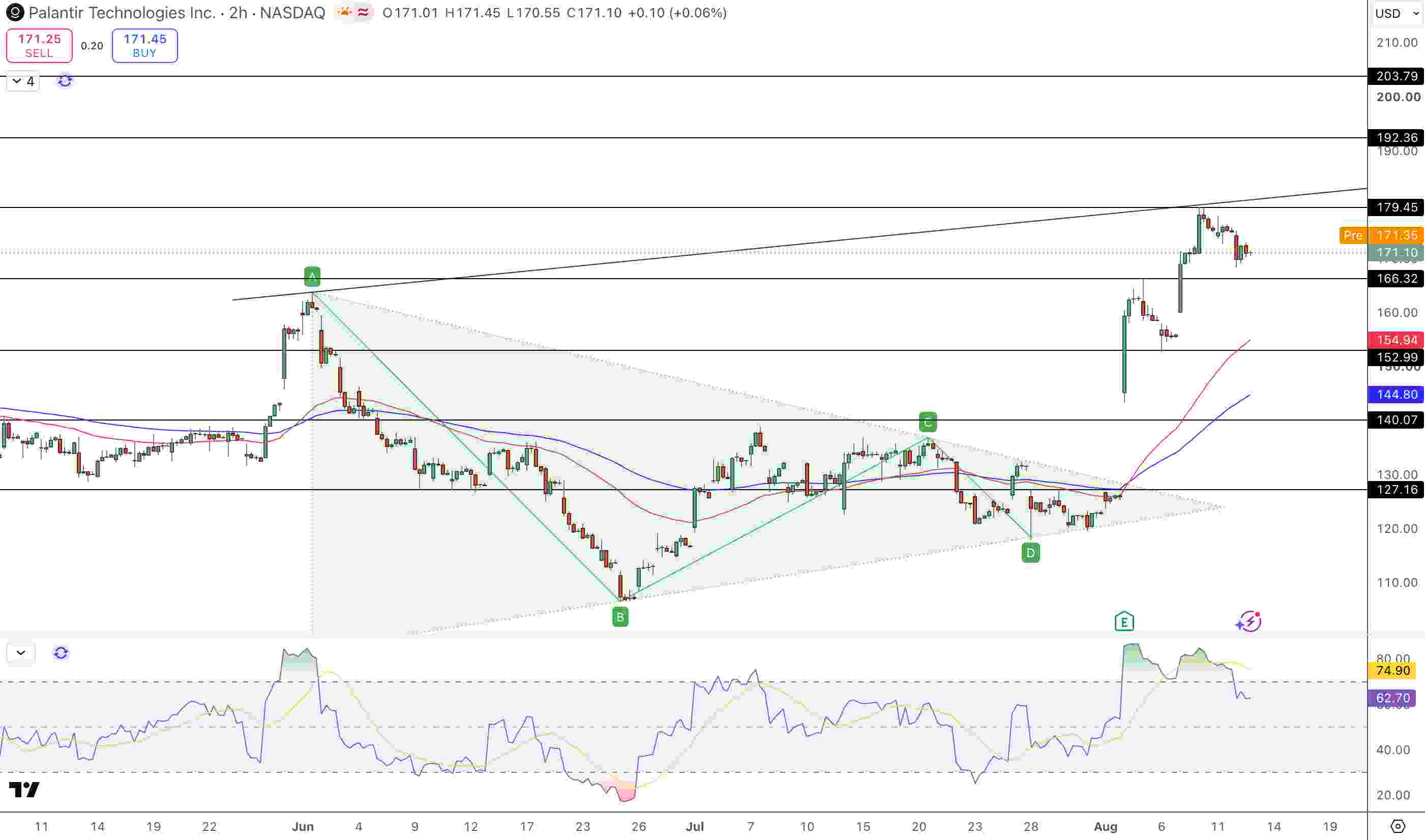
PLTR Price Chart - Source: Tradingview
Momentum has definitely cooled. The RSI has pulled back from above 70 to approximately 63. This is actually bullish for the trend as some of the momentum has come back and RSI S also has not dropped below the 50 bearish level. A break of the previous high at $179.45 exposes $192.36, and beyond that $203.79.
Key Levels (Aug 13)
- Immediate resistance: $179.45 (rejection level, must break)
- Extended targets: $192.36, $203.79 (if resistance breaks)
- Critical support: $166.32 (pivot, must hold)
- Secondary support: $154.94 (50 EMA), $152.99
- Deeper support: $144.80 (100 EMA)
- Current price: $171.10 (consolidating below resistance)
- RSI: 63 (strong but cooled from overbought)
Why Is the Stock Pulling Back Despite the Operational Beat?
Two reasons. First, after a 48-point rally in two weeks ($130-$179), a selloff was inevitable. The stock went up significantly all the way into the earnings, creating a lot of extended buyers. Second, valuing the stock at $171, means that the stock represents 107x forward earnings based on Street consensus. The pullback is essentially pricing $171 as expensive even for 93% growth. The pullback should also be seen as an opportunity for bulls to buy the stock on the way down before the next run up.
The Bottom Line
The recent numbers show it has been a stellar couple of quarters for Palantir (PLTR) in 2026: 93% YoY impressive revenue growth, a Rule of 40 at 155%, 149% in U.S. commercial, $6.24B in RDV (10+ Quarters of Visibility), and a 62% operating margin with $1.2B in free cash flow. AI integrations with OpenAI and Anthropic validate the platform strategy. Along with a sizable backlog and remaining deal value state palantir should not have any quarter demand risk.
After a strong breakout from a multi-month symmetrical triangle Palantir traded sideways in the $170 range before being established above support at $171.10. With an RSI of 63, PLTR is poised for significant growth. Key technical support is validated between $166.32 and $154.94. For swing traders support is validated at $166.32 and should be defended. For hold traders the 93% growth, 155% Rule of 40, $6.24B RDV, and AI integrations justify the current price. Consider buying stock for hold at any excursion above the support ranges. Disclaimer: not investment advice.
Nothing in this material constitutes investment advice, personal recommendation, investment research, an offer, or a solicitation to buy or sell any financial instrument. The content has been prepared without consideration of your individual investment objectives, financial situation, or needs, and should not be treated as such.
Past performance is not a reliable indicator of future performance and/or results. Forward-looking scenarios or forecasts are not a guarantee of future performance. Actual results may differ materially from those anticipated.
Mitrade makes no representation or warranty as to the accuracy or completeness of the information provided and accepts no liability for any loss arising from reliance on such information.
Recommended Articles


