



PDD Q2 Earnings Preview: Revenue Growth May Fail to Mask Profit Pressure as Wall Street Cuts Target Price to $80
TradingKey - Before the U.S. market open on August 24, Pinduoduo (PDD) will report its second-quarter 2026 financial results and hold an earnings conference call at 7:30 a.m. Eastern Time.
FactSet estimates that the company's second-quarter revenue will reach approximately $16.94 billion, up about 16.7% year-over-year, while adjusted earnings per share are projected at around $2.72, down roughly 11.6% year-over-year.
This means Pinduoduo may once again deliver results showing continued revenue growth alongside a decline in profitability.
As of the trading day prior to the earnings release, Pinduoduo's stock price was still hovering around $90, with the market awaiting the report to provide new answers regarding the company's growth prospects and valuation.
Revenue Continues to Grow, but Profit Pressure Is Mounting
Based on market expectations, Pinduoduo's second-quarter growth rate slowed noticeably compared to the past few quarters, but still maintained double-digit growth. Meanwhile, profitability faces greater pressure.
This is closely tied to the company's strategic adjustments in recent years.
Facing weak consumer demand and intensifying domestic e-commerce competition, Pinduoduo continues to maintain platform competitiveness through subsidies and supply chain investments. In particular, promotional strategies such as the "10 Billion Subsidy" program help the platform sustain user activity and transaction volume, but also mean yielding a portion of profits to consumers and merchants.
In addition, Pinduoduo is further strengthening its private labels, supply chain, and first-party merchandise business. Such investments are difficult to quickly translate into short-term profits, but could determine the platform's future product mix and profitability.
Its overseas business also requires substantial funding support. Temu has continued to expand its overseas market reach in recent years, with costs for logistics, marketing, localized operations, and consumer subsidies remaining elevated. In other words, Pinduoduo currently appears to be trading a portion of short-term profits for future market share.
Daiwa Securities expects Pinduoduo's second-quarter adjusted operating margin to drop by about 2 percentage points year-over-year to 24.7%. Morgan Stanley also notes that as the company enters a new business investment cycle, investments in supply chain and first-party brands could continue to put pressure on profitability in the second half of the year.
Temu Is Changing Pinduoduo's Revenue Structure
Compared with profit margins, Temu may be the most noteworthy long-term variable in this earnings report.
In the first quarter of this year, Pinduoduo's transaction services revenue reached RMB 56.3 billion, up 20% year-over-year, surpassing online marketing services revenue for the first time to become one of the company's largest revenue sources.
In the past, the market largely viewed it as an e-commerce platform relying on advertising and traffic monetization; however, with the rising importance of its transaction services business, the company is transitioning toward a more diversified business model.
From a long-term perspective, this shift is positive. A larger overseas market means that Temu could theoretically help Pinduoduo unlock new room for growth. However, practical challenges are equally real: Temu currently still needs to acquire users through price advantages, marketing, and logistics fulfillment, and whether revenue growth can ultimately convert into stable profits will still take time to verify.
Therefore, what the market truly wants to see from the second-quarter earnings report is not just how much revenue Temu generated, but whether its growth efficiency has improved. If transaction volume continues to expand rapidly while cost growth begins to decelerate, investors may re-rate Pinduoduo's overseas business upward; conversely, if Temu still relies on heavy subsidies to sustain its expansion, profit margin pressure may persist for longer.
However, Temu is currently still in an expansion phase.
Although overseas markets offer greater potential for growth, they are also accompanied by complex factors such as regulation, logistics, taxes, and localized operations. The market is willing to pay a valuation premium for Temu's long-term growth, but only on the condition that the company can ultimately prove this business can generate not only revenue but also a gradually improving profit contribution.
Analysts Give Lowest $80 Price Target
Wall Street's stance on Pinduoduo has turned noticeably cautious recently, reflecting cooling market expectations for the company's future growth rate and profitability prospects.
Source: TipRanks
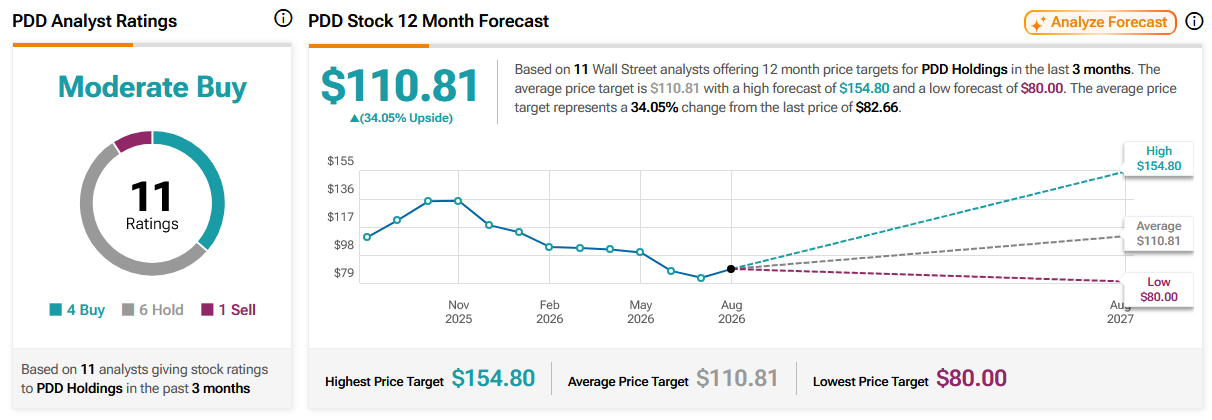
According to TipRanks statistics, 11 analysts have provided price targets for PDD Holdings over the past three months, with an average target of $110.81, a high of $154.80, and a low of just $80.
Over the past few months, several institutions have successively lowered their price targets for PDD. On May 28, Barclays cut its price target from $165 to $89, Macquarie reduced its target from $151 to $87, and Benchmark lowered its target from $160 to $127; Citi cut its target price from $142 to $123 on May 27.
On June 16, BNP Paribas initiated coverage with an $89 price target; subsequently, Daiwa Securities downgraded Pinduoduo to "Hold", with its price target further lowered to $80. Successive target price cuts by analysts indicate that the market is re-evaluating Pinduoduo's growth potential and risk premium.
As expectations cooled, PDD's valuation also pulled back significantly. As of August 21, the stock closed at $88.38, down 1.27% on the day, with the company's market capitalization at approximately $125.8 billion. Although its current valuation is at a relatively low level, whether the stock can regain upward momentum still depends on whether earnings growth can stabilize and whether the company can alleviate market concerns over intensifying competition and rising investments.
Nothing in this material constitutes investment advice, personal recommendation, investment research, an offer, or a solicitation to buy or sell any financial instrument. The content has been prepared without consideration of your individual investment objectives, financial situation, or needs, and should not be treated as such.
Past performance is not a reliable indicator of future performance and/or results. Forward-looking scenarios or forecasts are not a guarantee of future performance. Actual results may differ materially from those anticipated.
Mitrade makes no representation or warranty as to the accuracy or completeness of the information provided and accepts no liability for any loss arising from reliance on such information.
Recommended Articles


