



Nokia Q3 Earnings Beat Estimates as AI and Cloud Grow 123%, Yet Stock Still Falls Over 3% Pre-Market
TradingKey - Before the market open on October 22 ET, Nokia (NOK) reported its third-quarter 2026 financial results, with net sales increasing 10% year-over-year to 5.154 billion euros (approximately $5.788 billion), above market estimates of 5.06 billion euros; comparable operating profit rose 35% to 605 million euros, beating market estimates of 454 million euros.
Sales to AI and cloud customers grew 123% year-over-year, and order intake rose 118%, becoming a major driver of performance growth.
However, Nokia's third-quarter reported operating profit fell 22% year-over-year to 196 million euros, and the reported operating margin dropped from 5.4% in the same period last year to 3.8%, mainly impacted by higher restructuring and integration costs.
Meanwhile, the company lowered its full-year free cash flow conversion rate expectation to 35%–55%, reflecting cash flow pressure from increased working capital investment and accelerated restructuring.
Nokia maintained its full-year 2026 comparable operating profit guidance of 2.1 billion to 2.6 billion euros and expects fourth-quarter sales to grow 20% to 24% sequentially. Whether subsequent performance can meet expectations will depend on the realization of AI network demand, fourth-quarter revenue growth, and cost control.
As of press time, Nokia's pre-market stock price was down 3.14% at $8.96.
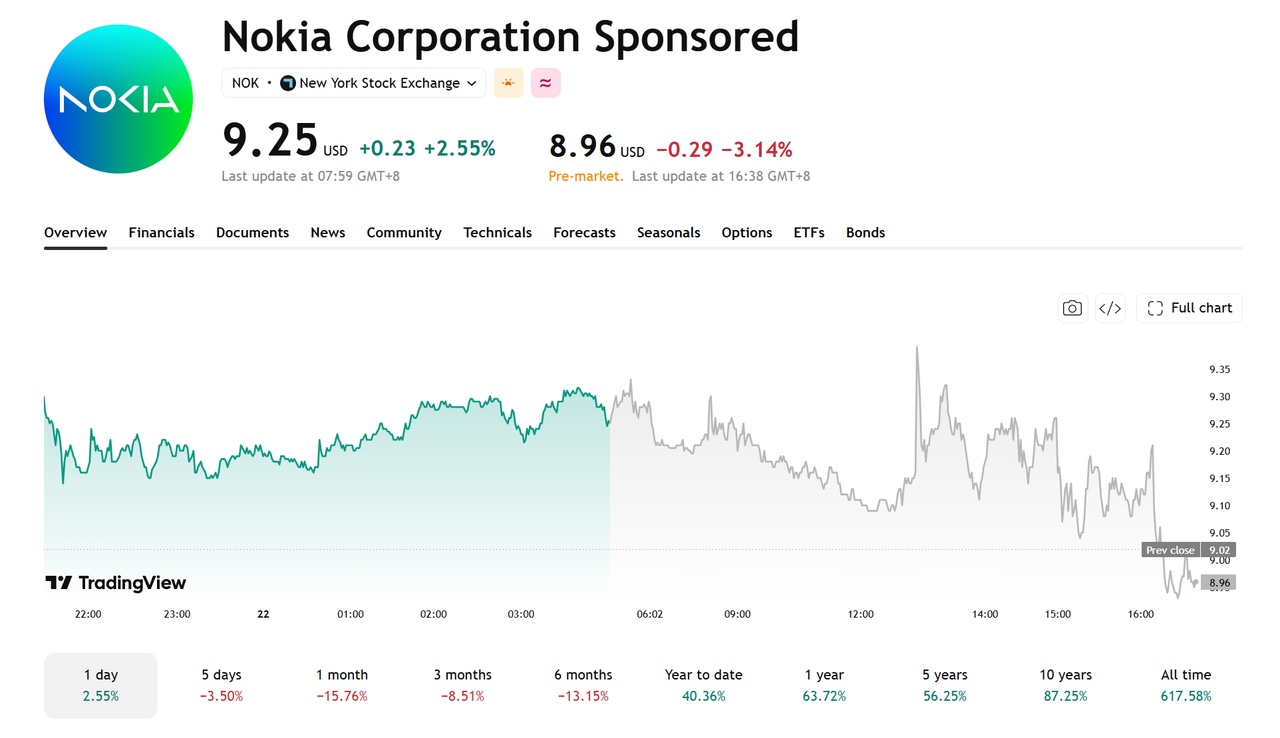
[Source: TradingView]
AI Data Center Demand Drives Networking Business Growth
On a constant currency basis, Nokia's third-quarter Network Infrastructure net sales grew 15% year-over-year, with IP Networks sales up 43% and Optical Networks sales up 18%.
During the same period, the company's sales to AI and cloud customers surged 123% year-over-year, while related order intake rose 118%.
The ongoing expansion of AI data centers has driven demand for high-speed routing, switching, and optical transport equipment. Nokia expects combined growth in its IP Networks and Optical Networks businesses to reach 25%-30% by 2027, higher than previous growth levels, reflecting the company's optimism regarding their business prospects.
Going forward, order delivery and revenue recognition progress remain key to watch. If customer procurement and project delivery meet expectations, AI-related demand is poised to continue driving growth in the Network Infrastructure business.
Nokia's Cash Flow Pressure Still Needs Attention
Nokia lowered its full-year 2026 free cash flow conversion rate guidance from 55%–75% to 35%–55%, and raised its forecast for restructuring and related expenses to 1.1 billion euros.
The company plans to invest an additional 400 million euros in working capital to secure supply and support business growth in 2027, while accelerating its restructuring process.
Despite continued growth in comparable operating profit, increased working capital investment and restructuring expenses may still weigh on cash flow performance. Going forward, key factors to watch include whether business growth materializes as planned, and whether the company can control restructuring costs and improve cash flow.
What Should Investors Watch Next?
Nokia's future performance primarily depends on whether the growth in its AI networking business can translate into sustainable profitability. If orders continue to materialize and fourth-quarter results meet expectations, the market may pay further attention to its 2027 growth potential; conversely, if revenue growth slows or cash flow pressure expands, valuation improvement could be constrained.
Investors should focus on fourth-quarter revenue and comparable operating profit, order conversion from AI and cloud customers, as well as changes in free cash flow and restructuring charges. While AI networking demand provides Nokia with growth opportunities, sustained share price support still hinges on improvements in profitability and cash flow.
Nothing in this material constitutes investment advice, personal recommendation, investment research, an offer, or a solicitation to buy or sell any financial instrument. The content has been prepared without consideration of your individual investment objectives, financial situation, or needs, and should not be treated as such.
Past performance is not a reliable indicator of future performance and/or results. Forward-looking scenarios or forecasts are not a guarantee of future performance. Actual results may differ materially from those anticipated.
Mitrade makes no representation or warranty as to the accuracy or completeness of the information provided and accepts no liability for any loss arising from reliance on such information.
Recommended Articles


