



Nvidia Stock Price Forecast: Jensen Huang's Return Eases Leadership Uncertainty, but House Hearing Scrutiny Looms as Stock Still Risks Falling to $142
TradingKey - On November 23, Eastern Time, the board of directors of Nvidia (NVDA) reinstated Jensen Huang as chief executive officer, easing uncertainty over company leadership.
However, Nvidia still faces two major risks: on what basis the board determined that Huang's reinstatement would not pose national security risks, and how Nvidia and the U.S. Department of Commerce previously handled advanced chip exports and customer vetting.
Huang is reportedly set to appear before the House of Representatives on December 1 for a closed-door interview, the first congressional inquiry he must face following his reinstatement.
Democrats Question Basis for Reinstatement as Probe Extends to Government Decisions
Senate Democratic Leader Chuck Schumer said Democrats will vigorously investigate Jensen Huang, other Nvidia executives, and government officials. Elizabeth Warren, who is expected to take the helm of the Senate Banking Committee next January, criticized the reinstatement decision as "reckless" and demanded that the board provide an explanation to Congress.
Democratic Representative Debbie Dingell questioned why the board decided to bring Huang back before Congress had even heard from him directly. Republican Senator John Cornyn also pressed for the basis on which the board determined that the reinstatement posed no national security risk.
More noteworthy for investors than political posturing is that lawmakers have already begun seeking decision records. Warren and others demanded that the Department of Commerce, the State Department, and the White House preserve documents related to Nvidia's advanced chip exports to China and associated national security risks.
A House committee letter to Nvidia also raised issues such as potential chip diversion, end-use checks, and whether the company had interfered with export control investigations, which involve Singapore customer Megaspeed. These matters remain under investigation. Meanwhile, Trump stated that the Attorney General confirmed to him that the government has no evidence of wrongdoing by Huang himself.
What Inquiries Are Coming in December, and How Might They Impact Nvidia?
On December 1 and 2, the House of Representatives will separately hear testimony from Jensen Huang and Nvidia General Counsel Tim Teter. The Foreign Affairs Committee, the Intelligence Committee, and the Select Committee on Strategic Competition between the United States and China will jointly conduct closed-door interviews, producing a verbatim transcript.
For Nvidia, the most direct operational risk lies in delivery timelines for overseas orders. If the investigation prompts regulators to tighten end-user verification, some orders may require supplemental documentation or face longer wait times before shipping, and related revenue recognition could also be delayed. Only if subsequent legislation further restricts specific customers or regions from obtaining advanced chips would the impact expand from delivery delays to a narrowing addressable market. Schumer had previously publicly called on Congress to advance chip export control legislation.
In the near term, valuation may reflect pressure from the investigation sooner than financial performance. Nvidia's board has clarified that the independent investigation will continue following Jensen Huang's reinstatement. For shareholders, the key focus in December is whether the inquiries reveal previously undisclosed compliance issues, and whether the Department of Commerce alters licensing or enforcement requirements as a result. The former affects market confidence in the board's oversight capabilities, while the latter would directly alter investors' expectations for overseas revenue.
Nvidia Technical Analysis
From a technical perspective, boosted by Jensen Huang's return, Nvidia gapped up sharply following a steep plunge in the previous trading session, climbing back above its prior low ($164.27). However, an intraday dip to $156.93 indicates that this prior low remains a contested battleground.
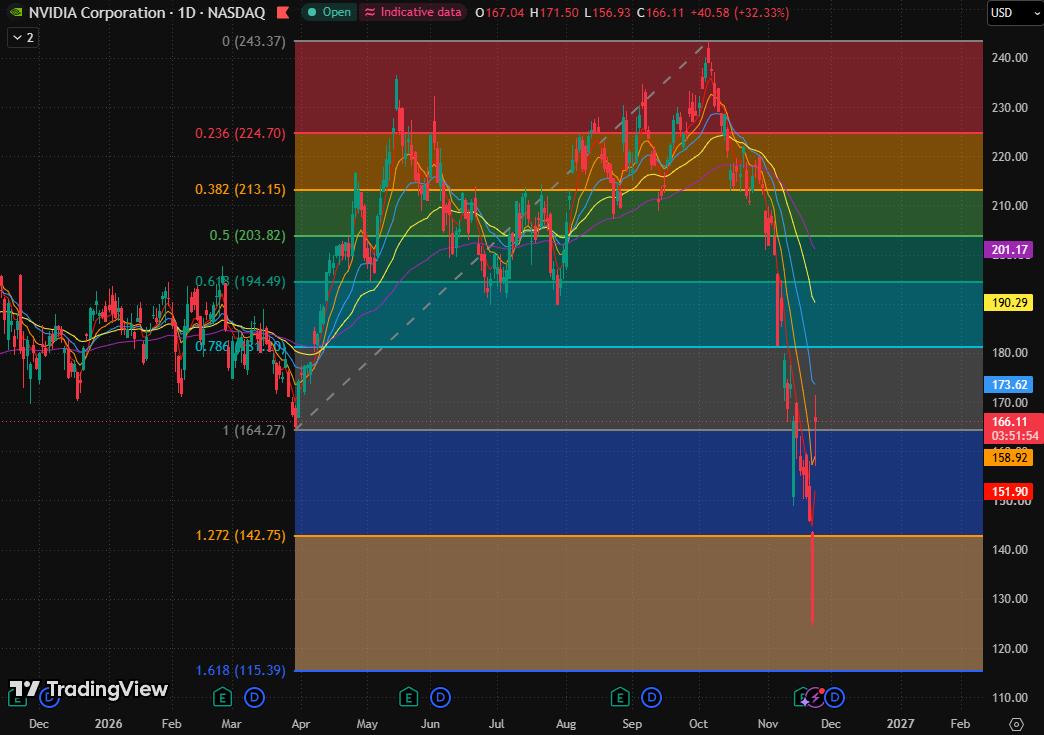
Nvidia Daily Chart, Source: TradingView
Regarding moving averages, the stock price has climbed back above the 5-day exponential moving average ($151.90) and the 10-day exponential moving average ($158.92), with both averages turning upward alongside the rebound. Meanwhile, the 20-day exponential moving average ($173.62), 80-day exponential moving average ($190.29), and 160-day exponential moving average ($201.17) continue to trend downward. The five moving averages remain sequentially higher across shorter to longer timeframes, maintaining a bearish alignment.
The current focus is on whether the stock can hold $164.27 on a pullback. If it successfully defends this level, the rebound is expected to continue testing the $171.50–$173.62 zone formed by the intraday high and the 20-day exponential moving average. Further structural resistance lies at the 0.786 Fibonacci retracement level ($181.20).
The primary risk is that, despite the news-driven catalyst, the stock still fails to reclaim $164.27 and subsequently breaks below the upper boundary of the gap. If buying support also fails to emerge near the 5-day exponential moving average, the stock could proceed to fill the gap and retest the area near the 1.272 Fibonacci extension reference ($142.75).
Nothing in this material constitutes investment advice, personal recommendation, investment research, an offer, or a solicitation to buy or sell any financial instrument. The content has been prepared without consideration of your individual investment objectives, financial situation, or needs, and should not be treated as such.
Past performance is not a reliable indicator of future performance and/or results. Forward-looking scenarios or forecasts are not a guarantee of future performance. Actual results may differ materially from those anticipated.
Mitrade makes no representation or warranty as to the accuracy or completeness of the information provided and accepts no liability for any loss arising from reliance on such information.
Recommended Articles


