



NZD/USD (NZDUSD) Moved Sharply on Sep 23: Are Central Bank Expectations Shifting?
NZD/USD (NZDUSD) is down 0.51% at Sep 23 04:15(ET), now at $0.56961, with a 7-day down of 0.27%.
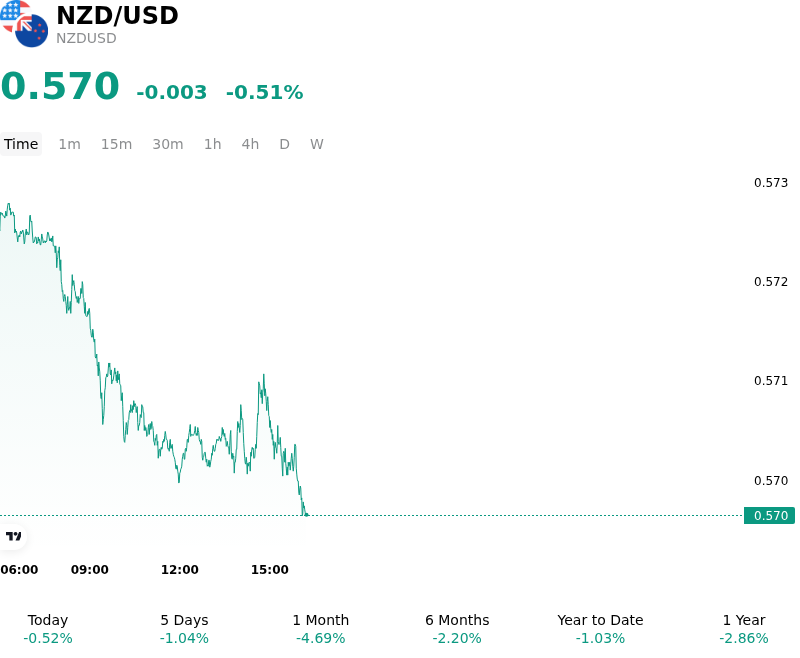
What is driving NZD/USD (NZDUSD)’s stock price down today?
The weakness in the New Zealand dollar against the US dollar was primarily driven by broad-based strength in the greenback, as foreign exchange markets continued to reprice Federal Reserve monetary policy expectations toward a more restrictive stance. Hawkish communications from Federal Reserve officials highlighted persistent upside inflation risks and sustained labor market resilience, fueling market sentiment that US interest rates will remain higher for longer, with the potential for additional monetary tightening before the end of the year. This elevated hawkish tone pushed the US Dollar Index to multi-month highs and lifted US Treasury yields across the front end of the curve.
The resulting expansion of the US yield advantage relative to New Zealand benchmark rates exacerbated downside pressure on the currency pair. While the Reserve Bank of New Zealand previously delivered a quarter-point rate increase to bring its Official Cash Rate to 2.75 percent, subsequent central bank guidance was interpreted as relatively cautious and data-dependent. Consequently, market expectations for further RBNZ tightening lagged behind the more aggressive monetary posture of the Fed. The widening short-term interest rate differential between the United States and New Zealand served as the primary macro mechanism driving capital outflows from the kiwi toward higher-yielding greenback assets.
Subdued risk sentiment and fluctuations in global commodity markets, particularly easing energy prices, provided additional headwinds for risk-sensitive currencies like the New Zealand dollar. With the macro backdrop dominated by relative monetary policy trajectories, institutional positioning favored the dollar's superior yield backing and defensive qualities. Technical factors further reinforced the downward trajectory, as the pair struggled to overcome resistance below short-term moving averages, encouraging systematic and momentum-based selling. In the absence of high-tier domestic economic catalysts from New Zealand to counter the greenback's momentum, the broader macro divergence between the Federal Reserve and the Reserve Bank of New Zealand kept the balance of risks firmly tilted to the downside.
Technical Analysis of NZD/USD (NZDUSD)
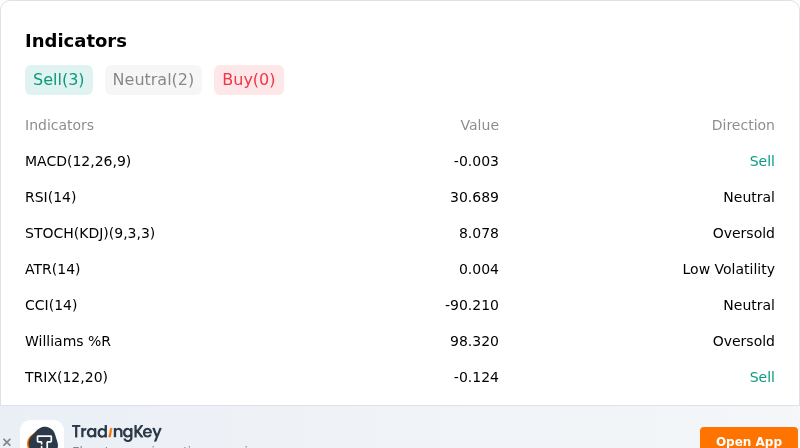
Technically, NZD/USD (NZDUSD) shows a MACD (12,26,9) value of -0.003, indicating a sell signal. The RSI at 30.689 suggests neutral condition and the Williams %R at 98.320 suggests oversold condition. Please monitor closely.
More details about NZD/USD (NZDUSD)
Recent Events and Risks:
- Widening US-NZ Yield Differential: Hawkish comments from Federal Reserve officials emphasizing persistent US inflation have reinforced higher-for-longer rate expectations, expanding the US 2-year yield premium over New Zealand toward historical extremes and keeping continuous downward pressure on NZDUSD around the 0.5710 level.
- RBNZ Cautious Outlook and Domestic Economic Weakness: Market participants remain wary of the Reserve Bank of New Zealand's cautious policy trajectory, as domestic growth headwinds—including rising unemployment approaching 5.0%, sluggish housing market activity, and subdued household spending—limit RBNZ's scope to match Fed rate levels.
- Risk Off Sentiment Ahead of Geopolitical and Macro Events: Subdued market sentiment ahead of US preliminary PMI data releases and upcoming high-stakes diplomatic trade talks continues to curb global risk appetite, exposing high-beta commodity currencies like the Kiwi dollar to sudden intraday sell-offs.
- Technical Breakdown and Bearish Momentum: NZDUSD's sustained break below the critical 0.5720 support level and trading beneath its key exponential moving averages has confirmed a dominant short-term bearish trend, exposing the pair to further downside acceleration toward 0.5630.
Nothing in this material constitutes investment advice, personal recommendation, investment research, an offer, or a solicitation to buy or sell any financial instrument. The content has been prepared without consideration of your individual investment objectives, financial situation, or needs, and should not be treated as such.
Past performance is not a reliable indicator of future performance and/or results. Forward-looking scenarios or forecasts are not a guarantee of future performance. Actual results may differ materially from those anticipated.
Mitrade makes no representation or warranty as to the accuracy or completeness of the information provided and accepts no liability for any loss arising from reliance on such information.
Recommended Articles


