



SPCX Stock Price Prediction: SpaceX President Plans to Sell $52 Million of Stock, Can the Stock Keep Rising?
TradingKey - At the close on September 22 US Eastern Time, SpaceX (SPCX) shares rose approximately 1.9% to close at $154.72, snapping a two-day losing streak. However, in after-hours and overnight trading, news that company President and Chief Operating Officer Gwynne Shotwell filed to sell stock weighed on market sentiment, sending SPCX slightly lower at one point overnight.
Currently, SpaceX's stock price is in a key bull-bear battleground around $150 in the short term. On one hand, executive stock sales and a potential increase in share supply post-IPO may limit short-term valuation expansion; on the other hand, Starship's next key flight test, Starlink's business growth, and government contracts continue to provide fundamental support for SpaceX.
Executive Selling Brings Short-Term Pressure as Starship Remains Core Catalyst
According to the latest filing, Shotwell plans to sell 342,170 shares of SpaceX common stock, with a total value of nearly $52 million based on the price at the time of filing. However, the sale is not a spontaneous decision, but part of a Rule 10b5-1 trading plan she established in June this year, which involves up to 585,605 shares.
Therefore, the share reduction itself does not directly imply a change in company fundamentals. However, as SpaceX only recently completed its IPO in June this year, the market remains relatively sensitive to insider sales and the increase in circulating shares. Following the announcement, SPCX's after-hours price briefly pulled back to around $154.1, down about 0.3% from its closing price of $154.72.
Meanwhile, another layer of support exists on the supply-demand side of the stock. Following the latest quarterly rebalancing of the Nasdaq-100, SpaceX's weight in the index is expected to increase from approximately 1.28% to up to roughly 2.82%. As a large number of ETFs and index funds need to track weight adjustments in the Nasdaq-100 Index, this means some passive capital may need to increase allocation to SPCX, partially offsetting the pressure brought by early shareholders and insiders increasing stock supply.
On the business front, Starship remains the core variable affecting SPCX's valuation. SpaceX currently plans to conduct the 14th flight test of Starship no earlier than September 28. The goals of this mission include having the Starship upper stage complete its first stable orbital flight, orbiting Earth six times, and deploying 26 Starlink V3 satellites, with the entire mission expected to last nearly 10 hours.
Compared with previous tests, the significance of Flight 14 lies in Starship further transitioning from a pure test platform to undertaking actual satellite deployment missions. If the mission is successfully completed, it will help validate Starship's capability to deploy Starlink V3 satellites on a large scale in the future, while also bearing on SpaceX's plans to further reduce unit launch costs and expand Starlink network capacity.
SpaceX's traditional aerospace business has also recently gained support from new orders. On September 18, NASA awarded SpaceX an additional contract of approximately $946 million for three additional crewed missions to the International Space Station, raising the total value of their commercial crew contract to roughly $5.92 billion and increasing the total number of NASA crewed missions awarded to SpaceX to 17.
SPCX Stock Technical Analysis: $150 Becomes Key Support, Next Target Eyes $172
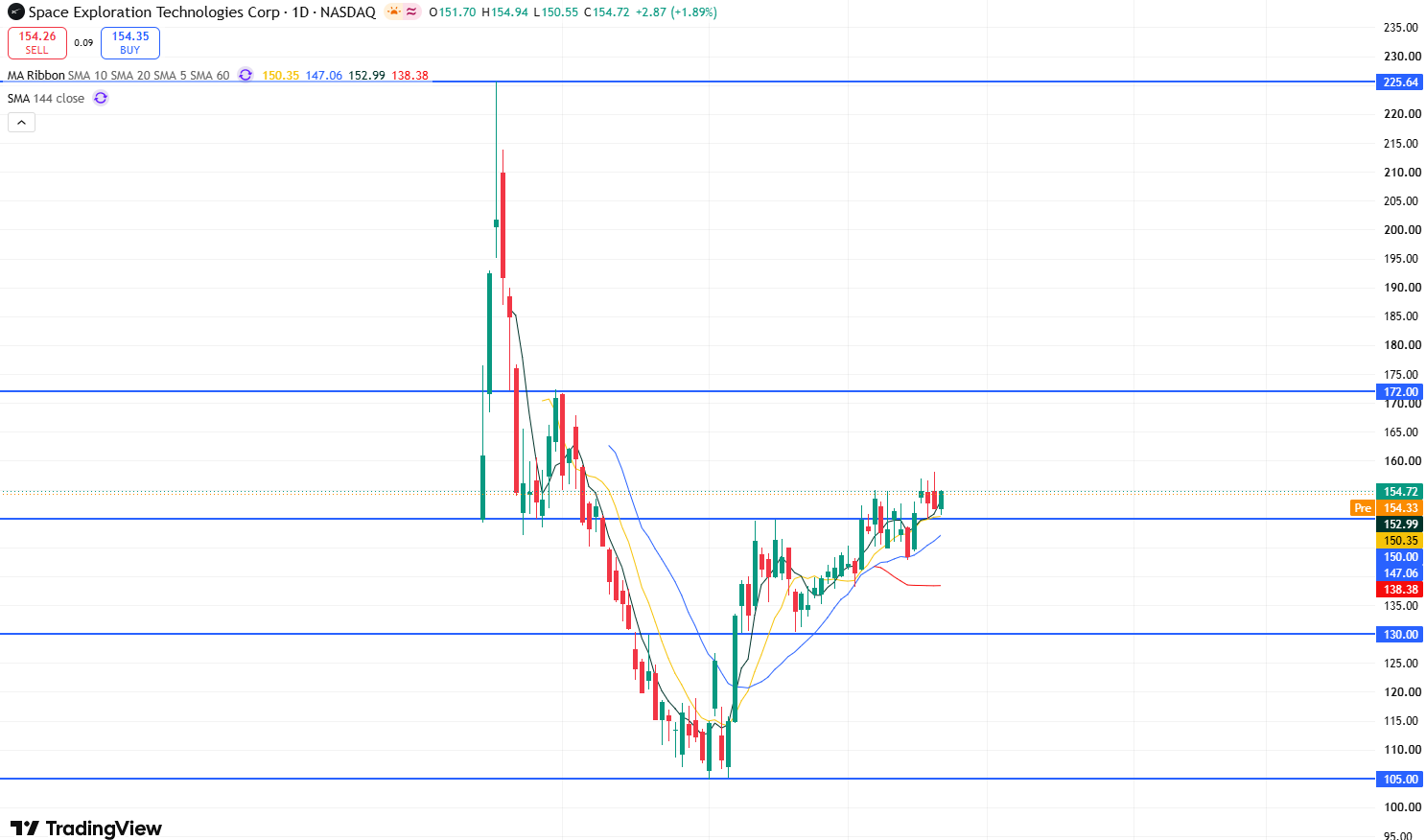
SPCX daily stock price chart, Source: TradingView
From the daily chart of SPCX's stock price, after surging 5.15% on September 16 and reclaiming $150, SPCX has closed above $150 for four consecutive trading days, indicating that the $150 area has become the most crucial short-term support zone for bulls.
Meanwhile, SPCX has continued to trade above its 20-day moving average recently, indicating that its short-term trend maintains strong bullish momentum. Bullish sentiment dominates the market, and SPCX may continue to rise in the short term.
At present, the primary upside resistance level to watch for SPCX is $160, followed by $168. If SPCX holds firmly above $168, it will test the resistance level at $172. A breakthrough above this level would open up greater upside room, with the potential to challenge the $200 mark.
On the downside, the primary support level to watch for SPCX is $150. If this level is lost, SPCX may further test the support of its 20-day moving average, with the next level down at $140.
Nothing in this material constitutes investment advice, personal recommendation, investment research, an offer, or a solicitation to buy or sell any financial instrument. The content has been prepared without consideration of your individual investment objectives, financial situation, or needs, and should not be treated as such.
Past performance is not a reliable indicator of future performance and/or results. Forward-looking scenarios or forecasts are not a guarantee of future performance. Actual results may differ materially from those anticipated.
Mitrade makes no representation or warranty as to the accuracy or completeness of the information provided and accepts no liability for any loss arising from reliance on such information.
Recommended Articles


