



United States Dollar Index jumps to near 100.70 as Fed maintains hawkish rhetoric
- The US Dollar Index trades firmly near its seven-week high at around 100.70.
- The Fed is almost certain to deliver at least one more interest rate hike this year.
- Fed’s Goolsbee warns that policy could turn “more aggressive and more and more front-loaded.
The US Dollar reflects strength on Wednesday amid firm expectations that the Federal Reserve (Fed) will deliver more interest rate hikes this year.
In the Asian trade, the US Dollar Index (DXY), which gauges the Greenback’s value against six major currencies, trades 0.15% higher to near 100.70, the highest level seen in over seven weeks.
US Dollar Price Today
The table below shows the percentage change of US Dollar (USD) against listed major currencies today. US Dollar was the strongest against the New Zealand Dollar.
| USD | EUR | GBP | JPY | CAD | AUD | NZD | CHF | |
|---|---|---|---|---|---|---|---|---|
| USD | 0.16% | 0.20% | 0.13% | 0.12% | 0.19% | 0.42% | 0.09% | |
| EUR | -0.16% | 0.03% | -0.02% | -0.02% | 0.05% | 0.25% | -0.06% | |
| GBP | -0.20% | -0.03% | -0.04% | -0.08% | 0.02% | 0.23% | -0.02% | |
| JPY | -0.13% | 0.02% | 0.04% | -0.02% | 0.02% | 0.28% | 0.00% | |
| CAD | -0.12% | 0.02% | 0.08% | 0.02% | 0.05% | 0.30% | 0.03% | |
| AUD | -0.19% | -0.05% | -0.02% | -0.02% | -0.05% | 0.24% | -0.02% | |
| NZD | -0.42% | -0.25% | -0.23% | -0.28% | -0.30% | -0.24% | -0.26% | |
| CHF | -0.09% | 0.06% | 0.02% | -0.01% | -0.03% | 0.02% | 0.26% |
The heat map shows percentage changes of major currencies against each other. The base currency is picked from the left column, while the quote currency is picked from the top row. For example, if you pick the US Dollar from the left column and move along the horizontal line to the Japanese Yen, the percentage change displayed in the box will represent USD (base)/JPY (quote).
According to the CME FedWatch tool, the odds of the Fed delivering at least one more interest rate hike this year are almost 90%.
Latest remarks from various Fed members pointing to upside inflation risks from both demand and supply shocks and the needs of more interest rate hikes have strengthened the US Dollar.
Fed rhetoric keeps Dollar bulls on the front foot
Brown Brothers Harriman’s Elias Haddad highlights that Fed officials are reinforcing the prospect of additional tightening, underscoring the bank’s constructive view on the Dollar. BBH notes that St. Louis Fed President Alberto Musalem, a non-voter this year, cautioned that “further rate hikes may be needed to curb inflation,” while Chicago Fed President Austan Goolsbee, a 2027 voter, warned that policy could turn “more aggressive and more and more front-loaded” if demand is judged to be overheating. According to BBH, this combination of hawkish guidance from both current and future FOMC participants helps sustain the perception that “more tightening is in the pipeline,” supporting the US growth and yield advantage versus the Euro, Pound and Yen.
On Tuesday, Richmond Fed Bank President Thomas Barkin said,” Last week's rate hike will help restore price stability, we'll see if more hikes are needed.”
US Dollar Index Technical Analysis
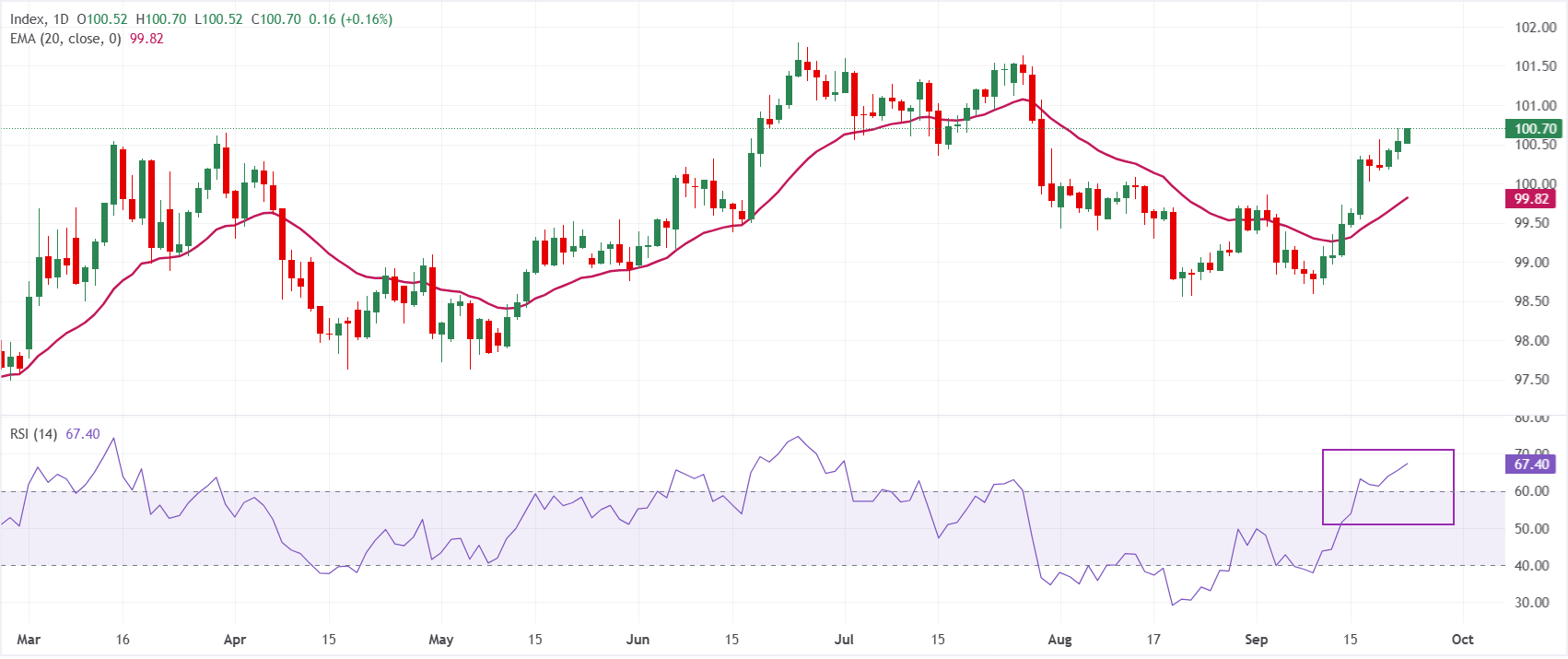
In the daily chart, Dollar Index Spot trades at 100.70. The index holds above the 20-day exponential moving average (EMA) at 99.82, keeping the near-term tone bullish as price extends its advance away from the short-term trend reference. The Relative Strength Index (14) at 67.40 approaches overbought territory, suggesting strong but stretched upside momentum after the recent climb.
On the downside, immediate support is seen at the current area around 100.70, followed by the 20-day EMA at 99.82, which reinforces the underlying demand zone on any pullback. With no nearby overhead technical levels from this dataset, momentum conditions hint that the index could consolidate or correct modestly before attempting further gains, while staying broadly supported above the 20-day EMA.
(The technical analysis of this story was written with the help of an AI tool. Know more.)
US Dollar FAQs
The US Dollar (USD) is the official currency of the United States of America, and the ‘de facto’ currency of a significant number of other countries where it is found in circulation alongside local notes. It is the most heavily traded currency in the world, accounting for over 88% of all global foreign exchange turnover, or an average of $6.6 trillion in transactions per day, according to data from 2022. Following the second world war, the USD took over from the British Pound as the world’s reserve currency. For most of its history, the US Dollar was backed by Gold, until the Bretton Woods Agreement in 1971 when the Gold Standard went away.
The most important single factor impacting on the value of the US Dollar is monetary policy, which is shaped by the Federal Reserve (Fed). The Fed has two mandates: to achieve price stability (control inflation) and foster full employment. Its primary tool to achieve these two goals is by adjusting interest rates. When prices are rising too quickly and inflation is above the Fed’s 2% target, the Fed will raise rates, which helps the USD value. When inflation falls below 2% or the Unemployment Rate is too high, the Fed may lower interest rates, which weighs on the Greenback.
In extreme situations, the Federal Reserve can also print more Dollars and enact quantitative easing (QE). QE is the process by which the Fed substantially increases the flow of credit in a stuck financial system. It is a non-standard policy measure used when credit has dried up because banks will not lend to each other (out of the fear of counterparty default). It is a last resort when simply lowering interest rates is unlikely to achieve the necessary result. It was the Fed’s weapon of choice to combat the credit crunch that occurred during the Great Financial Crisis in 2008. It involves the Fed printing more Dollars and using them to buy US government bonds predominantly from financial institutions. QE usually leads to a weaker US Dollar.
Quantitative tightening (QT) is the reverse process whereby the Federal Reserve stops buying bonds from financial institutions and does not reinvest the principal from the bonds it holds maturing in new purchases. It is usually positive for the US Dollar.
Nothing in this material constitutes investment advice, personal recommendation, investment research, an offer, or a solicitation to buy or sell any financial instrument. The content has been prepared without consideration of your individual investment objectives, financial situation, or needs, and should not be treated as such.
Past performance is not a reliable indicator of future performance and/or results. Forward-looking scenarios or forecasts are not a guarantee of future performance. Actual results may differ materially from those anticipated.
Mitrade makes no representation or warranty as to the accuracy or completeness of the information provided and accepts no liability for any loss arising from reliance on such information.
Recommended Articles


