



WTI Futures (USOIL-F) Is up 2.14% on Oct 23: What Changed in Supply and Demand?
WTI Futures (USOIL-F) is up 2.14% at Oct 23 05:35(ET), now at $101.15, with a 7-day up of 2.19%.
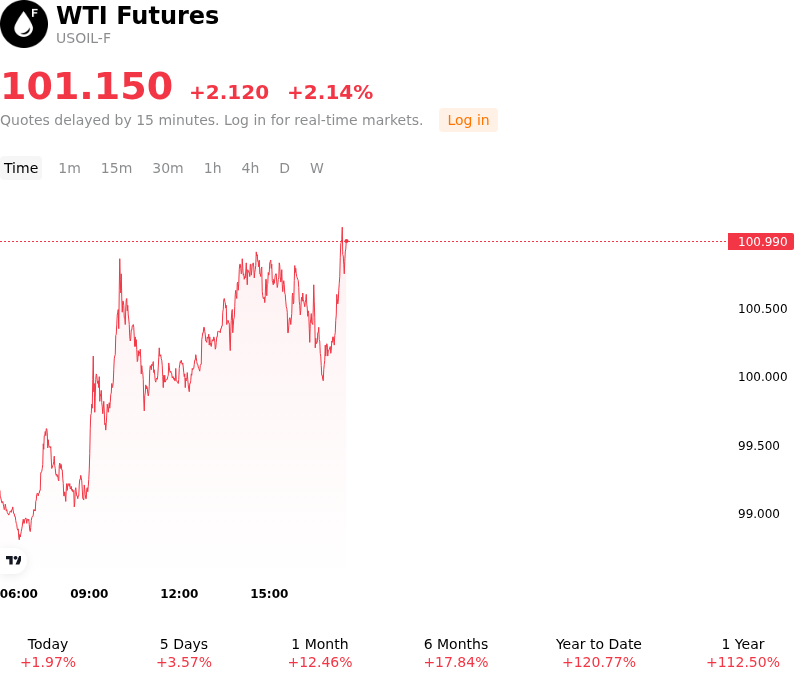
What is driving WTI Futures (USOIL-F)’s stock price up today?
West Texas Intermediate crude futures advanced as intensifying geopolitical risks in the Middle East sparked mounting concerns over potential supply disruptions across major energy production hubs and vital shipping corridors. Escalating strikes targeting Saudi Arabian oil infrastructure, alongside escalating security threats to commercial vessels negotiating the Strait of Hormuz, prompted institutional investors to aggressively price in a heightened risk premium. Reports of precautionary evacuations at key regional energy facilities and localized production curtailments in North Africa, including pipeline closures in Libya, further amplified global supply vulnerability expectations.
Domestic fundamental data provided strong additional support to the upward move. The latest weekly Energy Information Administration inventory report revealed a larger-than-expected draw in U.S. commercial crude stockpiles, accompanied by tightening gasoline inventories. The draw down in inventories reinforced a tightening domestic physical balance, particularly within middle distillate supplies, against sustained refining demand. In response, the WTI futures curve deepened its backwardated structure, with prompt-month contracts outperforming longer-dated tenors, reflecting strong institutional demand for immediate physical coverage and favorable roll yields.
While medium-term global demand uncertainties and long-term production capacity adjustments remain under observation, immediate market dynamics are firmly driven by supply security risks and physical market tightness. Elevated seaborne shipping costs and war risk insurance surcharges continue to distort international flow dynamics, sustaining a wide premium between global and domestic crude benchmarks. Energy strategists maintain that volatility will remain elevated as institutional capital flows prioritize prompt inventory protection, with price action tightly tied to security conditions along critical maritime choke points and the duration of regional operational disruptions.
Technical Analysis of WTI Futures (USOIL-F)
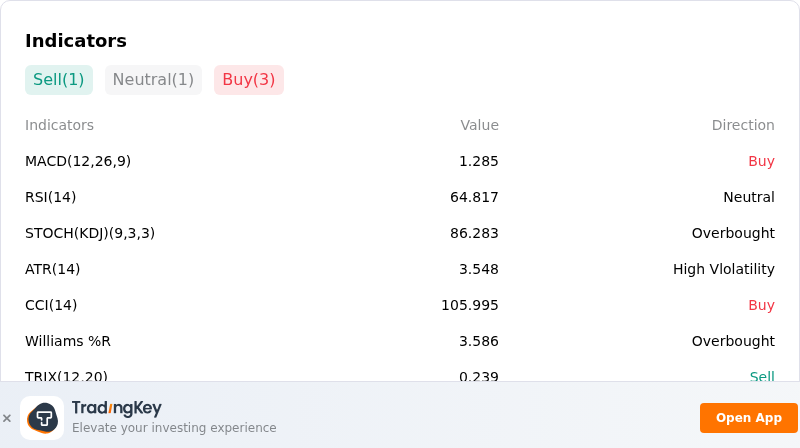
Technically, WTI Futures (USOIL-F) shows a MACD (12,26,9) value of 1.285, indicating a buy signal. The RSI at 64.817 suggests neutral condition and the Williams %R at 3.586 suggests overbought condition. Please monitor closely.
More details about WTI Futures (USOIL-F)
Recent Events and Risks:
- Cushing Storage Accumulation and Delivery Hub Pressure: Despite broader commercial crude inventory declines, stockpiles at Cushing, Oklahoma—the key physical delivery point for NYMEX WTI futures—built by nearly 1.0 million barrels to 27.6 million barrels. This localized accumulation places physical pressure on prompt WTI cash differentials and widens the pricing discount of domestic benchmark crude relative to international seaborne benchmarks.
- Unexpected Distillate Stock Build and Softening Fuel Consumption: Energy Information Administration (EIA) weekly data showed a counter-seasonal build of 1.675 million barrels in U.S. distillate inventories (diesel and heating oil) against market expectations of a 1.3 million-barrel draw. The surprise surge in middle distillate stocks signals underlying weakness in industrial fuel consumption, creating an intraday drag on refinery margins and WTI futures.
- Surging Tanker Freight Costs and Export Bottlenecks: Record seaborne freight rates and elevated maritime insurance premiums out of the US Gulf Coast have narrowed the export arbitrage to European and Asian refiners, leading to a weekly drop of over 1.1 million barrels per day in U.S. crude exports. These logistical export constraints threaten to leave domestic light-sweet crude stranded locally, increasing near-term domestic oversupply risks.
- Geopolitical Risk-Premium Unwind and Long Liquidation Risk: Having rallied near multi-week technical resistance around the $98–$100 per barrel range, WTI contracts face steep intraday profit-taking and forced long-position liquidation if direct supply disruptions fail to materialize. Furthermore, sustained high oil prices are stoking broader inflationary fears and monetary tightening expectations, reinforcing macro risk-off sentiment and long-term demand destruction concerns.
Nothing in this material constitutes investment advice, personal recommendation, investment research, an offer, or a solicitation to buy or sell any financial instrument. The content has been prepared without consideration of your individual investment objectives, financial situation, or needs, and should not be treated as such.
Past performance is not a reliable indicator of future performance and/or results. Forward-looking scenarios or forecasts are not a guarantee of future performance. Actual results may differ materially from those anticipated.
Mitrade makes no representation or warranty as to the accuracy or completeness of the information provided and accepts no liability for any loss arising from reliance on such information.
Recommended Articles


