



Bank of Japan to leave interest rates steady at 1.25%
- The BoJ is expected to hold interest rates steady at 1.25% on Friday.
- The interest of investors will be on the BoJ’s future rate path..
- USD/JPY has been consolidating within 156-159 for the last six weeks.
The Bank of Japan (BoJ) is set to announce its monetary policy decision on Friday at around 02:30 GMT.
Like the Federal Reserve (Fed), financial markets are confident that the BoJ will leave interest rates unchanged, after raising them by 25 basis points (bps) to 1.25% in the September policy meeting. This is the highest interest rate level seen in 31 years in Japan. So far this year, the BoJ has delivered two quarter-to-a-percent interest rate hikes.
Commerzbank said in a note that markets anticipate “the overnight rate remaining steady, and none of the economists surveyed by Bloomberg expects a hike on Friday”. This consensus view leaves investors focusing more on the monetary policy statement, the central bank’s outlook report and Governor Kazuo Ueda’s press conference for the policy outlook into year-end.
Ueda leaned hawkish as AI demand and inflation near BoJ goals
BoJ Governor Ueda’s remarks after the September policy meeting have shown his concern about energy-driven inflationary risks. Ueda has also stressed the importance of anchoring core inflation near the 2% target. He has reiterated several times that the central bank will remain on the monetary tightening path.
Ueda’s speech on October 16 was scored at 8.2/10 versus by FXStreet’s Speechtracker, signaling a modest hawkish tilt compared to Ueda’s average 7.5 score. Ueda stressed that underlying inflation is “quite close” to 2% and that economic and price moves are roughly in line with forecasts. The commitment to “continue to raise interest rates” while financial conditions remain accommodative, and the plan to discuss whether to tweak the assessment of inflation approaching 2%, reinforced a gradual normalization bias that supports a firmer Yen backdrop.
Ueda’s remark that there is “no big gap” between the Bank of Japan’s view on AI-driven inflationary pressure and that of global policymakers, alongside noting some counterparts are more bullish on AI demand, underscores upside risks to prices that justify keeping a tightening path on the table. By explicitly tying the timing and pace of future rate hikes to FX, AI demand and Middle East developments, the speech framed a data- and risk-sensitive reaction function that is incrementally supportive for the Japanese Yen, especially if AI-related demand and external shocks sustain inflation around the 2% target.
These comments suggest that BoJ’s Ueda will remain hawkish on the monetary policy outlook and will highlight the importance of keeping price pressures anchored near the central bank’s 2% target.
What are expectations for December’s policy meeting?
According to the October 13-19 Reuters’ poll, nearly 70% of economists, 54 of 78, expected the BoJ to raise its policy rate to 1.5% this quarter, almost double the share in the previous poll, Reuters reported. The consensus is for another hike before the year end.
How can USD/JPY react to the BoJ’s decision?
The BoJ’s interest rate decision itself appears to be a non-event for the USD/JPY pair, given that market participants are highly confident about policy rates remaining steady. What will be impactful would be the tone in the BoJ’s monetary policy outlook and any cues on where they see the terminal rate.
Any indication from the BoJ that it could approach the terminal rate faster would be favorable for the Japanese Yen (JPY). On the contrary, signs from the Japanese central bank that it would pursue a gradual monetary tightening path could have little impact on the Japanese currency. Therefore, risks are moderately tilted to the downside for USD/JPY.
USD/JPY Technical Outlook: Trading within range, volatility contracted
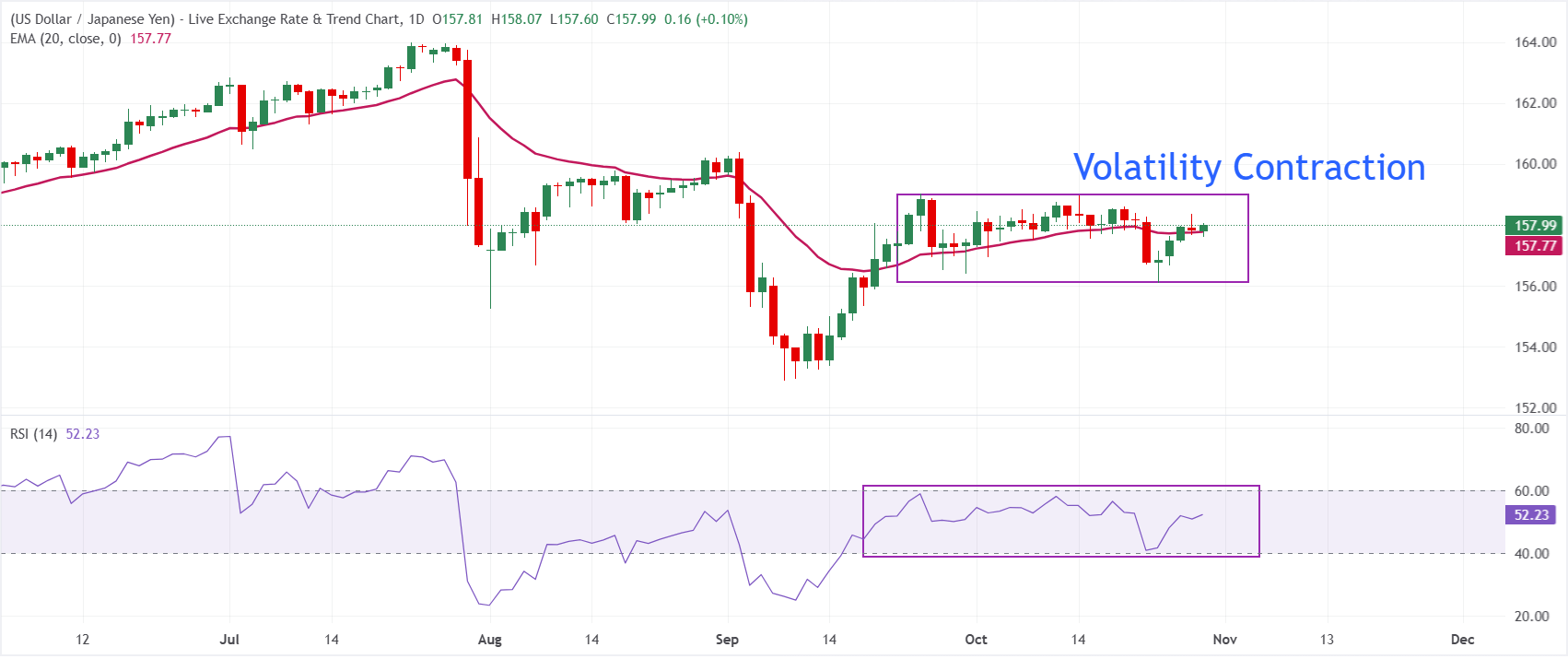
Trend: At the time of writing, USD/JPY trades at around 157.80. The USD/JPY pair has remained in a limited range between 156.08 and 159.04 for over a month. The 20-day exponential moving average (EMA) at 157.77 is flat-lined, reflecting that the overall trend is sideways.
Momentum: The Relative Strength Index (RSI) has been inside the 40.00-60.00 range for a month, indicating a sharp volatility contraction and reinforcing the current consolidation.
Support: On the downside ,the lower-end of the above-mentioned range at 156.08 is the immediate support. The pair would get exposed to the September 14 high at 155.00 if it fails to hold 156.08.
Resistance: Looking up, the immediate hurdle for the pair is the upper-end of the consolidation near 159.04; a decisive break above that would increase the likelihood of further upside towards 160.00, followed by the September high near 160.40.
(The technical analysis of this story was written with the help of an AI tool. Know more.)
Bank of Japan FAQs
The Bank of Japan (BoJ) is the Japanese central bank, which sets monetary policy in the country. Its mandate is to issue banknotes and carry out currency and monetary control to ensure price stability, which means an inflation target of around 2%.
The Bank of Japan embarked in an ultra-loose monetary policy in 2013 in order to stimulate the economy and fuel inflation amid a low-inflationary environment. The bank’s policy is based on Quantitative and Qualitative Easing (QQE), or printing notes to buy assets such as government or corporate bonds to provide liquidity. In 2016, the bank doubled down on its strategy and further loosened policy by first introducing negative interest rates and then directly controlling the yield of its 10-year government bonds. In March 2024, the BoJ lifted interest rates, effectively retreating from the ultra-loose monetary policy stance.
The Bank’s massive stimulus caused the Yen to depreciate against its main currency peers. This process exacerbated in 2022 and 2023 due to an increasing policy divergence between the Bank of Japan and other main central banks, which opted to increase interest rates sharply to fight decades-high levels of inflation. The BoJ’s policy led to a widening differential with other currencies, dragging down the value of the Yen. This trend partly reversed in 2024, when the BoJ decided to abandon its ultra-loose policy stance.
A weaker Yen and the spike in global energy prices led to an increase in Japanese inflation, which exceeded the BoJ’s 2% target. The prospect of rising salaries in the country – a key element fuelling inflation – also contributed to the move.
Nothing in this material constitutes investment advice, personal recommendation, investment research, an offer, or a solicitation to buy or sell any financial instrument. The content has been prepared without consideration of your individual investment objectives, financial situation, or needs, and should not be treated as such.
Past performance is not a reliable indicator of future performance and/or results. Forward-looking scenarios or forecasts are not a guarantee of future performance. Actual results may differ materially from those anticipated.
Mitrade makes no representation or warranty as to the accuracy or completeness of the information provided and accepts no liability for any loss arising from reliance on such information.
Recommended Articles


