



Oil Prices Rise for Fourth Day, Brent Returns Above $100
TradingKey - As of the close on Wednesday, April 22 (ET), Brent crude oil futures settled at $101.91 per barrel, up 3.48%. WTI crude oil prices closed at $92.96 per barrel, up 3.67%, marking the fourth consecutive trading session of gains for Brent crude.
During the Asian session on Thursday, oil prices extended their rally, with Brent crude hitting a high of $106.15 per barrel.
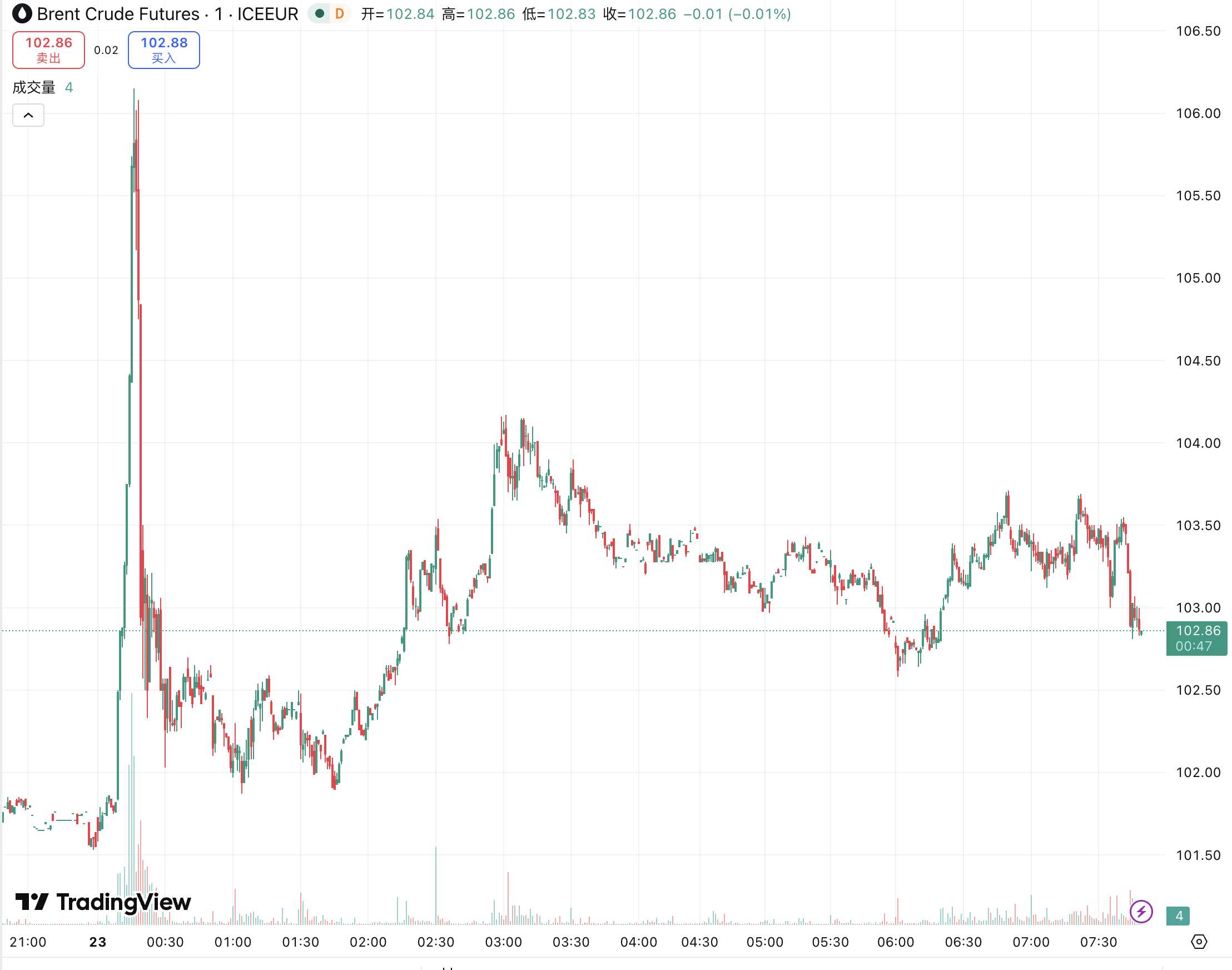
[Source: TradingView]
Although the interim ceasefire agreement between the U.S. and Iran has been extended, Trump has explicitly stated that he "will not rush into a bad deal." If an agreement cannot be reached before the ceasefire expires, the likelihood of a further extension is extremely low. Iran has refused to participate in the second round of negotiations, the Islamabad talks have been shelved, and the core demands of both parties remain difficult to reconcile.
The order of passage through the Strait of Hormuz has completely changed. The Iranian Revolutionary Guard Corps (IRGC) has stipulated that civilian vessels must use Iranian-designated routes and coordinate with the Guard, while military vessels remain prohibited from passing. On April 22, daily transit through the strait fell to three ships, and the Middle East's daily crude supply loss reached 12 million barrels.
An International Energy Agency (IEA) report indicates that global oil supply fell to 97 million barrels per day (bpd) in March, a decrease of 10.1 million barrels from the previous month, marking the largest single-month supply disruption on record. In April, refineries in the Middle East and Asia cut processing volumes by about 6 million bpd to 77.2 million bpd due to feedstock shortages. The IEA stated that if passage through the Strait of Hormuz remains obstructed through the end of May, the market would lose 450 million barrels of refined products.
U.S. Energy Information Administration (EIA) data shows that for the week ending April 17, U.S. gasoline inventories fell by 4.6 million barrels and distillate inventories decreased by 3.4 million barrels, both slightly below their five-year seasonal averages. Gasoline inventories are 0.5% below the five-year average, while distillate inventories are 6% lower. The reduction in refined product inventories has intensified supply tightness.
With oil prices returning to the $100 level and March CPI rising 3.3% year-over-year—including a 10.9% month-over-month surge in the energy component—expectations for a Federal Reserve rate cut have significantly diminished. CME interest rate futures indicate that the probability of a 25-basis-point cut in June is only 1.7%, while the possibility of a rate hike is negligible.
Morgan Stanley believes that inflationary pressures from tariffs and oil prices may be transitory and that there is still room for rate cuts this year; however, if inflation does not moderate as expected, policy could remain on hold for an extended period.
Goldman Sachs forecasts that the average price of Brent crude will reach $85 per barrel in 2026, but if transport through the Strait of Hormuz is disrupted for more than 10 weeks, oil prices could surpass the record high of $147 set in 2008.
Oil prices have currently rebounded to the $100 level, primarily as a result of the combined effects of geopolitical tensions, supply halts, and declining inventories. Short-term trends will depend on whether the Hormuz standoff escalates and whether the U.S.-Iran diplomatic deadlock can be broken.
During this period, oil prices may fluctuate within a high range of $90 to $110, as the energy market gradually returns to a phase where pricing is dominated by geopolitics. Investors should remain attentive to progress in U.S.-Iran negotiations, weekly EIA inventory reports, and signals regarding strategic reserve releases from the IEA.
Nothing in this material constitutes investment advice, personal recommendation, investment research, an offer, or a solicitation to buy or sell any financial instrument. The content has been prepared without consideration of your individual investment objectives, financial situation, or needs, and should not be treated as such.
Past performance is not a reliable indicator of future performance and/or results. Forward-looking scenarios or forecasts are not a guarantee of future performance. Actual results may differ materially from those anticipated.
Mitrade makes no representation or warranty as to the accuracy or completeness of the information provided and accepts no liability for any loss arising from reliance on such information.
Recommended Articles


