



Gold slips as Warsh Fed hike bets, Oil rally lift US yields
- Gold slips as Warsh remarks revive September Fed hike bets.
- Oil rally lifts inflation fears, pushing Treasury yields higher.
- US PMIs and jobs data drive next bullion catalyst.
Gold (XAU/USD) price retreats some 0.40% on Monday after last Friday's hawkish remarks by Federal Reserve (Fed) Chair Kevin Warsh, which sparked speculation of a possible rate hike at the September meeting. Despite this, bullion is poised to end the month with gains of over 9%, with XAU/USD trading at $4,432 after hitting a daily high of $4,472.
XAU/USD retreats as higher Oil prices revive inflation and Fed hike risks
Warsh's said last Friday that the Fed is committed to tackling high inflation, even if it does not aim for the 2% goal, with the new Fed Chair noting that they “have work to do” if prices remain elevated.
Aside from this, the main theme on Monday is the conflict in the Middle East. The US and Iran exchanged strikes, which pushed energy prices higher. West Texas Intermediate (WTI), the US crude Oil benchmark, rose 2.50% on Monday to $85.62, a headwind for the yellow metal.
Why? Becausehigher energy prices increase the chances of higher interest rates. Hence, Gold fares positively amid lower-yield environments, not the current one, as the US 10-year Treasury yield is up two and a half basis points at 4.706%.
The Greenback retreats some 0.25%, according to the US Dollar Index (DXY). The DXY, which tracks the performance of the buck against six currencies, is at 99.42, below last week’s high of 99.72.
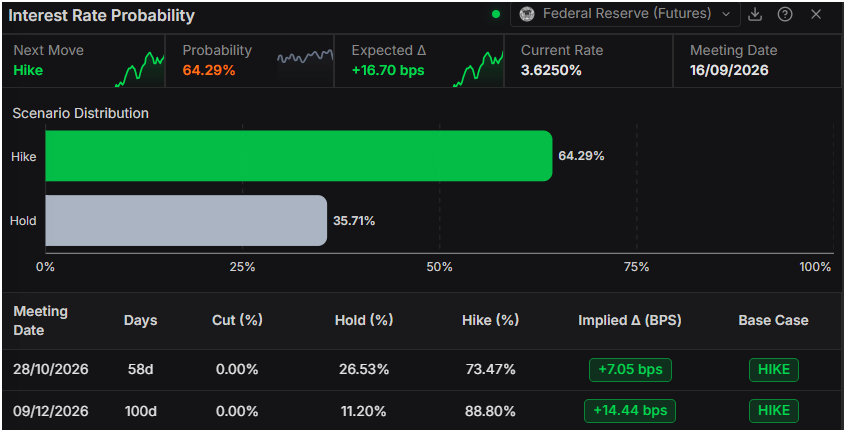
Given the current backdrop, money markets have priced in at least 26 basis points of tightening towards the year-end, according to Prime Terminal. For the September 16 meeting, the odds stand at 64% for a hike and 36% for keeping the Fed funds rate unchanged at 3.50%-3.75%.
Ahead this week, the US economic docket will be busy, with the release of ISM Manufacturing and Services PMIs, a tranche of jobs data – JOLTS Job Openings and Initial Jobless Claims –and, to end, Nonfarm Payrolls figures.
XAU/USD technical analysis: Gold fails to conquer $4,500, eyes are on 100-day SMA
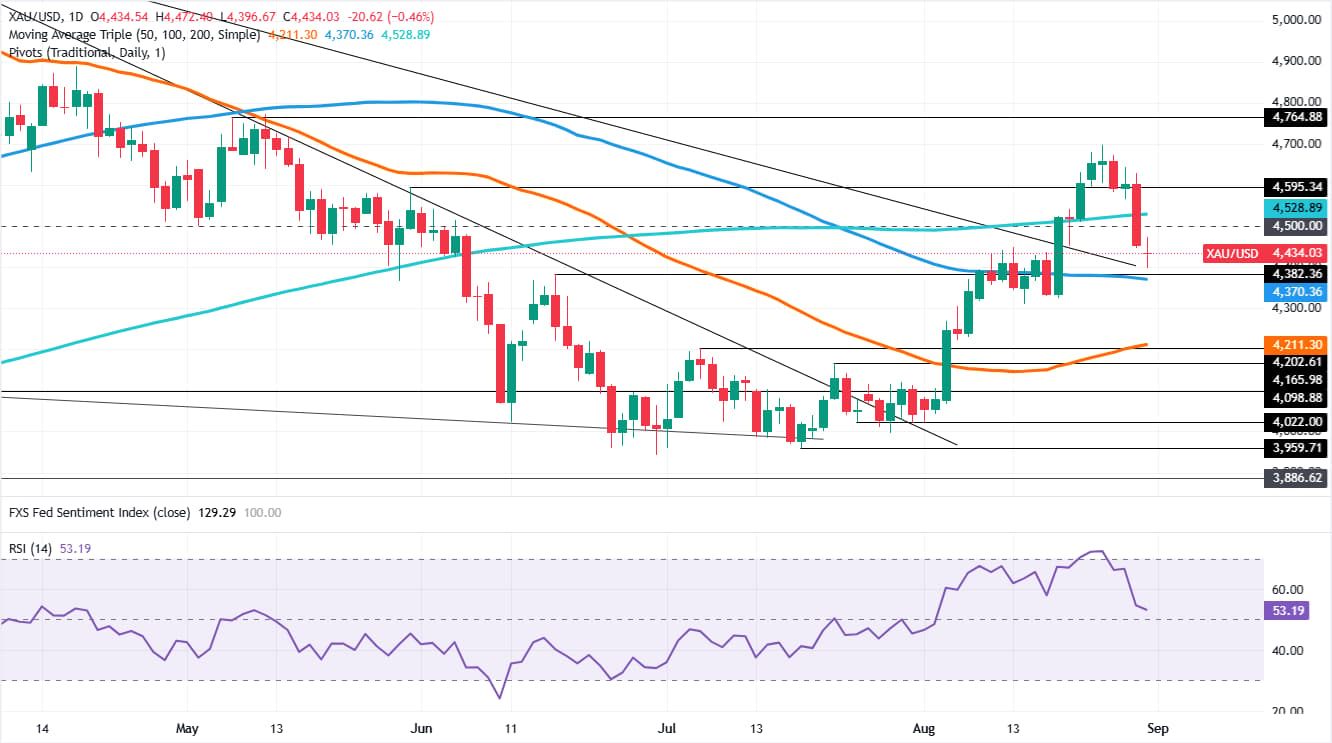
Price action shows Gold is trapped within the 100- and 200-day Simple Moving Averages (SMAs) at around $4,370 and $4,528, respectively, with no definitive direction as a ‘doji’ candle forms in the daily chart.
The Relative Strength Index (RSI) seems to be normalising, despite remaining above its 50-neutral level, which suggests buyers are in charge, but price action suggests XAU could be trading sideways.
For a bullish resumption, Gold must reclaim $4,500 followed by the 200-day SMA. Above this area, the next resistance is the August 25 swing high at $4,697, ahead of the $4,700 mark
Downwards, the first support is $4,400, followed by the 100-day SMA. A decisive push below that level opens the path to $4,300 and to the 50-day SMA at $4,211.
Gold FAQs
Gold has played a key role in human’s history as it has been widely used as a store of value and medium of exchange. Currently, apart from its shine and usage for jewelry, the precious metal is widely seen as a safe-haven asset, meaning that it is considered a good investment during turbulent times. Gold is also widely seen as a hedge against inflation and against depreciating currencies as it doesn’t rely on any specific issuer or government.
Central banks are the biggest Gold holders. In their aim to support their currencies in turbulent times, central banks tend to diversify their reserves and buy Gold to improve the perceived strength of the economy and the currency. High Gold reserves can be a source of trust for a country’s solvency. Central banks added 1,136 tonnes of Gold worth around $70 billion to their reserves in 2022, according to data from the World Gold Council. This is the highest yearly purchase since records began. Central banks from emerging economies such as China, India and Turkey are quickly increasing their Gold reserves.
Gold has an inverse correlation with the US Dollar and US Treasuries, which are both major reserve and safe-haven assets. When the Dollar depreciates, Gold tends to rise, enabling investors and central banks to diversify their assets in turbulent times. Gold is also inversely correlated with risk assets. A rally in the stock market tends to weaken Gold price, while sell-offs in riskier markets tend to favor the precious metal.
The price can move due to a wide range of factors. Geopolitical instability or fears of a deep recession can quickly make Gold price escalate due to its safe-haven status. As a yield-less asset, Gold tends to rise with lower interest rates, while higher cost of money usually weighs down on the yellow metal. Still, most moves depend on how the US Dollar (USD) behaves as the asset is priced in dollars (XAU/USD). A strong Dollar tends to keep the price of Gold controlled, whereas a weaker Dollar is likely to push Gold prices up.
Nothing in this material constitutes investment advice, personal recommendation, investment research, an offer, or a solicitation to buy or sell any financial instrument. The content has been prepared without consideration of your individual investment objectives, financial situation, or needs, and should not be treated as such.
Past performance is not a reliable indicator of future performance and/or results. Forward-looking scenarios or forecasts are not a guarantee of future performance. Actual results may differ materially from those anticipated.
Mitrade makes no representation or warranty as to the accuracy or completeness of the information provided and accepts no liability for any loss arising from reliance on such information.
Recommended Articles


