



Brent Crude Tops $115 to Hit Five-Month High as Middle East Supply Risks Rise
TradingKey - On October 23, international oil prices extended gains, with London Brent crude (UKOIL) futures rising to $115 per barrel in intraday trading, hitting a five-month high. The continuous deterioration of the security situation in the Middle East has led the market to reassess potential impacts on crude oil production, transportation, and exports, driving up the supply risk premium.
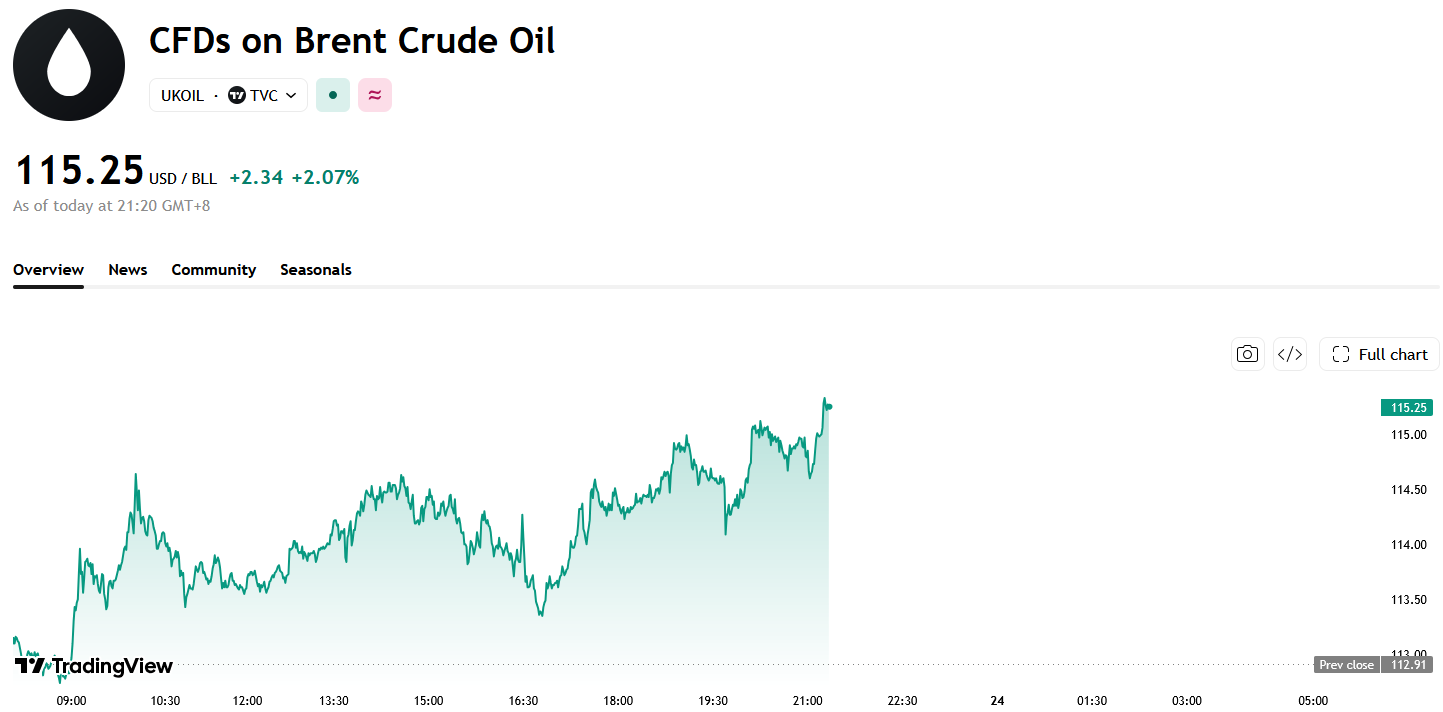
Source: TradingView
Market anxiety intensified after the U.S. ordered the evacuation of some non-emergency government personnel and their families from Saudi Arabia. Recent attacks on local oil fields, airports, and other infrastructure, combined with increased drone operations by Iran-backed Houthis, have heightened investor concerns that the conflict could spread to other parts of the Persian Gulf. Saudi Arabia is a major global oil producer, and any damage to its energy facilities or transport networks could quickly spill over into the international crude market.
Meanwhile, traders are also assessing whether the U.S. and Israel might initiate a new round of military action against Iran following the U.S. midterm elections. Prior expectations of a post-election pullback in oil prices are fading, as the market begins to price in the possibility of a prolonged or even escalated conflict. Renewed tensions between Russia and Ukraine, along with rising heating and fuel demand as the Northern Hemisphere enters winter, are providing additional support for oil and natural gas prices.
Beyond crude oil supply itself, surging maritime shipping costs have emerged as another driver pushing up energy prices. According to International Energy Agency data, tanker freight rates reached historical highs in September; as of mid-October, the cost of shipping crude from the Persian Gulf to Asia using large tankers rose above $37 per barrel, more than five times pre-war levels. Even if crude oil can still be loaded normally, rising insurance, rerouting, and vessel chartering costs will inflate actual procurement expenses for refiners and end consumers.
Soaring freight rates and uncertainty in the Strait of Hormuz are prompting oil-producing nations to readjust their export strategies. Iraq, the UAE, and Saudi Arabia are accelerating the construction of oil pipelines and storage facilities outside the Persian Gulf, while production increases in the U.S., Canada, Brazil, and Guyana are driving a gradual shift in the center of global crude supply toward the Western Hemisphere. However, such structural adjustments require considerable time and remain unlikely to fully offset the pressure from Middle East shipping disruptions in the short term.
Nothing in this material constitutes investment advice, personal recommendation, investment research, an offer, or a solicitation to buy or sell any financial instrument. The content has been prepared without consideration of your individual investment objectives, financial situation, or needs, and should not be treated as such.
Past performance is not a reliable indicator of future performance and/or results. Forward-looking scenarios or forecasts are not a guarantee of future performance. Actual results may differ materially from those anticipated.
Mitrade makes no representation or warranty as to the accuracy or completeness of the information provided and accepts no liability for any loss arising from reliance on such information.
Recommended Articles


