



US Stocks Close: Three Major US Indexes Diverge, Memory Stocks Extend Yesterday's Decline; Cerebras Plunges 20%, Qualcomm Launches Data Center CPU
TradingKey - On June 24, Eastern Time, the resumption of shipping through the Strait of Hormuz accelerated, but the market adopted a cautious wait-and-see stance ahead of Micron's post-market earnings report. The three major U.S. stock indexes diverged, with only the Dow posting gains, while memory and chip stocks extended yesterday's losses.
At the close, the Dow Jones Industrial Average rose 0.36% to 51,850.31; the Nasdaq Composite fell 0.43% to 25,476.64; and the S&P 500 slid 0.10% to 7,358.33.
Tech stock performance
Cerebras Systems (CBRS) tumbled 19.54% to $182.41 following its earnings release.
Cerebras Systems' first-quarter financial report showed that core revenue (non-GAAP) grew 94% year-over-year to $193.4 million, beating analysts' average estimate of $181.2 million. Full-year core revenue guidance is projected between $855 million and $865 million, representing a 69% year-over-year increase at the midpoint, which is higher than analysts' average estimate of $824.8 million. However, the company expects its second-quarter core gross margin to contract significantly to 36%-38% from 46.5% in the first quarter, with the full-year core operating margin range projected at negative 28% to negative 32%.
Among mega-cap tech stocks, TSMC (TSM) rose 0.94%, Broadcom (AVGO) gained 0.51%, and Amazon (AMZN) edged up 0.07%; on the downside, Microsoft (MSFT) fell 2.27%, Tesla (TSLA) slipped 1.59%, SpaceX (SPCX) dropped 1.01%, Meta Platforms (META) decreased 0.81%, Nvidia (NVDA) dipped 0.52%, Apple (AAPL) shed 0.41%, and Google (GOOGL) ticked down 0.24%.
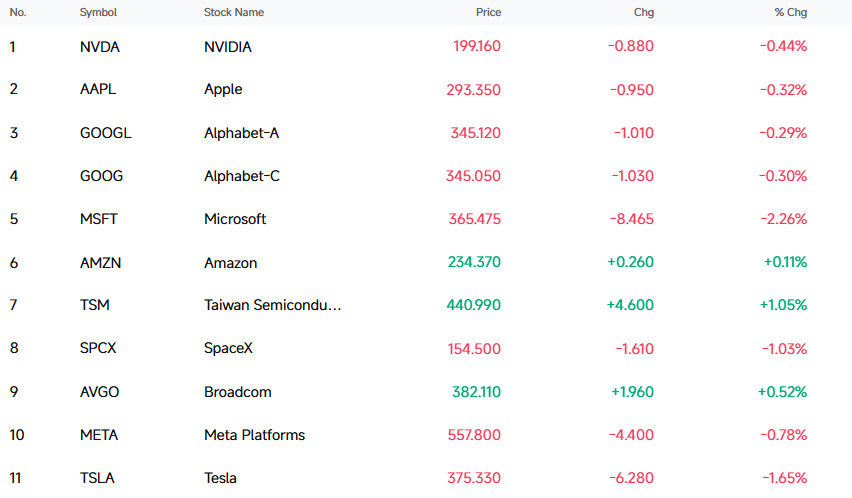
[Source: FutuBull]
The Philadelphia Semiconductor Index saw more decliners than gainers, closing down 0.18% at 13,458.19 points. Among its 30 constituents, 18 declined and 12 advanced. Qualcomm (QCOM) fell 3.29%, Arm Holdings (ARM) dropped 2.00%, and KLA (KLAC) slipped 1.64%.
Corporate News
Amazon's Zoox Unveils New Generation of Uniquely Designed Robotaxi
Zoox, the self-driving vehicle company owned by Amazon, has introduced an updated version of its robotaxi. The new vehicle features multiple hardware optimizations centered on the passenger experience, officially entering the mass-production phase and paving the way for its nationwide commercial expansion in the U.S. this year.
The new model retains its iconic "toaster" shape and steering-wheel-free design, keeping the four-seat, face-to-face cabin layout. Upgrades focus on passenger experience details, including higher-definition touchscreens, improved seat and headrest comfort, and a modified interior structure to reduce the likelihood of passengers leaving personal items behind. Additionally, bidirectional reflective signage has been enlarged and repositioned to enhance the vehicle's external visibility from both front and rear. This model represents the final production version and is set to join the active fleet later this year.
Qualcomm to Acquire Modular for $3.9 Billion in All-Stock Deal to Strengthen AI Software Capabilities and Boost Data Center Business
Chip giant Qualcomm announced today that it will acquire AI software company Modular in an all-stock transaction valued at approximately $3.9 billion. The deal is expected to close in the second half of 2026.
Modular’s core asset is an open-source, AI-native software stack, with a founding team consisting of early core developers of global AI infrastructure. Its unified development platform enables the highly efficient execution of AI models across multiple chip architectures, delivering industry-leading performance. This acquisition will bridge Qualcomm’s capability gap in AI software, supporting the technical implementation and commercialization of its data center business.
Qualcomm Unveils AI CPU for Data Centers
Qualcomm has introduced a data center central processing unit (CPU) called the Dragonfly C1000, noting that Meta Platforms plans to adopt the processor when mass production begins in 2028. According to Qualcomm, this new data center CPU is custom-designed for agentic AI, focusing on delivering exceptional computing performance without excessive power consumption. The move further signals that the chipmaker, traditionally known for smartphone processors and modems, is aggressively expanding into the data center market.
OpenAI Partners with Broadcom to Develop Custom AI Inference Chip
OpenAI has officially introduced Jalapeno, its first custom-designed AI chip developed in collaboration with Broadcom. This marks the ChatGPT parent company’s first foray into proprietary AI hardware. The core strategy is to improve operational efficiency and drastically reduce computing costs by deeply customizing and adapting the silicon to its own large language model workloads.
The first batch of chip samples is currently undergoing live testing, with data indicating a cost reduction of approximately 50% compared to general-purpose AI GPUs. Mass-production versions will be deployed at scale in data centers of partners like Microsoft starting in the second half of this year. Broadcom expects the overall deployment scale next year to surpass its previous forecast of 1.3 gigawatts, driven by robust downstream demand.
SK Hynix Seeks to Raise $29.4 Billion Through U.S. Listing
Memory chip giant SK Hynix is moving forward with a U.S. ADR offering aiming to raise approximately $29.4 billion. The offering, which rivals Saudi Aramco’s record-setting 2019 IPO in size, is poised to become one of the top three largest initial public offerings in global history.
Proceeds from the offering will primarily target capacity expansion and the procurement of EUV lithography systems to reinforce its technological and production advantages. A U.S. listing holds twofold strategic value for SK Hynix: first, it broadens the investor base to attract global institutional capital; second, it could narrow the valuation gap with its peers, replicating TSMC's post-U.S.-listing valuation rerating path and further solidifying its leading position in the global AI memory chip market.
Google Senior AI Researchers Reportedly Defecting to Anthropic
Two of Google’s top artificial intelligence researchers, Jonas Adler and Alexander Pritzel, are planning to leave the search giant to join rival Anthropic, according to media reports. The departures are fueling concerns that Google's leadership in the highly competitive AI sector could be slipping.
Industry & Macro News
US Congress introduces first-ever AI grid cost-sharing legislation, aiming to force tech companies to pay for data center grid strain
The U.S. House of Representatives will review the Ratepayer Protection Act on Wednesday, aiming to mandate at the federal level that tech companies bear the costs of grid upgrades and additional power supply driven by data centers. This marks the first time Congress has initiated legislative proceedings targeting the external electricity costs of AI data centers.
The policy's introduction coincides with the midterm election window, turning electricity rates and consumer livelihood into a key bipartisan battleground. Tech giants such as Amazon, Google, Microsoft, Meta, and xAI are currently expanding AI computing centers on a massive scale; a single large data center can consume as much electricity as 100,000 households, becoming the core driver of U.S. electricity demand growth. Consequently, local grid expansion costs are climbing rapidly and being passed down to residential utility bills. Although leading tech companies have indicated they do not oppose paying for new power capacity, the bill must still clear multiple rounds of voting in committees and both chambers of Congress, leaving its ultimate enactment highly uncertain.
JPMorgan raises S&P 500 year-end target to 7,800
JPMorgan has raised its year-end target for the S&P 500 Index from 7,600 to 7,800, representing approximately 6% upside. The bank believes that, supported by the dual tailwinds of stronger-than-expected corporate earnings growth and progress toward a U.S.-Iran peace agreement, U.S. equities are approaching their most optimistic 'blue-sky scenario.'
JPMorgan notes that the upward trajectory is inherently non-linear, and short-term pullbacks are a normal part of the market digesting obstacles. Since previous earnings reports have continuously raised the profitability bar, it has naturally become harder for companies to beat expectations during the second-quarter earnings season, representing a healthy digestion of expectations.
Resumption of traffic through Strait of Hormuz accelerates, with at least 35 million barrels of crude oil already exiting the strait
According to commodity intelligence firm Kpler, at least 20 non-Iranian tankers carrying 35 million barrels of crude oil have sailed out of the Persian Gulf. Stranded for over three months due to the strait's blockade during the conflict, these vessels are expected to arrive at major destinations, including Asia, starting in early August.
A Kpler analyst stated that a fleet of tankers that completed loading in late April has carried 51 million barrels of crude oil out of the Strait of Hormuz this month. All of these vessels were non-Iranian and turned off their transponders during transit, meaning actual transport volumes are likely higher than currently compiled data.
U.S. Treasury Secretary Bessent says domestic economic growth is on track to return to 3% this year
The U.S. Treasury Secretary stated that negotiations with Iran have touched on pricing Iranian oil and gas exports in U.S. dollars, while Venezuela is returning to the dollar system, and Russia is expected to resume dollar-denominated settlements once the Russia-Ukraine conflict ends. He characterized these developments as part of a broader reshaping of the dollar's global dominance. Meanwhile, he projected that U.S. GDP growth is poised to return to 3% within the year.
Nothing in this material constitutes investment advice, personal recommendation, investment research, an offer, or a solicitation to buy or sell any financial instrument. The content has been prepared without consideration of your individual investment objectives, financial situation, or needs, and should not be treated as such.
Past performance is not a reliable indicator of future performance and/or results. Forward-looking scenarios or forecasts are not a guarantee of future performance. Actual results may differ materially from those anticipated.
Mitrade makes no representation or warranty as to the accuracy or completeness of the information provided and accepts no liability for any loss arising from reliance on such information.
Recommended Articles


