



Nike Q4 Earnings Preview: Can Shares Rebound Under Low Expectations?
TradingKey - On June 30 Eastern Time, Nike ( NKE) will report its fiscal fourth-quarter 2026 earnings. For this report, the market's focus is not only on performance, but more importantly, on verifying whether the turnaround plan driven by CEO Elliott Hill is working.
From an expectations standpoint, market anticipation for Nike has clearly cooled. Consensus estimates show Nike's Q4 revenue at approximately $10.846 billion, down about 3% year-over-year, with EPS of about $0.12. The company's previous guidance also projected a 2% to 4% year-over-year decline in Q4 revenue, with Greater China revenue potentially falling by about 20%.
Greater China remains the greatest source of risk
In this earnings report, the market's core focus is on the performance of Greater China. Nike's previous quarterly report noted that, as Nike's third-largest market, Greater China revenue in Q4 could decline by approximately 20% due to factors including digital channel cleanups, reductions in low-quality shipments, inventory adjustments, and competitive pressure from local brands like Anta and Li-Ning.
For investors, the key point to watch is whether the revenue decline in the Chinese market is nearing a bottom. If the drop in Greater China is less than 20%, or if management hints that the inventory cleanup is nearing an end, Nike's stock price may find support. Conversely, if Greater China continues to deteriorate, or if the company remains cautious about the Chinese market for fiscal 2027, the stock price could continue to face pressure.
Institutional views are also cautious. Reuters pointed out that Nike has declined for several consecutive quarters in China, and CEO Elliott Hill has referred to China as the 'longest road' in the company's global recovery, admitting the need to reset its strategy for the Chinese market. The Financial Times also noted that Nike's past over-reliance on direct channels and lifestyle products led to its market share being diverted by local brands in China.
Therefore, Greater China is not merely a matter of regional revenue this time, but rather a concentrated reflection of Nike's brand popularity, channel management, and product innovation capabilities. If revenue in the Chinese market continues to decline, it could mean Nike is structurally losing market share; if the decline in the Chinese market narrows, it is expected to become an important catalyst for a stock price rebound.
Destocking and channel rebuilding are at the core of the recovery.
Inventory clearance is central to Nike's turnaround plan. Over the past few years, Nike bet too heavily on direct and digital channels, weakening its relationships with wholesalers and brick-and-mortar retailers, while oversupplying certain classic shoes and lifestyle products, which led to increased discounting and elevated channel inventory. Since taking the helm, Elliott Hill's primary strategy has been to refocus on performance products, repair wholesale channels, and rein in promotions and low-quality shipments.
Some positive signals already emerged in the previous quarter. Nike's Q3 revenue was $11.3 billion, roughly flat but down 3% on a currency-neutral basis; within this, wholesale revenue grew 5%, while Nike Direct revenue fell 4%. This indicates that the company is re-strengthening its wholesale channels, though its direct and digital businesses remain weak. For investors, the improvement in wholesale is a positive sign, as it means Nike is repairing its relationships with channel partners like Foot Locker and Dick's Sporting Goods; however, the decline in Direct also shows that the brand's proprietary traffic and online conversion have not yet recovered.
For this earnings release, if the data shows declining inventory, lower discount rates, and improving wholesale orders, the market will perceive the recovery as higher quality, and the stock price could rebound even if short-term revenue continues to slide. Conversely, if revenue is sustained by promotions, or if inventory clearance continues to drag on the Chinese and European markets, investors will worry that Nike may still need several quarters to return to normal growth.
Gross margin is more critical than revenue.
Gross margin is the most critical profitability metric in this earnings report. Nike's current challenge is whether it can safeguard its profitability while clearing inventory, reducing discounts, and absorbing tariff pressures. In the previous quarter, Nike's Q3 gross margin was 40.2%, down approximately 130 basis points year-over-year, primarily driven by tariff pressures in North America. The market expects a Q4 gross margin of about 39.9%, and the company has previously indicated that gross margin could continue to face pressure.
If Nike clears inventory through aggressive discounting, short-term revenue might look strong, but gross margin will be squeezed, which the market could interpret as low-quality growth. Conversely, if revenue does not significantly beat expectations but gross margin comes in better than expected, it would indicate easing promotional pressures, an improved product mix, and more orderly inventory clearance, which could instead drive a rebound in the stock price.
For the stock price, gross margin is more decisive in shaping market sentiment than EPS itself, as EPS can be improved in the short term through expense control, whereas gross margin reflects brand pricing power and channel health. Therefore, a better-than-expected gross margin in this earnings report will be viewed as a crucial signal that Nike's stock price may halt its decline; if it continues to miss expectations, it will indicate that pressures from inventory, discounting, tariffs, and product mix are still eroding profits.
Nike Stock Price Analysis: Rebound Requires Guidance Support, $40 Becomes Key Support
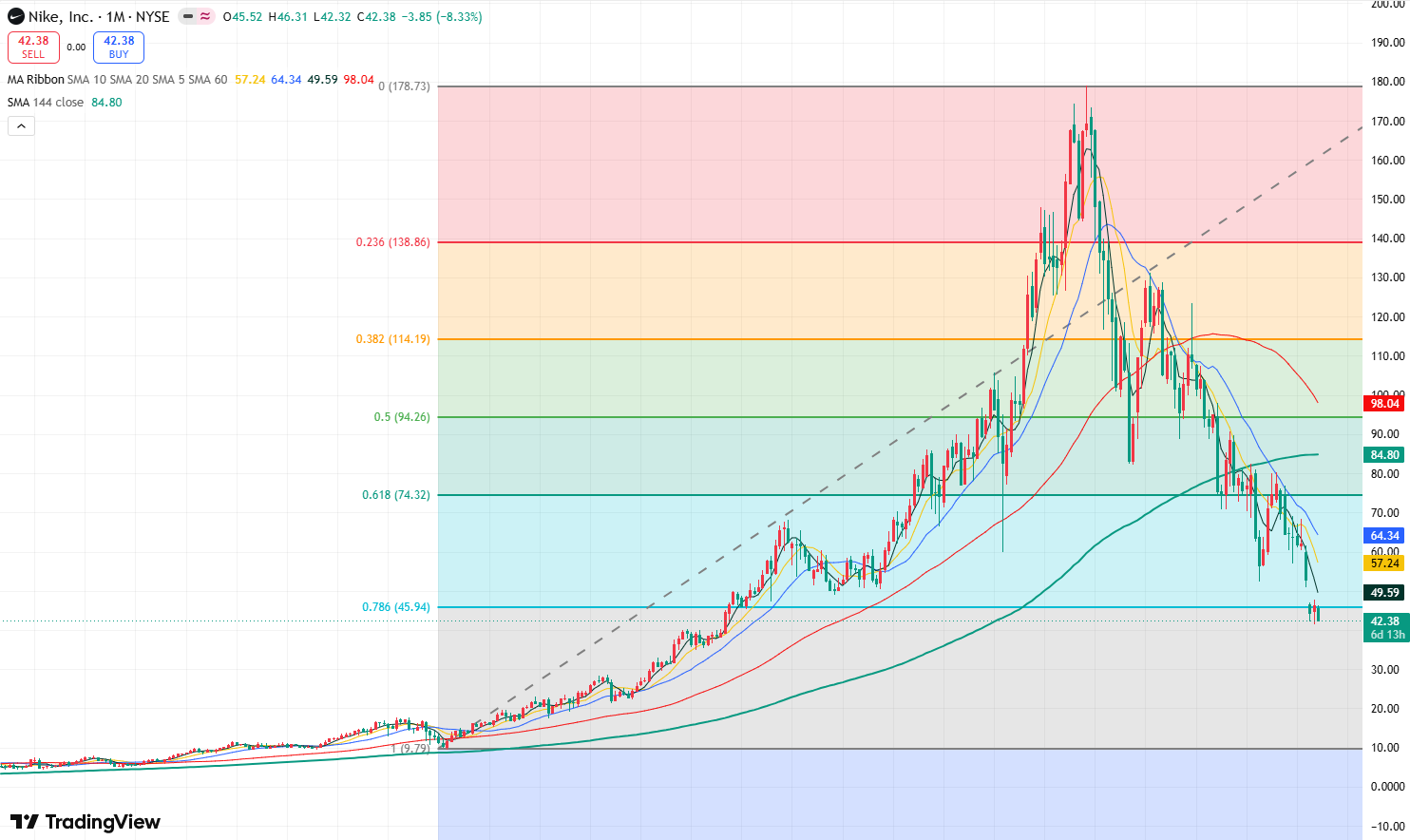
Nike monthly stock price chart, Source: TradingView
Looking at the monthly chart, Nike is trading near multi-year lows. According to the latest market data, NKE is priced at $42.38, with a market capitalization of approximately $62.8 billion. While analysts' average price target of around $60 suggests significant upside potential from current levels, market sentiment remains weak, and the stock may slide to test the key support level at $40.
If the earnings report shows a smaller-than-expected decline in Q4 revenue, better-than-expected gross margins, no further deterioration in Greater China, and management signals improvements for fiscal 2027, NKE is poised for a valuation recovery. In the short term, a potential rebound could target the $45–$48 range, with further resistance at $56.40. If earnings merely meet expectations but guidance is conservative, the stock will likely consolidate at low levels. In the worst-case scenario—characterized by further deterioration in China, worse-than-expected gross margins, and management pushing back the recovery timeline—the stock could slide to test support at $40. If this level fails to hold, it could open the door for further downside toward $28.70.
Nothing in this material constitutes investment advice, personal recommendation, investment research, an offer, or a solicitation to buy or sell any financial instrument. The content has been prepared without consideration of your individual investment objectives, financial situation, or needs, and should not be treated as such.
Past performance is not a reliable indicator of future performance and/or results. Forward-looking scenarios or forecasts are not a guarantee of future performance. Actual results may differ materially from those anticipated.
Mitrade makes no representation or warranty as to the accuracy or completeness of the information provided and accepts no liability for any loss arising from reliance on such information.
Recommended Articles


