



Pre-Market Drop of 5% Turns to Over 5% Gain: How to Read Pinduoduo's Earnings Report?
TradingKey - On August 24 US Eastern Time, Pinduoduo (PDD) experienced sharp volatility in US pre-market trading. Following the release of its second-quarter earnings report, the stock initially plunged over 5% before rapidly surging into positive territory, gaining as much as over 5% to $92.91.
As of press time, Pinduoduo's pre-market shares were trading at $91.62, up 3.67%. From the initial drop to the rebound, market interpretations of the earnings report remain divided.
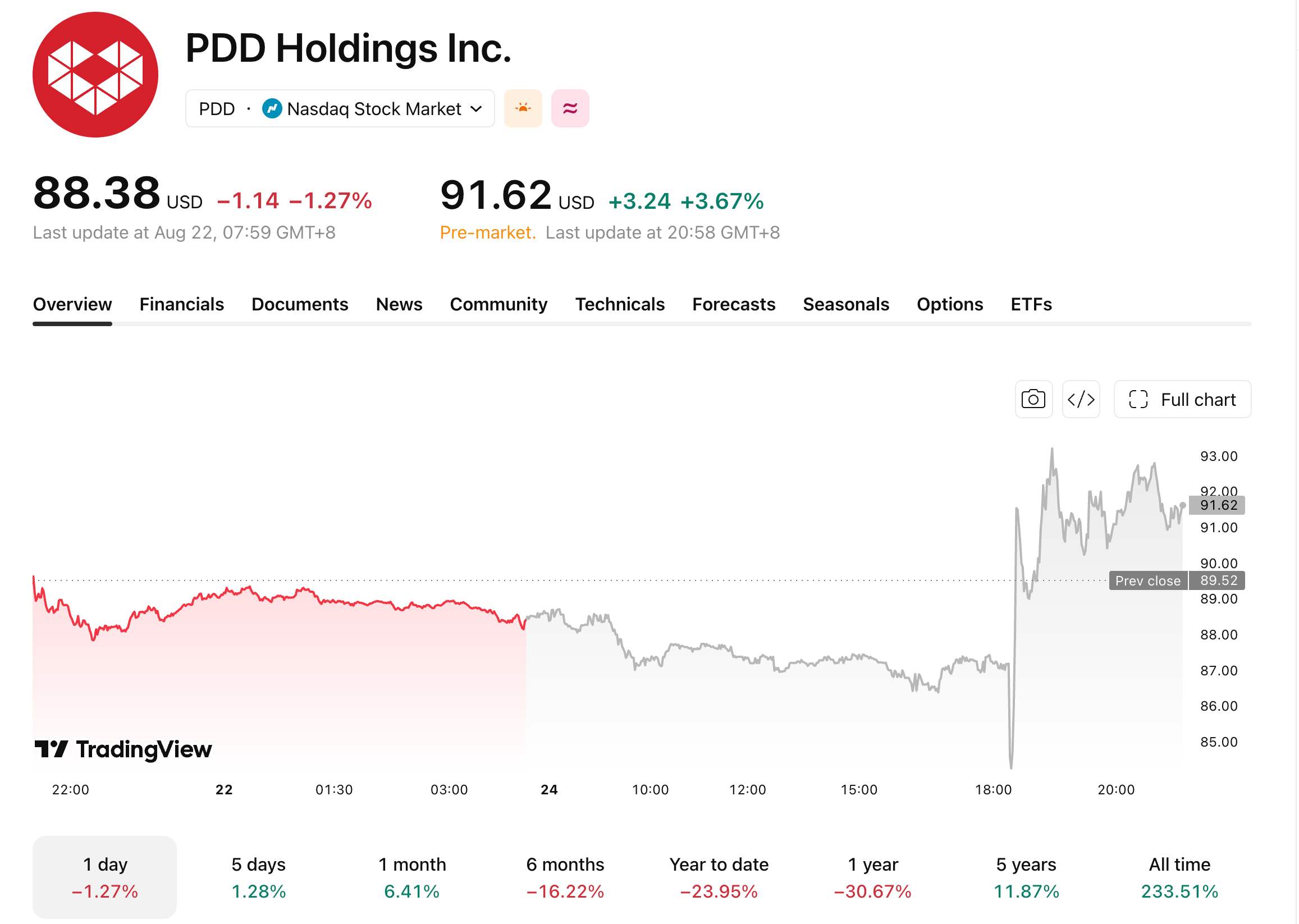
[Source: TradingView]
Revenue Misses Estimates, Profit Unexpectedly Beats
On the revenue front, signals of a growth slowdown are relatively clear. Revenue for the quarter reached RMB 112.4 billion (approximately $16.6 billion), up 8% year-over-year, falling short of market expectations of RMB 115.2 billion. Among this, transaction services revenue stood at RMB 54.7 billion, up 13% year-over-year, remaining the main growth engine; online marketing services revenue came in at RMB 57.6 billion, with growth slowing to single digits. The revenue miss was the direct cause of a 5% dive in early trading.
On the profit side, performance surpassed expectations. Non-GAAP net profit was approximately RMB 28.5 billion, down 13% year-over-year, but higher than market expectations of RMB 28 billion; adjusted earnings per ADS reached RMB 19.33, beating analysts' estimate of RMB 18.51. Non-GAAP operating profit was RMB 29.1 billion, up 5% year-over-year. Missing on revenue while beating on profits explained why the stock quickly rebounded into positive territory.
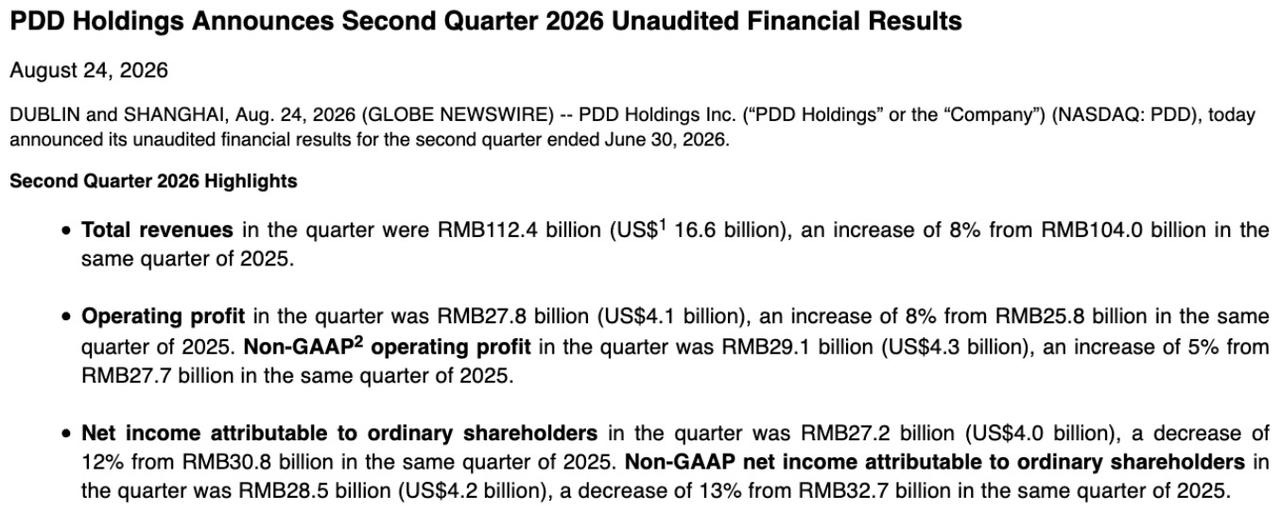
[Source: Pinduoduo Official Website]
Alongside the earnings beat, structural changes on the cost side are also noteworthy. Sales and marketing expenses for the quarter reached RMB 29.7 billion, while Non-GAAP R&D investment stood at RMB 4.3 billion, up 40% year-over-year. The company continued to advance its "100 Billion Support" strategy, with funds mainly allocated to merchant subsidies, platform governance, and technological research and development. While these investments weighed on profitability in the short term, the market broadly views them as necessary investments for the platform's long-term growth.
The question lies in when these investments will translate into revenue growth momentum. Judging from the Q2 data, transaction services revenue growth remained at 13%, showing progress in the transformation, but advertising revenue growth slowed to about 3.5%, which also warrants caution.
In line with its revenue performance, the company's cash reserves remain abundant. As of the end of the second quarter, Pinduoduo's cash, cash equivalents, and short-term investments totaled RMB 456.4 billion, up by more than RMB 30 billion from RMB 422.3 billion at the beginning of the year.
Valuation at Just 9x P/E: What Is the Market Worried About?
On the valuation front, however, the market has not granted a premium to the ample cash flow. The current TTM P/E ratio stands at 9.63x, well below the five-year median of 17.59x. Over the past three months, institutional analysts have made zero upward revisions and seven downward revisions to full-year EPS estimates, reflecting the market's cautious stance on growth prospects.
While valuation is at historical lows with limited downside, frequent downward revisions to expectations indicate a lack of upward momentum. Combining both factors, PDD Holdings is currently at a low valuation but lacks earnings catalysts. The key to a stock price turnaround lies in a meaningful recovery in revenue growth; a single-quarter profit beat alone is not enough.
Summary
Overall, this earnings report delivered mixed signals. Revenue growth slowed to single digits, but core profit remained resilient. The 5% drop in pre-market trading followed by a subsequent 5% gain reflected market divergence.
In the short term, profitability provides some support for the stock price, while the medium-term trend will depend on whether revenue growth can return to double digits. Growth in Q3 transaction service revenue will be a key metric for assessing the transformation process.
Nothing in this material constitutes investment advice, personal recommendation, investment research, an offer, or a solicitation to buy or sell any financial instrument. The content has been prepared without consideration of your individual investment objectives, financial situation, or needs, and should not be treated as such.
Past performance is not a reliable indicator of future performance and/or results. Forward-looking scenarios or forecasts are not a guarantee of future performance. Actual results may differ materially from those anticipated.
Mitrade makes no representation or warranty as to the accuracy or completeness of the information provided and accepts no liability for any loss arising from reliance on such information.
Recommended Articles


