



Micron Jumps After NVIDIA Earnings as AI Memory Demand Holds - Can MU Break $977?
TradingKey - On August 27, Micron Technology benefited from NVIDIA's report, which continued to expect significant spending on cloud infrastructure. NVIDIA reported covered revenue of $96.22 billion for the quarter, with $89 billion from the Data Center segment, and guided $108 billion for the following quarter. With such outperformances, hyperscalers are expected to continue their large investments on AI, and Micron is therefore expected to maintain high demand for its memory products. Micron still expects revenues of around $50 billion for the fiscal quarter ending in October, combined with an 86% gross margin, which are positive and strong fundamentals.
NVIDIA Results Strengthen the Memory Demand Read-Through
Micron Technology is focused on High Bandwidth Memory (HBM) with every new iteration of AI accelerators. Results from NVIDIA solidify the memory demand read-through for Micron Technology. With NVIDIA's results, Micron saw a 4% rally on premarket opening for August 27, which makes Micron much more important from a technical standpoint as it crossed the resistance level of $976.72 much earlier than expected. The crossing of the level is strong in and of itself, but crossing the level during the day would be an even better sign.
Micron Technology also closed at $938.40 on August 26, and before the markets opened on August 27 it was trading around $977.
September 30 Earnings Put the $50 Billion Target in Focus
With no formal guidance changes, Micron’s fiscal Q4 earnings on September 30 at 2:30 pm MT should cement their previous target of $50.0 billion, plus or minus $1 billion, 86% gross margin, GAAP EPS of $30.73 plus or minus $1.00 and non-GAAP EPS of $31.00 plus or minus $1.00.
This target is set against their record fiscal Q3 revenue of $41.46 billion, a steep rise against the previous quarters' $23.86 billion and $9.30 billion from the previous year. The GAAP gross margin was set at 84.6% and strong pricing and high utilization is the key focus of the investment case. The investment case becomes more reliant on the strength of demand and pricing and less on strong demand.
HBM4 and Leadership Changes Target the Next AI Cycle
Micron retains an advantage with their product roadmap. The high-volume shipments for HBM4, built on 1-beta DRAM, have started for Micron’s lead customer’s platform, and multiple other customers have received qualification samples. Production of HBM4E based on 1-gamma technology is scheduled for 2027, and as a result, Micron is positioned across several generations of AI accelerators.
Micron also made senior leadership changes on August 26. Manish Bhatia was named president and chief operating officer, now holding responsibilities for the global operations, business units, capital investment, manufacturing, and pricing and delivery.
Scott DeBoer also became president and chief technology and products officer, managing the product roadmap and Micron Research Labs. The changes focus on execution as AI customers are demanding more differentiated and customized memory.
Long-Term Investment Is Rising, but Competition Still Matters
Strong cash flow allows Micron to make substantial investments. August brought a planned $10 billion Micron Research Labs investment over the next decade, a new 60,000-square-foot Boise training center, and a $250 million Paradigm Fund for AI startups. Micron is investing research, talent, and early stage ecosystems of AI while the cash flow is strong. The primary risk is new competitive supply. CXMT in China is aggressive with their expansions and raised $8.6 billion through their July Shanghai IPO. CXMT shares closed at 466% above the offering price, after trading more than 500% above the offering price. Micron, SK hynix and Samsung lead the advanced HBM technology, but CXMT’s conventional DRAM capacity could affect industry competition.
MU Technical Setup: Premarket Move Tests the Breakout Zone
Prior to NVIDIA's earnings, MU was in a wide-ranging symmetrical triangle, with support around $931.64 and upper resistance at $976.72. The August 26 close at $938.40 kept MU above the lower breakout level and, following NVIDIA, the premarket jump positions the upper range at $976.72. A confirmed regular session breakout and hold above $976.72 will improve the structure and open the pathway to $1,034.50.
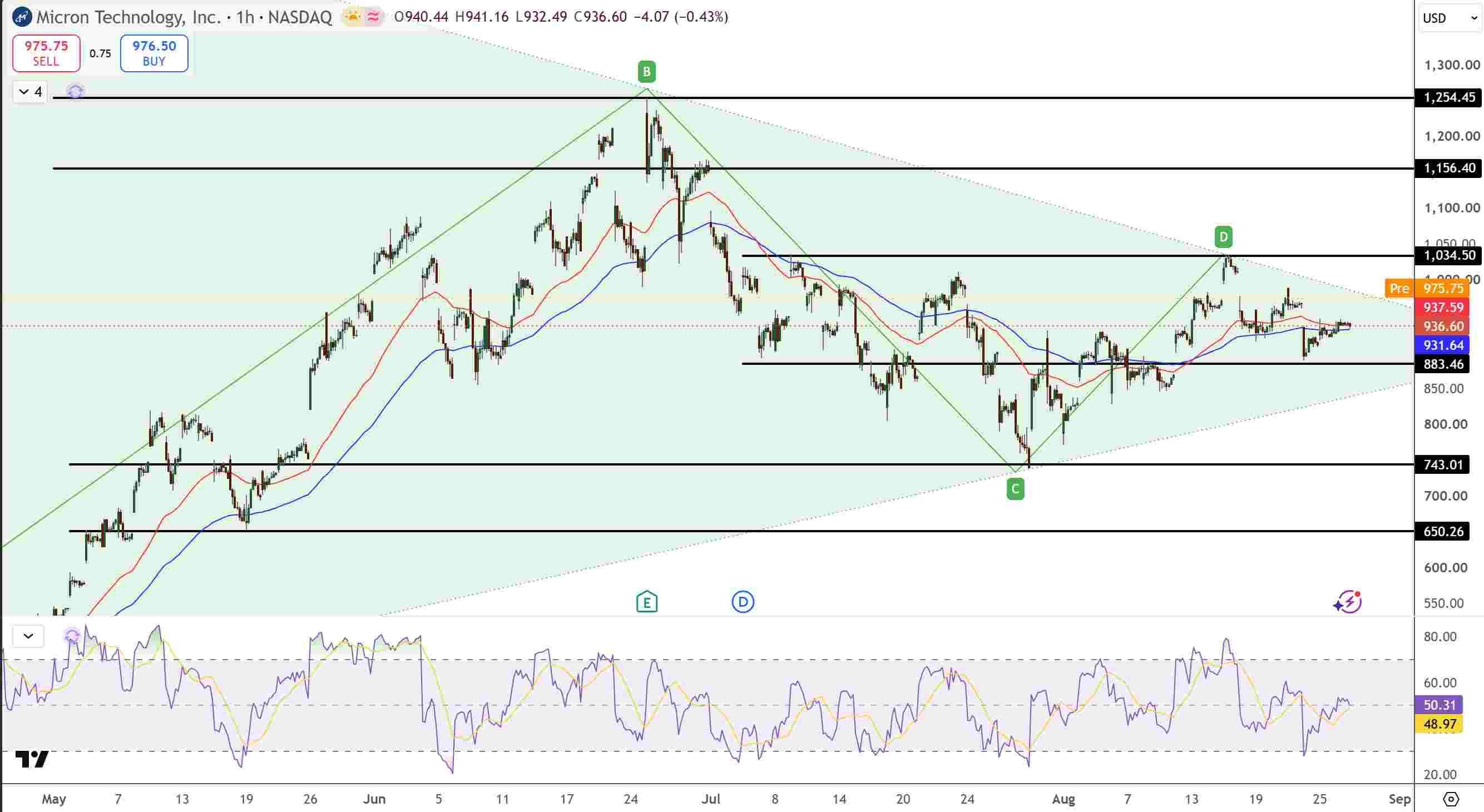
Micron Price Chart - Source: Tradingview
The larger, more substantial targets remain at $1,156.40 and $1,254.45. Should the premarket strength diminish, support levels will be $931.64 and $883.46. The previously mentioned RSI at 50 was neutral, and price movement will have to be the main factor in determining the next direction.
Key Levels
· Latest Completed Close: $938.40
· Immediate Breakout Zone: $937.59 - $976.72
· Primary Support: $931.64
· Major Support: $883.46
· Breakout Resistance: $1,034.50
· Target Resistance: $1,156.40 and $1,254.45
· RSI: Around 50, neutral in the supplied chart
Why is Micron stock rising after NVIDIA earnings?
NVIDIA earnings indicated healthy and strong demand for AI. From an investor’s perspective, this is a healthy demand for Nvidia's product line and a positive sign of demand for Micron's products.
When does Micron report earnings next?
Micron will hold earnings for Q4 2026 on September 30 at 2:30 PM Mountain Time and will be looking for guidance and a gross margin hold at 86% and a revenue target at the midpoint of 50 billion.
Bottom Line
Micron’s configuration is still robust, but the bar has been elevated. Demand is buoyed by the forecast from NVIDIA. With HBM4 now in significant shipment and Micron’s impressive Q4 forecast guidance, they are not providing any demand offsets. The first trading query is whether the rally on August 27 in the premarket can be sustained and subsequently broken above 976.72. If so, we next look to 1034.50. In the event the rally fails, the demand offset will be sustained if it holds at 931.64 and 883.46.
Nothing in this material constitutes investment advice, personal recommendation, investment research, an offer, or a solicitation to buy or sell any financial instrument. The content has been prepared without consideration of your individual investment objectives, financial situation, or needs, and should not be treated as such.
Past performance is not a reliable indicator of future performance and/or results. Forward-looking scenarios or forecasts are not a guarantee of future performance. Actual results may differ materially from those anticipated.
Mitrade makes no representation or warranty as to the accuracy or completeness of the information provided and accepts no liability for any loss arising from reliance on such information.
Recommended Articles


