



Moderna Stock Falls on $2B Notes Deal: Is the Cancer Rally Still Intact?
TradingKey - Moderna (MRNA) closed at $142.77 on August 27, down 4.6%, as investors digested the prospect of a $2 billion convertible note against the positive news of Phase 3 melanoma. The stock was already well above pre-trial levels following a 177% gain during trading on August 19. Loss of profitability has raised questions as to how far the valuation can justify positive oncology results.
The $2 Billion Convertible Offering Explains the Latest Pullback
On August 27, Moderna announced it intends to offer senior convertible notes in the amount of $2 billion to qualified institutional buyers, with an option for purchasers to buy an additional $300 million. The notes will be unsecured and will not accrue interest.
Moderna said that the proceeds of the offering will be used for general corporate purposes, including investment in oncology and debt repayment. Moderna also plans to undertake capped call options to further decrease potential dilution. The cap is anticipated to be set at a minimum of 150% over the stock price on the date of the offering.
The announced convertible note, which is proposed and not fully priced, could result in dilution. Final conversion terms will determine the dilution risk.
Phase 3 Melanoma Success Is a Genuine Fundamental Breakthrough
The financing news is not as important as the positive oncology results that Moderna and Merck released on August 19. Moderna’s personalized cancer therapy, intismeran autogene, and Keytruda met their primary endpoint and showed positive results in the treatment of high-risk melanoma surgery.
Recurrence-free survival was also substantially higher and the risk of distant metastases was considerably lower due to the use of the combination therapy versus Keytruda alone. 1,137 patients with stage IIB-IV resected melanoma were recruited in this study. Overall survival data is still pending, so investors should not consider this entirely as a final clinical analysis.
There is ongoing research with intismeran led by Moderna and Merck for several other cancers (lung, bladder, kidney, pancreatic, gastric) beyond melanoma. Even if intismeran becomes available for these other cancers, each of these will still have their own individual challenges for both clinical and legal/regulatory aspects.
Analysts Repriced Moderna, but Wall Street Still Disagrees
The positive melanoma clinical trial result caused a surprise reset in analyst forecasts. Bank of America set its price target at $170 and moved to a Neutral rating, while UBS raised its price target to $150, RBC to $130, Goldman Sachs to $120 and Morgan Stanley to $89. Citi and Jefferies remained very cautious at $60.
The analyst target price range demonstrates that Wall Street is highly valuing Moderna’s oncology asset after Phase 3, but still has disagreement on the manufacturing, timing of approval, pricing and what level of success beyond melanoma can be assumed.
Vaccines Add Commercial Support, but Moderna Is Still Loss-Making
Despite new commercial opportunities in other areas, Moderna is still losing money. The FDA approved mFLUSIVA on August 5 for use in adults 50 and older. This made mFLUSIVA the first U.S. approved mRNA flu vaccine. While Moderna made progress, meaningful U.S. flu revenue is not expected until later because Moderna missed much of the 2026 contracting cycle. On August 27, the FDA also approved updated 2026-2027 XFG-targeted formulations of Moderna's COVID vaccines.
The balance sheet is still important. Q2 revenue was $145 million, and Moderna reported GAAP net loss of around $0.8 billion and a loss of $1.97 per share. With respect to management performance, we recognize improvement in the expected cash balance at year end 2026 to between $4.7-$5.2 billion, and management has been successful in highlighting the savings target for operating expenses. The new source of financing demonstrates the importance of capital prior to bringing the oncology division of the business to a commercial state.
What Investors Should Watch Next
Moderna has not posted future earnings dates on their Investor Relations page. Therefore, November earnings dates aren't next potential catalysts. Investors should instead watch the final pricing of the convertible notes, the fuller INTerpath-001 efficacy and safety data, the regulatory chats Moderna and Merck are having, all potential signaling of filing and launch dates for intismeran.
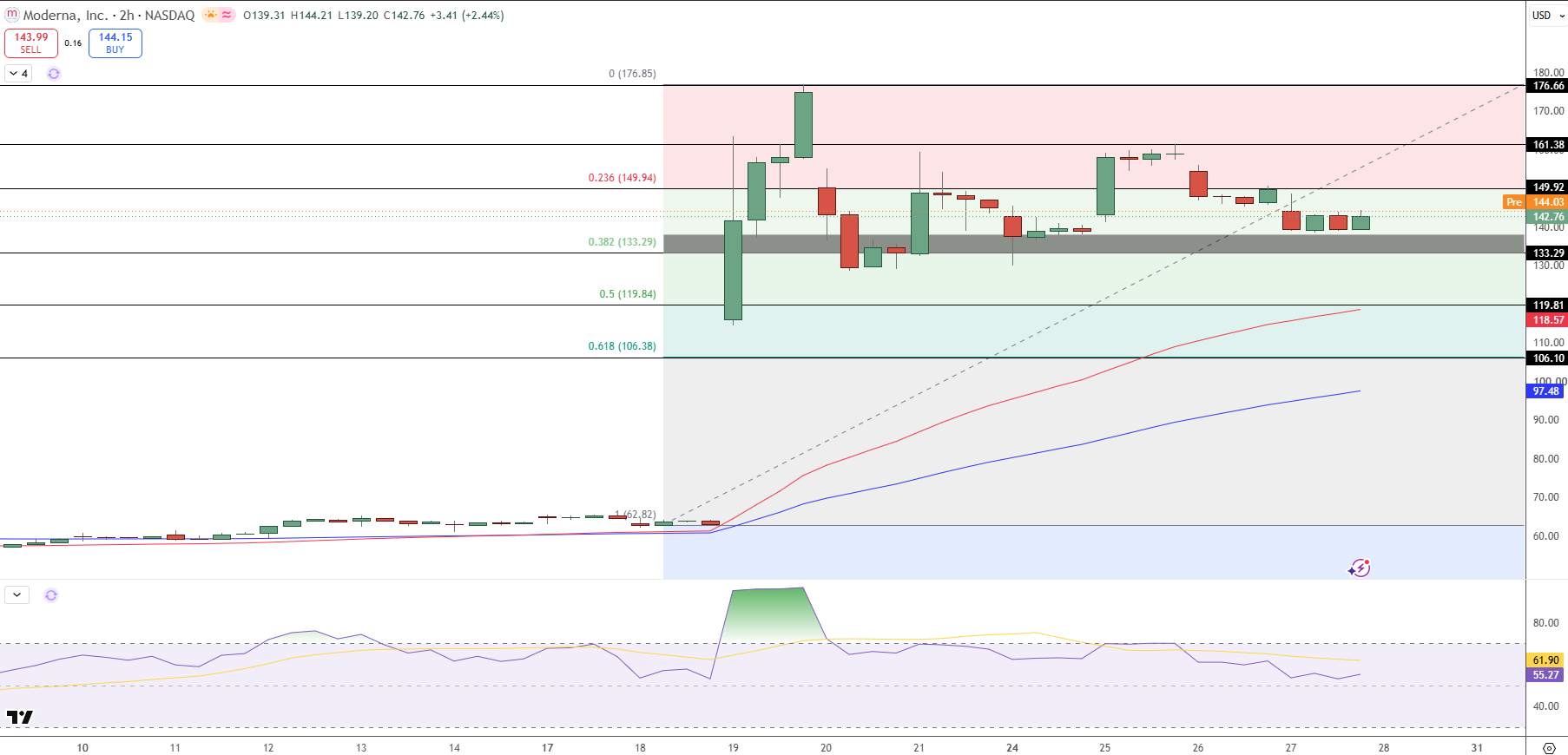
Moderna Stock Price Chart - Source: Tradingview
The risk profile has changed. The market is assigning substantial value to Moderna's oncology platform, which still has some challenging manufacturing, regulatory and commercialization hurdles to cross. This provides greater upside but potentially greater downside as the evidence does not support some of the expectations.
Key Levels
· Latest completed close: $142.77 on August 27
· Recent catalyst high: $174.38 closing price on August 19
· Financing size: $2.0B proposed, plus a $300M purchaser option
· Q2 revenue: $145M
· Q2 GAAP EPS: -$1.97
· 2026 year-end cash outlook: $4.7B-$5.2B before the new convertible financing
Is Moderna stock a buy after the melanoma data?
The outlook for Moderna's oncology division is more positive post-successful Phase 3 Melanoma studies, but MRNA now assumes way more success in its valuation. In valuation, investors assume a countervailing force to the potential for an outstanding cancer franchise—ongoing losses, execution risk, and possible dilutions in the convertible notes.
Why did Moderna stock fall after the cancer-vaccine rally?
The latest decline in Moderna's stock post the successful Phase 3 melanoma studies is due to Moderna's proposed $2B convertible-note offering. The deal has positive implications for Moderna's cash flow, but it also creates differences in value post the deal due to dilution.
Bottom Line
A positive Phase 3 result from Moderna’s melanoma trial has completely altered the case for investment. Intismeran scored a late-stage clinical win, analysts raised their targets, and new vaccine approvals provide market support. However, Moderna is still loss-making. Full survival data is pending, the oncology manufacturing must scale, and a $2 billion convertible financing proposed could dilute shareholders. At $142.77, the upside potential is dependent on the melanoma outcome becoming a multi-cancer oncology franchise.
Nothing in this material constitutes investment advice, personal recommendation, investment research, an offer, or a solicitation to buy or sell any financial instrument. The content has been prepared without consideration of your individual investment objectives, financial situation, or needs, and should not be treated as such.
Past performance is not a reliable indicator of future performance and/or results. Forward-looking scenarios or forecasts are not a guarantee of future performance. Actual results may differ materially from those anticipated.
Mitrade makes no representation or warranty as to the accuracy or completeness of the information provided and accepts no liability for any loss arising from reliance on such information.
Recommended Articles


