



Snowflake Earnings Preview: Stock Up Nearly 50% This Year as Wall Street Gives Highest Target Price of $500
TradingKey - Snowflake (SNOW) will report its second-quarter fiscal 2027 results after the U.S. market close on September 2. With its stock up nearly 50% year-to-date and once approaching its 52-week high, market expectations for its growth prospects have clearly heightened.
FactSet expects Snowflake's second-quarter revenue to be approximately $1.48 billion, up about 30% year-over-year, with adjusted earnings per share expected at $0.46. The company previously provided product revenue guidance of $1.415 billion to $1.420 billion, representing a 30% year-over-year growth, implying that the market has effectively set a high bar for this quarter's performance.
Can Product Revenue Sustain Over 30% Growth?
In the previous quarter, Snowflake had already signaled a re-acceleration in growth. In the first quarter of fiscal 2027, the company's product revenue reached $1.33 billion, up 34% year-over-year, significantly higher than the roughly 30% growth rate in preceding quarters. The company attributed this change to ongoing progress in enterprise cloud migration and increased customer demand for data processing around generative AI and intelligent agents.
Unlike traditional subscription software, Snowflake charges primarily based on actual customer usage. The more AI applications enterprises develop, the more data they need to store, organize, and retrieve, which ultimately increases the consumption of compute resources on the platform. Therefore, product revenue is the core metric for evaluating whether Snowflake can truly benefit from AI investments.
Management previously expected second-quarter product revenue to be approximately $1.4 billion, representing a year-over-year increase of 30%. If actual results significantly beat this level, it would suggest that the growth acceleration seen in the first quarter has some continuity. Conversely, if the growth rate drops below 30%, the market may again worry that AI projects remain stuck in the testing phase and have not yet generated sufficiently stable spending in production environments.
More importantly, regarding full-year guidance, Snowflake previously raised its fiscal 2027 product revenue forecast from $5.66 billion to $5.84 billion, pushing the expected year-over-year growth rate from 27% to 31%.
For Snowflake, whose current valuation has already risen significantly, merely delivering quarterly results in line with existing guidance may still fail to fully satisfy investors. What the market is truly looking for is for management to further raise full-year guidance, particularly whether product revenue can approach $6 billion. A significant upward revision in full-year guidance would signal that enterprise AI workloads are expected to continue driving platform consumption in the second half of the year.
RPO and NRR: Is AI Demand Translating Into Real Consumption?
Besides revenue, RPO and NRR will be two core metrics for evaluating the quality of Snowflake's growth in this earnings report.
In the first quarter, Snowflake's RPO reached $9.21 billion, up 38% year-over-year, indicating that the volume of contracts locked in advance by customers continues to grow rapidly. Meanwhile, the company had 779 customers with trailing 12-month product revenue exceeding $1 million, a year-over-year increase of 29%, showing that its large customer base is still expanding.
If second-quarter RPO continues to grow at over 30% and the number of high-value customers keeps increasing, the market will receive a clearer signal that enterprise customers are not merely testing AI features, but are expanding their data infrastructure investments.
The significance of NRR is even more direct. In the first quarter, Snowflake's net revenue retention rate stood at 126%, meaning that excluding new customers, spending by existing customers continued to grow rapidly. For Snowflake, whether NRR can remain stable is directly tied to whether its AI features are helping the company expand its share of customer wallet.
Products such as Cortex Code and Snowflake Intelligence are currently tasked with this mission. Their user counts alone are not the most critical factor; what truly impacts valuation is whether customer adoption of these tools increases platform consumption driven by data queries, model training, and AI agent operations.
If second-quarter NRR stays around 126% or even rebounds, the market will have stronger reason to regard Snowflake as a direct beneficiary of enterprise AI spending.
Wall Street Bullish Consensus Grows as High Valuations Test Earnings
Wall Street remains generally optimistic ahead of the earnings release. Analysts broadly believe that as enterprises accelerate data migration and build infrastructure for generative AI applications, Snowflake, as a crucial platform connecting enterprise data, AI models, and applications, is poised to continue benefiting from the growth in AI workloads.
According to TipRanks data, among 31 analysts covering Snowflake over the past 12 months, 28 give it a Buy rating. The average 12-month price target is $360.07, with a high target of $500, indicating that Wall Street remains bullish on the company's long-term growth potential.
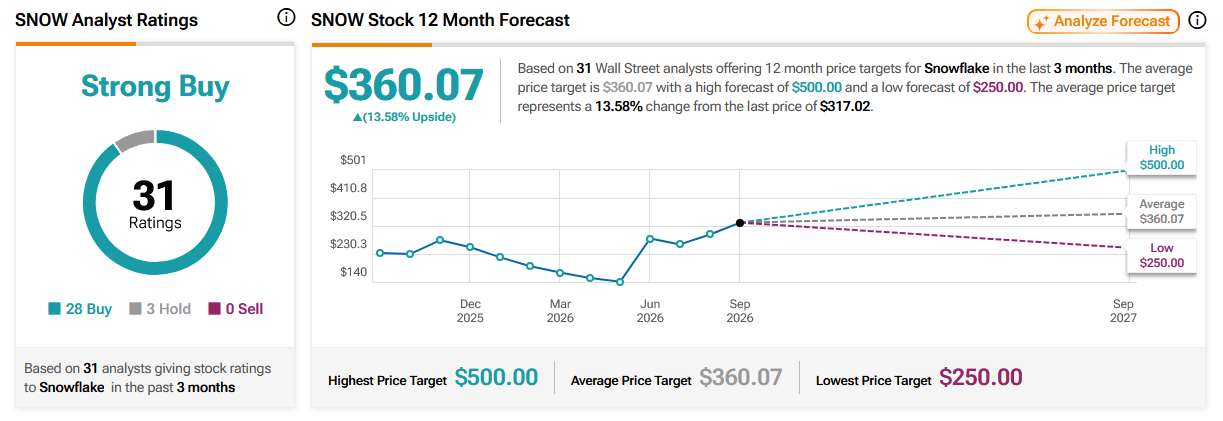
Source: TipRanks
However, current valuation already reflects high growth expectations. Based on next-12-month revenue, Snowflake's forward price-to-sales ratio is approximately 16x, significantly higher than most mature software companies. This implies that the market has already priced in an AI-driven acceleration in product revenue growth. Even if the company's performance meets its original guidance, if product revenue, NRR, or the full-year outlook fails to deliver a bigger surprise, SNOW stock could still come under pressure due to unmet expectations.
The options market also reflects cautious sentiment ahead of earnings. Current market pricing implies a potential post-earnings move of around 10%, based on a stock price near $322.50. Relatively active trading in short-term put options recently indicates that some investors are buying downside protection in advance.
Nothing in this material constitutes investment advice, personal recommendation, investment research, an offer, or a solicitation to buy or sell any financial instrument. The content has been prepared without consideration of your individual investment objectives, financial situation, or needs, and should not be treated as such.
Past performance is not a reliable indicator of future performance and/or results. Forward-looking scenarios or forecasts are not a guarantee of future performance. Actual results may differ materially from those anticipated.
Mitrade makes no representation or warranty as to the accuracy or completeness of the information provided and accepts no liability for any loss arising from reliance on such information.
Recommended Articles


