



AMD Stock Price Forecast: Shares Could Reach $684 as Market Cap Climbs Toward $1 Trillion After Crossing $600 for the First Time
TradingKey - On September 21 US Eastern Time, AMD (AMD) stock surged 9%, surpassing $600 for the first time to hit an all-time high, with its total market capitalization climbing to nearly $1 trillion. Year to date, AMD shares have gained over 180%.
Behind this rally is the market's repricing of the "legacy chip"—the CPU. Over the past two years, the spotlight of AI computing power was almost entirely on GPUs; however, as AI evolves from "answering questions" to "autonomously executing tasks," the importance of CPUs is quietly rebounding.
Catalyzing this shift are AI agent products represented by Meta's Muse. Unlike the Q&A format of chatbots, AI agents need to run continuously: spinning up independent cloud environments for each user and handling large volumes of tasks such as web browsing, code execution, and database queries—tasks where CPUs excel.
Although Muse's long-term user activity remains to be validated, Citi nevertheless sharply raised its forecast for the global CPU market size in 2030 from $137 billion to $237 billion—roughly eight times the $29 billion expected in 2025—and dubbed this demand expansion a "CPU Renaissance." The bank noted that the CPU-to-GPU ratio in AI systems is rising from 1:8 in the training stage to 1:4 in the inference stage, and could reach 1:1 or even higher in AI agent scenarios.
The industry side is also doubling down. Nvidia has designed its next-generation Vera CPU specifically for AI agent workloads, while AMD, Intel, and the Arm camp are all advancing next-generation server chips. Meanwhile, recent reports of successive chip price hikes have further reinforced expectations of tight supply.
At the product level, performance data for AMD's next-generation server chip, Venice, released last Friday, added further fuel to the stock price. According to its white paper, the flagship product's speed in authoritative tests reached 2.37 times that of Intel's current flagship Xeon 6980P and 2.24 times that of Nvidia's Vera, representing an ~78% speedup over its own previous generation; the 96-core high-frequency version was also about 20% faster than Nvidia's 88-core Vera, with an ~18% lead in memory bandwidth tests. However, some reviewers cautioned that certain comparisons utilized different versions of compilation tools, so actual deployment results may vary.
Currently, the consensus analyst rating for AMD is "Buy," with an average target price of around $604. If AI agent applications roll out as expected, CPUs are poised to move from a supporting role in AI infrastructure to center stage, which is precisely why the market is willing to pay a premium for AMD.
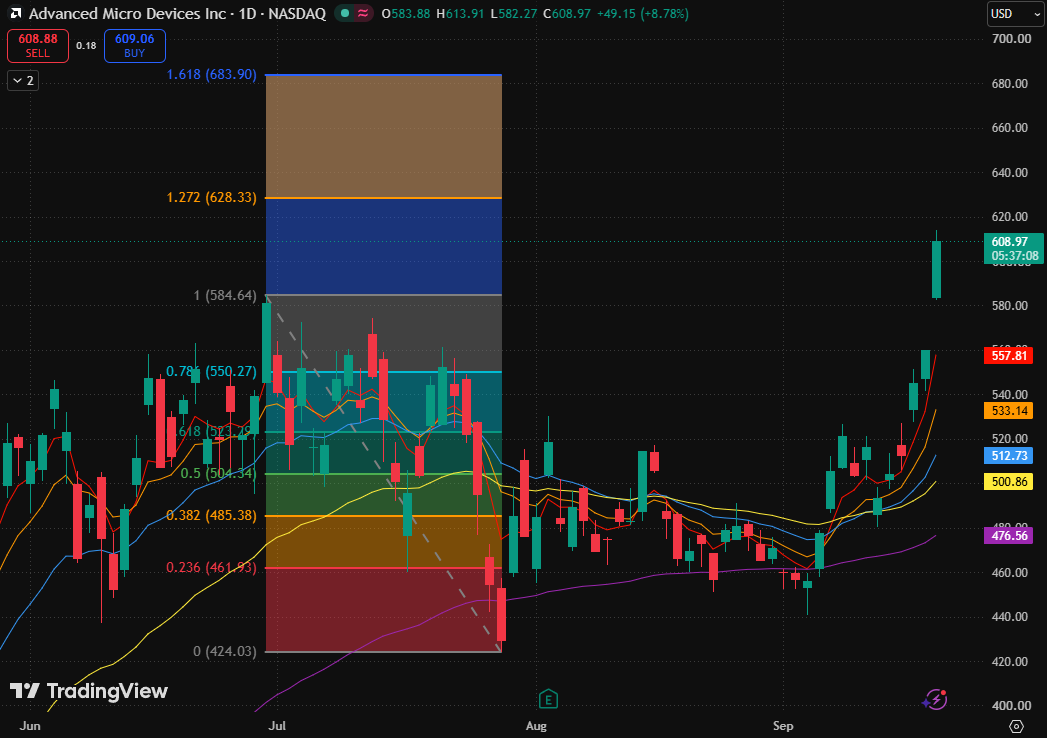
AMD Stock Chart, Source: TradingView
AMD's stock price has broken out of its prior consolidation zone, topping its previous high ($584.64) while trading above its short-, medium-, and long-term moving averages, indicating an extension phase following a strong trend breakout. As long as the $584.64 level is not decisively broken below, the price action remains treated as a breakout continuation; however, the likelihood of a pullback after testing highs near $628.33 is increasing.
Regarding upside potential, the current daily candlestick rallied sharply to break above $584.64, confirming that buyers remain dominant; however, the large real body also implies a rapid expansion in short-term bias. If the daily closing price holds firmly above $584.64, the rally is expected to target the 1.272 Fibonacci extension level ($628.33). A decisive breakout above this level could lead to a further rise toward the 1.618 Fibonacci extension level ($683.9).
If the breakout above the 1.272 Fibonacci extension ($628.33) lacks momentum, the stock price is expected to pull back to seek support near the previous high ($584.64), which serves as the core pivot for whether this breakout holds. If a retest holds above this price, it will still be treated as a post-breakout pullback.
Nothing in this material constitutes investment advice, personal recommendation, investment research, an offer, or a solicitation to buy or sell any financial instrument. The content has been prepared without consideration of your individual investment objectives, financial situation, or needs, and should not be treated as such.
Past performance is not a reliable indicator of future performance and/or results. Forward-looking scenarios or forecasts are not a guarantee of future performance. Actual results may differ materially from those anticipated.
Mitrade makes no representation or warranty as to the accuracy or completeness of the information provided and accepts no liability for any loss arising from reliance on such information.
Recommended Articles


