



Micron Faces Strike Risk in Taiwan: What It Means for MU Stock and Global Chip Supply
TradingKey - Micron Technology's (MU) labor dispute in Taiwan remains unresolved, with core differences focused on bonus calculation methods and long-term profit-sharing mechanisms.
In September this year, mediation between the Taoyuan union and the company ended without an agreement; the union demanded adjustments to the bonus system and the establishment of a long-term sharing mechanism linked to company profits; Micron had previously proposed a one-time bonus plan, but it failed to address the union's demands for system transparency and sustainability. The Taichung union is currently still in negotiations.
On October 7, the Taoyuan union announced that it had obtained strike authorization from its members, fulfilling the legal conditions to launch a strike, though a specific date for action has not yet been set. Micron responded that the company has listened to employee demands and will continue to communicate with unions across all plant sites.
According to the union, Micron held a board meeting on October 9, but as of now, the company has not announced a specific plan for the long-term profit-sharing mechanism that employees are concerned about. The union plans to hold a rally in Taipei on October 19 and emphasized that the event does not constitute a strike.
On October 15, Micron held an opening ceremony in Taichung for its Taiwan Advanced Assembly and Test Facility 2 (AATT2). This is the company's second advanced assembly and test facility in Taiwan, primarily aimed at expanding advanced packaging and testing capacity and supporting high-bandwidth memory (HBM) and AI-related demand.
Micron has received support from the Taiwan government for high-bandwidth memory (HBM) R&D. According to Reuters reports, the Taiwan government has also urged Micron and its employees to continue resolving labor disputes through negotiations.
How Important Are Taiwan Plants to Micron?
Micron has approximately 15,000 employees in Taiwan, China, with cumulative investment exceeding NT$1.6 trillion (around $49.4 billion). Taiwan serves as a key production base for Micron's DRAM and HBM, with relevant products primarily used in AI servers.
Micron's first advanced assembly and test facility in Taiwan, AATT1, is located in Houli, Taichung, and opened in November 2023, primarily dedicated to the packaging and testing of HBM3E and DRAM products.
AATT2, opened on October 15 and also located in Houli, Taichung, will further enhance HBM packaging capacity to meet AI server demand.
Manish Bhatia, President and Chief Operating Officer of Micron, stated that the facility's production capacity for 2027 is already fully sold out, and expects HBM growth to outpace traditional DRAM by 2028.
What Does It Mean for MU Stock Price and Global Chip Supply?
As of writing, Micron fell 3.66% to $880.66 in pre-market trading on October 15. The decline was mainly driven by a broad sell-off in AI chip stocks, rising rate-hike expectations, competition concerns regarding ChangXin Memory Technologies (CXMT), and strike risks in Taiwan.
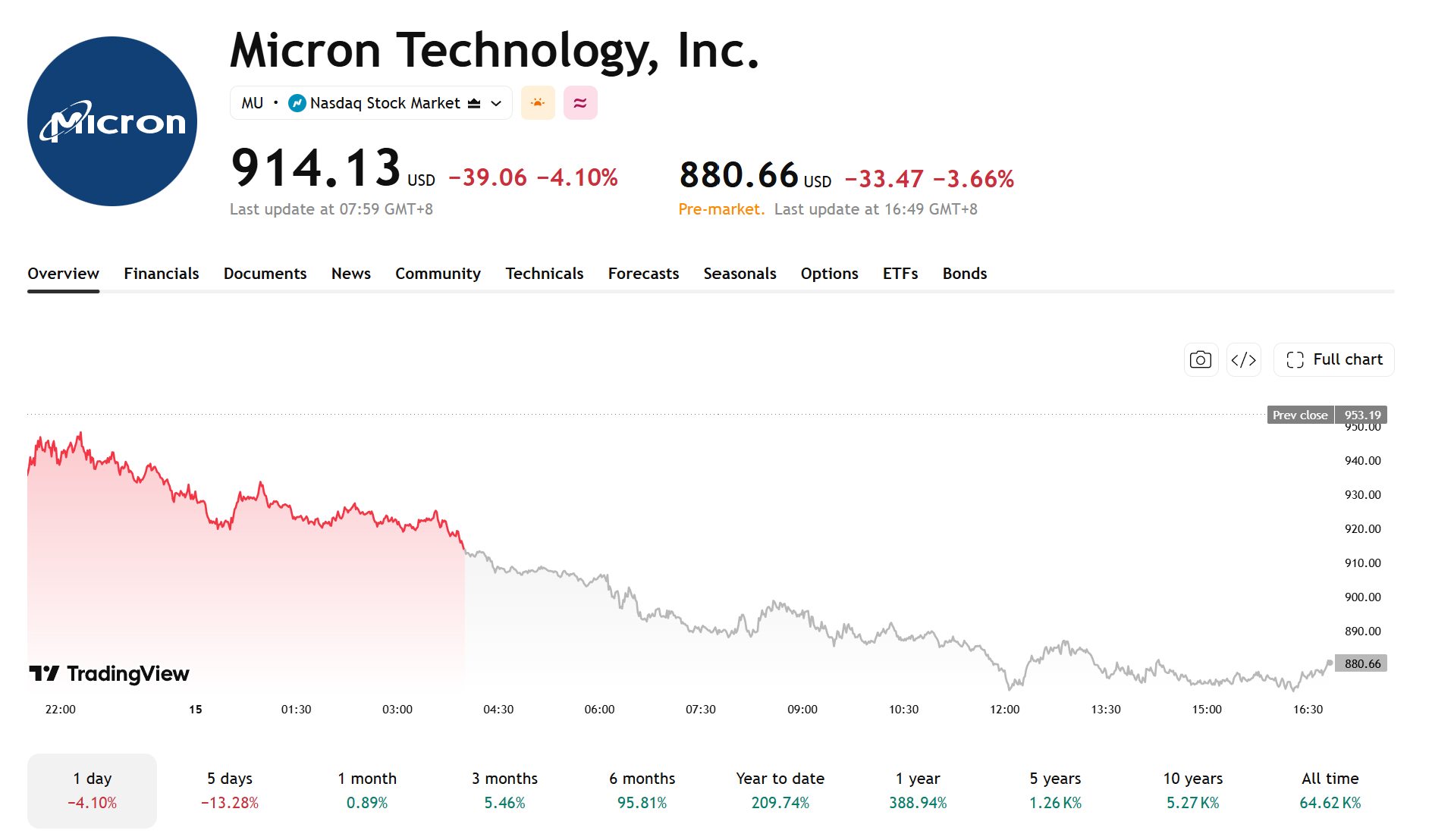
[Source: TradingView]
If the two sides continue negotiations and reach an agreement, the risk of supply disruptions may decline, leaving the impact on Micron's orders and earnings expectations limited. Currently, demand for HBM and server DRAM from AI servers remains strong, and customer commitments for 2027 capacity also provide support for the company's performance.
If negotiations break down and work stoppages occur, Micron may face issues such as production delays, delayed order deliveries, and increased overtime and compensation costs.
As Taiwan accounts for a significant portion of Micron's DRAM and HBM capacity, if work stoppages expand and persist for a longer duration, global memory supply could tighten further, prompting customers to lock in supply ahead of time and increasing price volatility for HBM and server DRAM.
MU's subsequent stock price depends on three developments: whether the union sets a strike date, whether work stoppages affect HBM and server DRAM production, and whether the company can maintain deliveries through other production bases and inventory arrangements.
If the labor dispute is resolved, market focus may shift back to memory prices, HBM shipments, and profit margins; if production is materially impacted, both MU's stock price and global memory supply could face greater volatility.
Nothing in this material constitutes investment advice, personal recommendation, investment research, an offer, or a solicitation to buy or sell any financial instrument. The content has been prepared without consideration of your individual investment objectives, financial situation, or needs, and should not be treated as such.
Past performance is not a reliable indicator of future performance and/or results. Forward-looking scenarios or forecasts are not a guarantee of future performance. Actual results may differ materially from those anticipated.
Mitrade makes no representation or warranty as to the accuracy or completeness of the information provided and accepts no liability for any loss arising from reliance on such information.
Recommended Articles


